
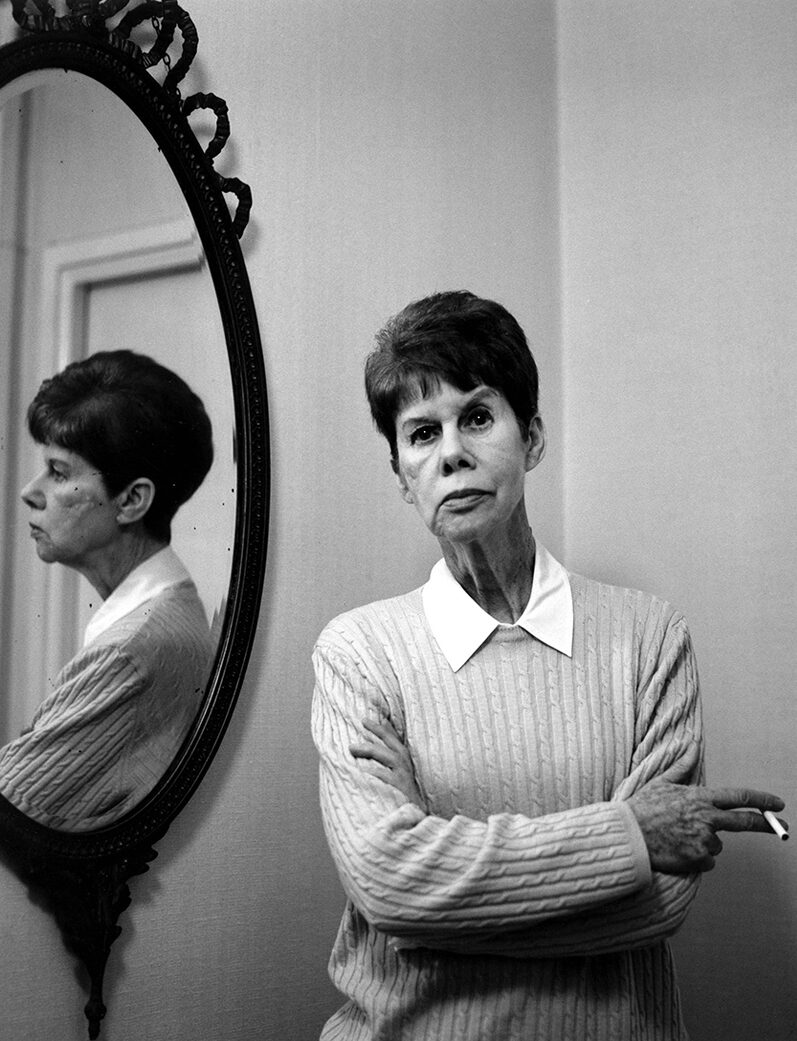
An extraordinary novelist needs an exceptional biographer; only Hermione Lee can do Anita Brookner justice. The sheer scale of this biography is itself an expression of Lee’s high valuation of Brookner’s work: the former insists – and I agree with her – that the novelist is major, and matters for our literary culture. Although Brookner’s work was loved by a coterie of devoted fans, and although she won the Booker Prize in 1984 for her novel Hotel du Lac, she could seem in her lifetime to belong in the margins of contemporary writing, while noisier talents took the foreground. It was almost a part of her cultivated style, in her writing and in her life, to perform the eccentricity and the marginalisation – to exaggerate it. Of course this was also her inalienable temperament; she couldn’t have lived or written otherwise.
In Brookner’s life was her old-fashioned elegance, her taste for the French Romantics, her stiffness and shyness and solitude, and the hiddenness of her private affairs. And in her novels the characters don’t in any outward sense live largely; their dramas, however searing, are interior and private. Yet in these stories, there’s exile, death, kindness, cruelty and passion, all mixed up with the fascination of observation and the hope of happiness. Although the timbre of her writing is melancholy, it is always stylish, and the books are essentially rich, poignant comedies. It is no wonder that she loved the painter Watteau, with his sad clowns and his characters like “a group of professional actors” wearing “beautiful, flimsy and bizarre” outfits, in landscapes like stage sets. Brookner’s characterisations of his art, as Lee says, are “like the mood of some of her novels”; although she also describes how Brookner loved and wrote about Jacques-Louis David, Antoine-Jean Gros and Eugène Delacroix, with their quite different grandeur and heroics. Brookner didn’t turn to fiction until she was in her fifties; before the novels (then alongside them), she had a distinguished career as an art historian at the Courtauld Institute, specialising in French Romantic art. Until she retired she wrote a novel a year in her room at the Courtauld, in long hand, over the summer break from teaching.
A small life lived at the margins turns out, if looked at closely, to contain multitudes – which might be the moral of Brookner’s fiction. And this capacious biography feels commensurate with Brookner’s large achievement and her mind; it takes hold boldly and generously of the life and the scholarship and the fiction. As she “went further into the deep forest of Brookner territory”, Lee experienced that unease which is the necessary angst of the conscientious biographer: she seemed to hear her subject “distinctly and courteously uttering two words: ‘Go away.’” Brookner was scrupulous in leaving few traces for posterity; friends share their guesses about possible lovers, and Lee is shrewd and convincing in weighing their accuracy. In the end, though, something in the life eludes us, as it should and must; readings of the novels take us deeper inside.
A large imagination, squeezed inside an inhibited personality, may find its outlet – its exhibitionism, almost – in the displays of fiction. Brookner’s personal reticence is only a part of her story: there was always an opposite impulse in her, a desire to be seen, to be known, to make herself heard. She confessed that she’d begun writing fiction “because of a terrible feeling of powerlessness: I felt I was drifting and obscure, and I rebelled against that.” There’s always this tension in the stories and in the style, between extremes of constraint and exposure – which is more like Delacroix than Watteau. (Delacroix’s compression of his “demonic intensity”, she wrote, is evidence of “both a furious temperament and the stoical discipline needed to bring it under control”.) Her experience of exposure could be cruel. Her fiction found enthusiastic reviewers, but was also often the target of what feels close to malevolence: “This is ladies’ music”; “divided between narcissism and self-mortification, between wallowing and astringency”; “[the] story drips with novelettish romance” (from three different reviewers on different books). She insisted on reading all her reviews, and suffered accordingly, but didn’t stop writing – the crucifixion in some sense became part of the work.

Brookner was an only child, born in 1928 to middle-class, second-generation Jewish immigrants in Herne Hill, south London. Her powerful grandmother ruled the family: her mother was weak and disappointed; her kind father was tolerated as coming from inferior social origins. Her family resembles the one in the wonderful 1985 novel Family and Friends, including its wicked uncle. “We often hear, in the novels and in her reminiscences,” Lee writes, “of a wary, watchful, solitary child, out on the fringe of the extended family, withdrawing from the fray, reluctant to be kissed and hugged and made a fuss of… [and] easily upset and offended.”
Brookner studied at King’s College London because her parents didn’t want her to leave home, then she began postgraduate work at the Courtauld at the end of the 1940s. When Anthony Blunt – Courtauld director in those days, and Brookner’s mentor – sent her off to study the artist Jean-Baptiste Greuze, she took lodgings in Paris and at once fell in love with France. She told her friend Julian Barnes that “the happiest time of her life was… doing her doctorate on Greuze and travelling round provincial art galleries by bus, in fog”. Her needy parents, however, couldn’t bear her absence, and guilt and affection and duty pulled her home: she lived all the rest of her life in London. An equivocation between home, the primal scene of belonging and alienation, and France – glamour, freedom, reason, sunshine, style – is the axis of so many Brookner novels.
She must be the greatest chronicler of parent care in English fiction. In book after book she experiments with different parent types, ranging from the innocently hapless to the culpably negligent, but all of them exacting a heavy toll on their adult children, if only in terms of love and loss, and the draining away of the child’s autonomy. Brookner’s father died in 1965 when she was 37, and she looked after her mother until the end, in 1969. In her story of herself, told with variations several times in interviews, patterns of dependency and control between parent and child formed her sensibility and shaped her fate, as they do for so many of her characters. She never married or lived in partnership with anyone or had children, and claimed in interviews later to have deeply regretted all this. Instead, she read and looked and wrote: first of all about French art.
Lee does full justice to Brookner’s richly intelligent essays on art history, which are eloquent with her connoisseurship and judgement and biographical insight. These qualities became unfashionable towards the end of her academic career – cue more malevolent reviews – and yet her writing on art reads so freshly now. About Jean-Auguste-Dominique Ingres, for instance, whose work she loved, Brookner wrote: “Fortunately while Ingres was trying hard to be one thing, a passionless and serene 19th-century ancient, his temperament was arranging for him to be something quite different, a portraitist of outstanding modernity.”
Brookner died in 2016, aged 87. John Berger described how, while an artist is still alive, “All his works, even those that are declared finished, are seen to some extent as works in progress.” After death, the artist’s works become “final and definitive… they gather together to form his destination”. The appearance of this biography invites us to pause and weigh up for our moment the “destination” of Brookner’s fiction, reassess that marginal place she seemed to write from, in such beautiful sentences, exact and solid, spare, tracking the inner flow of consciousness and experience in her protagonists. The Brookner timbre is unmistakable, and yet there’s great variety across the novels, which may be centred in women or men, young or old, solitary or in crowded families. Her characters transform over and over in the perpetual narration of self inside their minds; no sooner does the flow end with one certainty than it’s undone by the next encounter, or by a night’s sleep. This portrayal of unspooling, shifting consciousness is Brookner’s genius. In Family and Friends, Mimi – in the “strangeness, yet the dreamlike familiarity of the pearl-grey Parisian morning” – is “not even surprised to have exchanged the past, by which she was previously bound, for the present”. In Providence (1982), Kitty Maule’s “expression lightened, for she had found the key to her difficulties, and a pointer to future behaviour”. It won’t last.
Some of Brookner’s novels are more fully furnished than others, thicker with life, food, clothes and colour. Some are exceptionally attenuated, bleak and desperate to the edge of imagination. One of her few stumbles, I think – and it’s my hesitation, not Lee’s – is Hotel du Lac, in which something feels wrong to me in the tone, or in the narrative positioning in close third person. Edith Hope endlessly proclaims her own meekness and unworthiness, while making her lovable superiority too clear between the lines. In the privacy of Edith’s head, and in the novel’s sentences, she too easily gets the best of every encounter. As a rule, though, Brookner delivers the darkest things with devastating deadpan: in Brief Lives, 1990, for example: “She was not a very nice woman, but then neither am I… Basically I found her alarming and she found me boring.”
Her characters are questing and anxious, hoping for happiness. Often, they’re Jewish, sometimes with the trauma of loss or escape in their European past – which helps explain, as she does in her gorgeous Latecomers (1988), their sensation of having entered life “by the back door”. They are all more or less middle class, with enough money to be comfortable and probably a flat or a house somewhere in north-west London; yet even in old age they’re yearning, unsatisfied, hungry. Paul Sturgis in her last novel, Strangers (2009), “was on his own, in comfortable circumstances, yet intimately distressed by his inability to take these circumstances for granted, and uneasy, daily, until he could get out into the streets”. Her characters walk the streets for hours – as Brookner did herself – mostly in London and sometimes in Paris, escaping home or loneliness or themselves, through the suburbs and city parks, all with their particular, poignant atmosphere and architecture and weather. Brookner uncovers the power and importance of these hidden lives, rendering their mystery in her rich sentences on the page. In the churn of time and perception, what once seemed a view from the margins may turn out to belong at the centre of the picture. It isn’t so much that she was unfairly overlooked; it was from that overlooked place that she could clearly see.
Tessa Hadley’s Alone with a Book: On Reading, Writing and Looking will be published in November by Jonathan Cape
Anita Brookner: Art and Life
Hermione Lee
Chatto & Windus, 544pp, £28
Purchasing a book may earn the NS a commission from Bookshop.org, who support independent bookshops
[Further reading: Our island stories]
Content from our partners



Related
This article appears in the 16 Sep 2026 issue of the New Statesman, Will AI kill us all?
Join the debate
Subscribe here to comment