
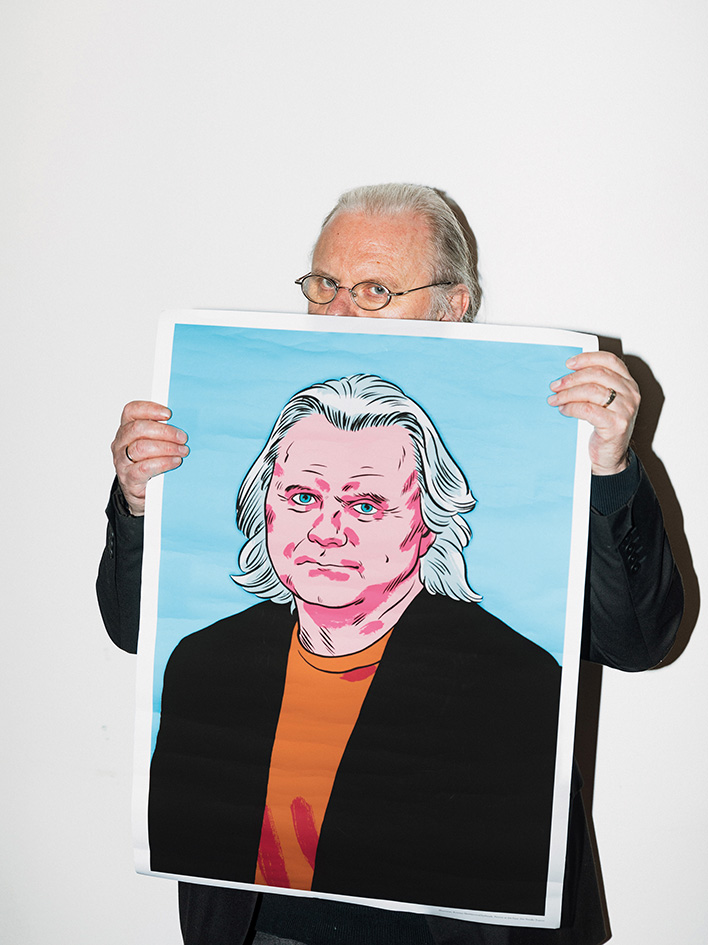
Jon Fosse, a novelist and a playwright and one of Norway’s best-known living writers, was born into a family of Quakers and Pietists in 1959. This religious formation is important for Fosse. At the age of seven, he had an accident that resulted in a near-death experience whose qualities – luminosity and a sense of peace – are in part responsible, Fosse has said, for his being a writer. But surely his sense of what those qualities were arises, retrospectively, from the kind of writer he is. His 2023 Nobel Prize citation borrowed from this vocabulary – to do with what hovers on the edge of life – and called him a writer of the “unsayable”. His new novel, Vaim, is about absurd, life-changing volte-faces as well as life’s calm sameness. In it, one of the characters, Frank, after having been drawn casually into a complete realignment of his existence, feels as his boat moves forward that “a kind of peace comes over everything”. The phrase again raises the question: what kind of writer is Fosse?
Although he’s long been eminent in Norway, few Anglophone readers would have heard of Fosse before he won the Nobel Prize in Literature in 2023. By this time, his work – in particular, Septology, a seven-part novel that appeared in one volume when it was translated into English – had barely begun to reach the English-language world through Fitzcarraldo Editions in translations by Damion Searls. Septology was shortlisted for the Man Booker International Prize, which these days has become one of the routes to the Nobel, at least for European writers.
It’s not the Nobel that’s of interest here, but a kind of writing that, from the romanticism of the 19th century onwards, constituted a subterranean stream in cultures dominated by the Enlightenment, and which made the literary such an inexplicable but powerful category in the modern world. One characteristic of this stream is an obsession with what another Nobel laureate, the Indian poet Rabindranath Tagore, called the anavashyak, or the “unnecessary” or “superfluous”. It’s a way of thinking that is deliberately indifferent to the thematic. When the filmmaker Satyajit Ray said that some of the worst films have been made on the noblest of themes, he was speaking from the heart of this tradition. The stream seems to have dried up in the time of globalisation, not least because of the monetisation of the thematic, the “relevant” and the representational by publishing houses and the role these categories have played in the new morality of today’s sociologically driven humanities. But a counter-movement has been at work, in which Fitzcarraldo has played a significant role, restating literature’s oddity while downplaying what’s so important about it to the mainstream – its moral temper and cheerleading capacities.
This counter-movement aims to interrogate genre, because genre no longer suggests the history and outline of a form: it’s a marketing tool. Fitzcarraldo publishes two kinds of book – non-fiction in white, fiction in blue – and then allows these demarcations to waver, as the white books sometimes feel fictional, the blue ones essayistic. This decision appears to signal that genre is a redundant parameter. The Rothko-like abstraction of the Fitzcarraldo covers and their Warhol-type repetition recall the formalistic (rather than thematic or genre-driven) nature of writing itself.

At the core of the counter-movement is the essay, often referred to as the “personal” essay, and a kind of novel that uses autobiography self-reflexively, known by the slightly ugly label of “autofiction”. This term can refer to any work that doesn’t seem conventionally realist or doesn’t adhere to the kind of “global” fiction we’ve become used to since the 1980s. Any misfit novel runs the risk of being called autofiction. The term has been applied for no good reason to Fosse’s work, and he’s been at pains to distance himself from it.
The market has been quick to naturalise this literary counter-movement (comprising novels, memoiristic non-fiction and the non-academic critical essay), to semi-recognise its peculiarity and christen it with complacent names that rob it of its impact: “genre-defying” or “genre-bending’”. According to publishers’ blurbs, genre-defying works are suddenly in abundance. This neither confirms nor denies a renaissance in this kind of writing – writing that refuses to serve as a transparent window into the world or our current preoccupations.
The pervasive misconception regarding this counter-movement is that it involves the rise of confessional writing, which speaks to our time for its subjective disclosures, for bearing witness to trauma. The “personal” in personal essay and the “auto” in autofiction signal to us the way these forms supposedly function. In Annie Ernaux’s work, in which personal essay and autofiction converge, disclosure is undertaken (so goes this interpretation) without breast-beating, in the precise language of art. The 2022 Nobel citation for Ernaux (who is also published by Fitzcarraldo) rehearses the notion of confession mediated by a distancing artfulness: “for the courage and clinical acuity with which she uncovers the roots, estrangements and collective restraints of personal memory”. “Courage” means we must congratulate the writer for her difficult candour. “Clinical acuity” gestures to the Enlightenment subject’s dispassionate rationality: it’s what makes disclosure possible and legible to the reader.
The breakthroughs of misfit writing arise not from a restatement of subjectivity, but the opposite: a questioning of the authority of the subjective voice, and a consequent freeing up of language, form and worldly objects. When Ernaux begins her Nobel Prize lecture by posing the question “Is it really me this is happening to?” she seems to be saying what any beauty pageant winner might in tearful ecstasy. But she is actually drawing attention to the looseness of ownership that the misfit writer has over the self or narrative, even if the work is autobiographical. “Is it really me this is happening to?” is what her memoirs and fictions ask. The “I” is an accident – it’s there to bear witness to and also to wonder at existence, but it is fragile and replaceable.
You have a sense from Ernaux’s writing of the mysterious fact that the person who experiences pain and delight in the world with such immediacy could just as well have been any other “I”. It’s this emptying out of the subject that leads to what she calls, in the same speech, “a neutral, objective kind of writing, ‘flat’ in the sense that it contained neither metaphors nor signs of emotion”. Not confession, then: the counter-tradition marks a late return to the practice of impersonality – not in the workaday or Enlightenment sense of the emotionless or scientifically “objective” (Ernaux uses this word with deliberate irony) but of being unbounded by a fixed perspective. Subjectivity becomes a child’s illusion, to be used in play but not invested in: “It was necessary for me to continue to say ‘I’.”
Fosse, in his various observations about writing, is keen not so much to escape the label of autofiction as the way the word privileges confession. He seems to see Ernaux in these terms. His caveat against subjectivity, in his Nobel lecture – “In any case, I have certainly never written to express myself, as they say. Rather it was to get away from myself” – is not that far away from Ernaux’s ambivalence about the self’s authority. Fosse’s words are almost a contemporary version of TS Eliot’s reminder to his readers: “Poetry is not a turning loose of emotion, but an escape from emotion; it is not the expression of personality, but an escape from personality.” Eliot is arguing for what he calls “significant emotion, emotion which has its life in the poem and not in the history of the poet”. This genealogy is where autofiction, the personal essay and the misfit writing of the last two decades should be placed.
The practice of impersonality, which Eliot theorised in 1919, was perhaps dependent on Europe’s encounter, from the 18th century onwards, with non-representational traditions from Asia and Africa: it’s from here that, to a great extent, what’s strange and compelling about modernism gets its resources. Eliot’s understanding of the self was deeply formed by his readings of Buddhist and Upanishadic texts.
Fosse mentions Beckett, Kafka, Woolf and the Bible among the works and authors that were formative for him. But the writers he cites all emerged in the aftermath of, and were the progeny of, this non-representational turn. The Bible by itself could never have caused the turn to occur. The “unsayable” in Fosse’s work, his novels’ abandoning of “message” (his word), is part of a longer subterranean intercultural itinerary than any idea of “Europe” can contain. To see autofiction or the contemporary essay as a purely European efflorescence misses its genealogy. To the Man Booker International Prize we owe, through its recognition of the likes of Ernaux and Fosse, our awareness of the emergence of a counter-tradition. But it’s an emergence that, for us, is inadvertently European. The new European novel comes to stand for the “genre-defying”; the Indian winners of the Man Booker International Prize, say, continue to stand for India.
Vaim is a 116-page novel in three sections. Brevity is one measure any counter-tradition might adopt to resist the realist or global novel’s large representational claims. Some of Ernaux’s books, for instance, seem to be between 5,000 and 30,000 words. This, too, has a genealogy in both publishing and fiction-writing. It’s only in the Anglophone world that the novel needs to exemplify the “fully formed”. For more than 100 years now, relatively tiny works have been published in Bengali, Japanese, French, Spanish, German and more as full-length books. It’s always a delight to hold such a seemingly slight volume in one’s hands, and you have to be grateful that Fitzcarraldo gives us the opportunity to experience this deceptive slightness.
Each section is narrated by three characters whose lives have been altered, or at least touched, by Eline, Vaim’s inexplicable, self-willed heroine. The first section is Jatgeir’s, Eline’s second husband. Jatgeir, a recluse, arrives in a big city, Bjørgvin, on his boat to buy a spool of black thread and needle, and is ripped off by the shopkeeper: he has to pay her 250 Norwegian kroners. He reflects on his stupidity: he should have bought the thread and needle from the Vaim General Store. He decides to proceed on his boat to the small town of Sund. The boat, as it happens, is named Eline, after a woman he was in love with when he was a young man. Eline had married Frank years ago and moved from Vaim to the town. Reaching Sund and succumbing to his notions of small-town generosity, Jatgeir buys another spool of thread and a needle and is overcharged. At night, lying in his boat, recovering from his day-long humiliations, he hears his name being uttered by a woman. It’s Eline. She has a suitcase with her – she’s about to leave Frank. Without quite knowing how, Jatgeir finds himself returning to Vaim with Eline, with whom he’ll spend the rest of his life.
The second section is Elias’s, Jatgeir’s one friend in Vaim, though the two have drifted apart. Through Elias, we glimpse Jatgeir’s life from a distance – the changes that came over it after Eline arrived; the new, alienating tidiness; the piles of the daily, the Northern Herald, removed from the “middle of the floor”. We also learn here of Jatgeir’s passing. The third section consists of Frank’s tale of how he met Eline in a restaurant named The Fowl: they didn’t know each other, but she was certain they had to be married, which is what happened. Frank is the name that Eline called him by from the moment they met, for reasons unknown (his real name is Olaf). By now, Jatgeir, Elias and, most recently, Eline are dead: Frank, with whom she was later reunited (again, on her initiative), must arrange for her to be buried next to Elias, who lies next to Jatgeir.
“Section” means sentence: strictly speaking, the novel is made up of three very long sentences, with occasional line breaks for dialogue. Each sentence constitutes a voice as well as disparate reflections merely held together by commas, and punctuated by obligatory yeses. Jatgeir’s, Elias’s and Frank’s voices sound the same. Yet since the purpose of the sentences is not to convey voice, as in a dramatic monologue, but contain shifts in thought, mood and occurrence, the matter of sameness becomes irrelevant. Instead, we’re entangled in knots of syntax and time, in the utterly riveting banalities that preoccupy people. This is in keeping with Fosse’s interest in the self-sufficiency of “writing” (which he says is “its own world”) over speech, whose principal function – for the late French philosopher Jacques Derrida as it is for Fosse – is to communicate: that is, to enable the subject to express themselves. Fosse’s sentences are part of a larger countervailing project today of making autobiography, personal reminiscence, voice and character inextricable from the aim of undoing the illusion of subjectivity.
The novel’s three movements, beautifully composed, are pattern-like rather than progressive in their exploration of the intersections between lives: Fosse might say “musical”. Yet their careful measure doesn’t diminish our sense of a shape determined by accidentality. Jatgeir and Frank must think, in Ernaux’s words, “Is it really me this is happening to?”. The characters’ tenuous relationship to their “me” is pointed to by the provisionality of their names: Jatgeir was really Geir; Frank was Olaf; and Eline wished for her actual name, Josefine, to be engraved on her headstone. Only Elias is reliably himself; Elias, and Vaim (a location which people escape from and return to, and which we know next to nothing about), and the Vaim General Store. This, like the tobacco shop of Fernando Pessoa’s well-known poem, comprises the novel’s subtle, ongoing referencing of the quotidian – an everyday that’s a counterpoint to the “unsayable”.
Vaim
John Fosse
Fitzcarraldo Editions, 120pp, £12.99
Purchasing a book may earn the NS a commission from Bookshop.org, who support independent bookshops
[Further reading: Wolf Moon and the fight against Franco]
Content from our partners



Related


This article appears in the 23 Oct 2025 issue of the New Statesman, Doom Loop
Join the debate
Subscribe here to comment