
For some years now, Amit Chaudhuri has been running a successful tour company. Departures and arrivals fleck his novels like logbooks of long-distance travellers. A young boy spends his summer holidays visiting Calcutta; a visiting professor sojourns in Berlin; a student arrives in Oxford; a professor brings his son from the US to see his parents in Calcutta.
Travel is an essential life-vest in the start-up kit of literary realism. Journeys promise renewal; they can rescue, and revive, even the most flailing of plots. Chaudhuri’s dislocations, however, are brightly, proudly plotless. Nothing happens, or rather, nothing seems to happen in his novels. It’s a wonder they never sink.
The fictions, for one, are startlingly slender. Even the longer ones feel weightless. It’s not that they lack the common burdens of history (Communism is a lingering spectre in Calcutta; the Holocaust in Berlin; the Raj in Oxford). It’s just that Chaudhuri isn’t interested in writing purposeful stories about politics or modernity. In fact, the very impulse to tell a story seems revolting to him.
Chaudhuri freely dispenses with the traditional priorities of the novel (character, setting, action) and, instead, fills his pages with the arbitrary, uneventful minutiae of daily life, otherwise swept away as so much dust under the carpets of intricately woven plotlines. A woman keeps actively cleaning a house. Or a man stays put in a double-decker bus creeping windingly though traffic. Chaudhuri is, in other words, a noticer, a loiterer, a jotter. His novels are portals, not of consequence, but of chromatic shifts in mood, texture, tone. Instead of his characters, it’s really the genre that Chaudhuri keeps dispatching on extended holidays.

On first glance, the innovations of Chaudhuri’s ninth novel, Château Rouge,seem true to reputation. The novel is short (its word count is roughly a seventh of Midnight’s Children). And it records yet another journey: an Indian novelist arrives in Paris to start his fellowship at the Center for American Thought. There are, however, some key distinctions, afforded not just by the stature of Chaudhuri’s latest destination, but also by new literary trends.
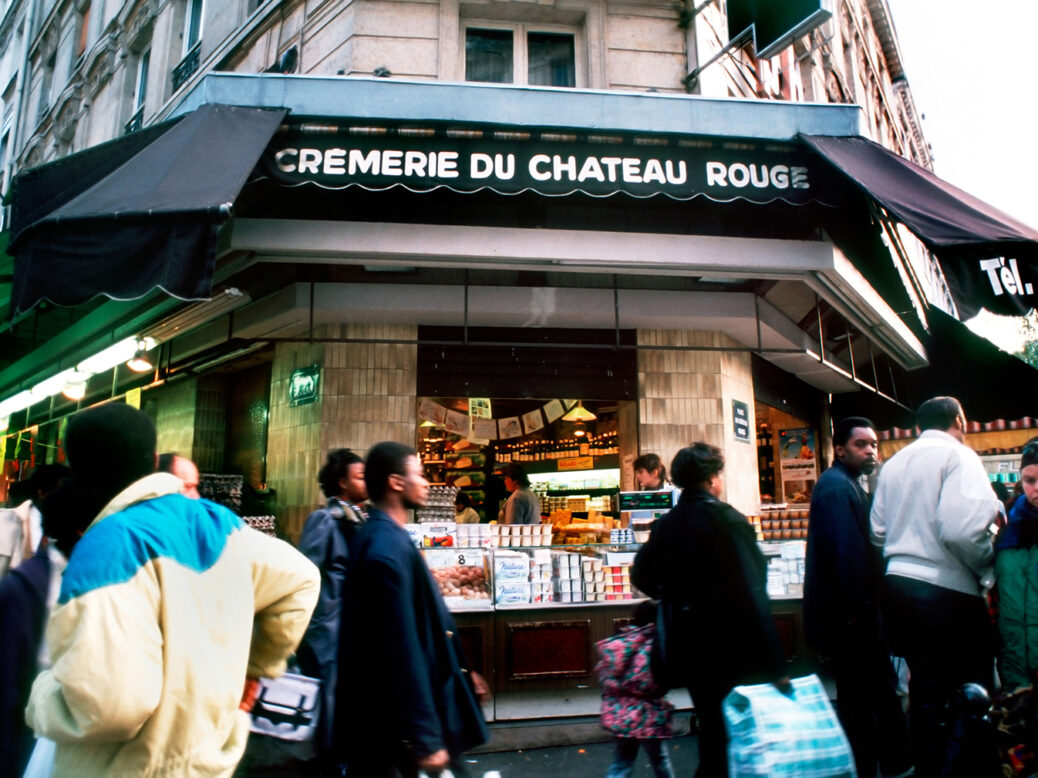
In the marketplace of world literature, Paris has been memorialised by visitors of such a diverse cast – Walter Benjamin and Hemingway, Fitzgerald and James Baldwin – that the metropole feels more like a museum. On cue, the narrator arrives “craving for the Paris of Proust’s house and Baldwin’s digs”. Even the name of his prospective neighbourhood, “Château Rouge”, inspires in him lofty visions of modernism (“Malevich’s painting of the red facade”). The reality, though, cut a different picture: “I was struck by how unimpressive everything was. By which I don’t mean the streets lacked history… The houses were 19th-century Haussmann buildings. I knew the type. You hardly noticed them, though. The pavements were dirty.” And his sublet apartment? “It was like standing in an emptied-out abattoir.”
The burners didn’t work; the toilet was stained; the locks wobbly; the mirrors spotted. Envious of other fellows imbibing the “real” Paris, the narrator resolves to abandon Château Rouge. Until his wife offers him the necessary counsel: “You know, if Hemingway were living in Paris now, this is where he’d be.”
This, then, is the epiphany that catalyses the novel: Château Rouge is the Paris of our times. The narrator spends his days ambling the city’s outer arrondisements, alongside West African, Bangladeshi, Sub-Saharan, Sri Lankan and Chinese migrants. At first, the theme of the “Parisian stroll” still feels formulaic. The setting is, indeed, a landmine of ready-made references to Walter Benjamin: flâneurs! Commodities! Crowds!
But looking through his wife’s eyes, the narrator is wary of such duplications. He shrewdly signposts the distinction between Château Rouge and Midnight in Paris. The latter’s milquetoast wonders – Hemingway and Fitzgerald walking around in costumes – aren’t for him. His own flânerie triggers a different kind of adventure. If the Paris of our times looks like Château Rouge, then what must the contemporary novel look like?
Chaudhuri’s novels have always drawn on material from his own life. Of late, though, autobiography has turned autofictional. In Friend of My Youth (2017), the protagonist, explicitly named “Amit Chaudhuri”, bore a spitting resemblance to the author (he, too, was a musician, who had studied at Oxford, and had even written a novel set in Bombay, also called The Immortals). Now, Château Rouge has shrunk even further the infinitesimal gap between these proper names. Chaudhuri narrates his novel in the first person.
Like other autofictions, Château Rouge also keenly dramatises the contemporary pressures of literary production. Chaudhuri offers lively “behind the scenes” tableaux: the narrator keeps trying to get his apartment repaired; the Center warns him to start using his office (or lose half the stipend); the Center’s managers oversee the fellows’ discussions; and the fellows remain a divided lot (the Arabs are cut off from the Ghanaians; the African Americans can’t see how identities blur outside the US; the Americans have usurped the French as custodians of “world literature”).
But Chaudhuri’s tone is neither gossipy nor exhibitionist. For much of the novel, the narrator is only running errands: buying a microwave, stocking up on packed lunches, shopping for groceries, getting coffee, buying bedsheets, washing clothes. The fidgety, stone-kicking rhythms of these chores also inflect the novel’s style. Unlike the looping, widely admired, long sentences of Chaudhuri’s early novels, the prose of Château Rouge is sharply clipped, once bountiful clauses now compacted like so much straw.
Things do happen: Notre-Dame burns; the Gilets Jaunes riot; there are elections in Congo; the narrator’s father-in-law dies; he gets pickpocketed. But Chaudhuri levels the monumental and the mundane on the same page. Château Rouge reads rather like a diary without dates. Laxly divided by single asterisks, its notations can be shuffled any number of times.
“You’ve been walking for 15 minutes; there’s dense tranquillity here – the silence of wealth. The opposite of a mosquito’s whine.”
“What could one gift (Jacques) Rancière? The macarons were not a gift.”
“They’re on the street because capitalism has failed. I would never say: ‘Capitalism has failed us.’ You could say that about socialism – ‘socialism has failed us’. But capitalism never made such a promise. It’s going wrong, and that’s all right.”
“I like Bangladeshi (hawkers)… for one reason mainly: they’re always ready to say they’re homesick.”
“This side of Château Rouge Metro, at the junction of Rue des Poissonniers, Rue Doudeauville, and Rue Poulet, is where the sex workers sit like mothers waiting for children to emerge from school.”
Ultimately, what makes Château Rouge “autofiction” isn’t the glut of autobiographical detail, it’s the surfeit of criticism. Various sections have an unusually sharp, argumentative edge. (The extended reflections on novels and history are particularly memorable.) Often, one catches Chaudhuri rolling his eyes at critics. And some sequences cleverly echo the author’s own criticism. (The discussion of “gaslight and pollution” in 19th-century Paris evokes the Bombay of Chaudhuri’s introduction to Arun Kolatkar’s Jejuri.) Even readers unfamiliar with Chaudhuri’s other work will notice these stylistic agitations, notably, the frequent irruptions of the “essay” in this “novel”. Château Rouge often reads like it’s trying to identify, even seize, the means of its own interpretation.
What explains this striving? Chaudhuri started his career swimming against the high tide of the “post-colonial novel”, books full of magical fables, tropical props, colourful tongues that were expected, or rather required, to perform the modern-day travails of “Indianness” for Western readers. Chaudhuri, though, refused to play the role of the post-colonial envoy. His self-consciously “minor” novels can be read as forms of dissent. Chaudhuri marked the publication of Friend of My Youth (2018) by noting: “The important European novelist makes innovations in the form; the important Indian novelist writes about India.” Why is it never otherwise?
In the literary marketplace, however, dissent brings its own dilemmas. Over the years, Chaudhuri’s admirers have popularised him as a miniaturist, who zealously studs each sentence with grammatical gemstones. Even when he’s celebrated as a modernist (comparisons to Proust are customary in reviews), it’s really his craft that gets emphasised (he’s often described as an exceptional writer of “sentences”). Critics are generally unwilling to appraise his miniatures in the broader realm of ideas. Freedom from the post-colonial purgatory, in this case, has entailed lengthy spells in the craftsman’s studio.
Château Rouge niftily dramatises these aesthetic conditions of entrapment and autonomy. On the streets, the narrator is often stopped in his tracks by the realisation: “I was amidst history.” This awareness is key, but not because it suddenly exalts the neighbourhood’s daily life to the status of history. Rather, it’s the other way around. This existential flux defamiliarises our historical common sense (what gets monumentalised, what gets scrapped, and why?). The statement might as well pass as a manifesto for Chaudhuri.
All the same, the narrator still calls his own bluff. Since history is always “retrospective”, one cannot know one is “amidst” history while still living in the present. The narrator also guards this “perverse” knowledge as a personal “secret”. He routinely requests his wife not to share her counsel with anyone. Or else, others, presumably his colleagues at the Center, would also follow his lead. Such a turn of events would compromise his own novel-in-progress, ruining any prospective chances of publication.
Ultimately, Château Rouge takes its place in history by advertising its own identity as a material object. It is the novel’s status as a physical book, as a commodity in the publishing industry, which holds the key, not just to the anxieties of Chaudhuri’s narrator, but also the dilemmas faced by writers from post-colonial societies.
Confessional self-awareness has become a universal signature of autofiction. Always hungry for more reality, the genre swallows up these moments like logs in a fireplace. But Chaudhuri’s self-absorption doesn’t slip into solipsism (there’s always too much “other” in Château Rouge for that to happen). Nor does it displace the novel’s montage of dailiness (he isn’t interested in outwitting his prospective critics by doing better critiques of capitalism). Chaudhuri loves life too much to extinguish it. Even the realisation – “I was amidst history” – unravels without much fuss, as if this, too, were an errand. Reading Château Rouge is like taking brisk sips of water at room temperature.
Château Rouge
Amit Chaudhuri
Faber & Faber, 208pp, £14.99
Purchasing a book may earn the NS a commission from Bookshop.org, who support independent bookshops
[Further reading: Doireann Ní Ghríofa: “Reading is a dark magic”]
Content from our partners



Related
This article appears in the 21 Oct 2026 issue of the New Statesman, Sally Rooney is a writer, not a terrorist
Join the debate
Subscribe here to comment