
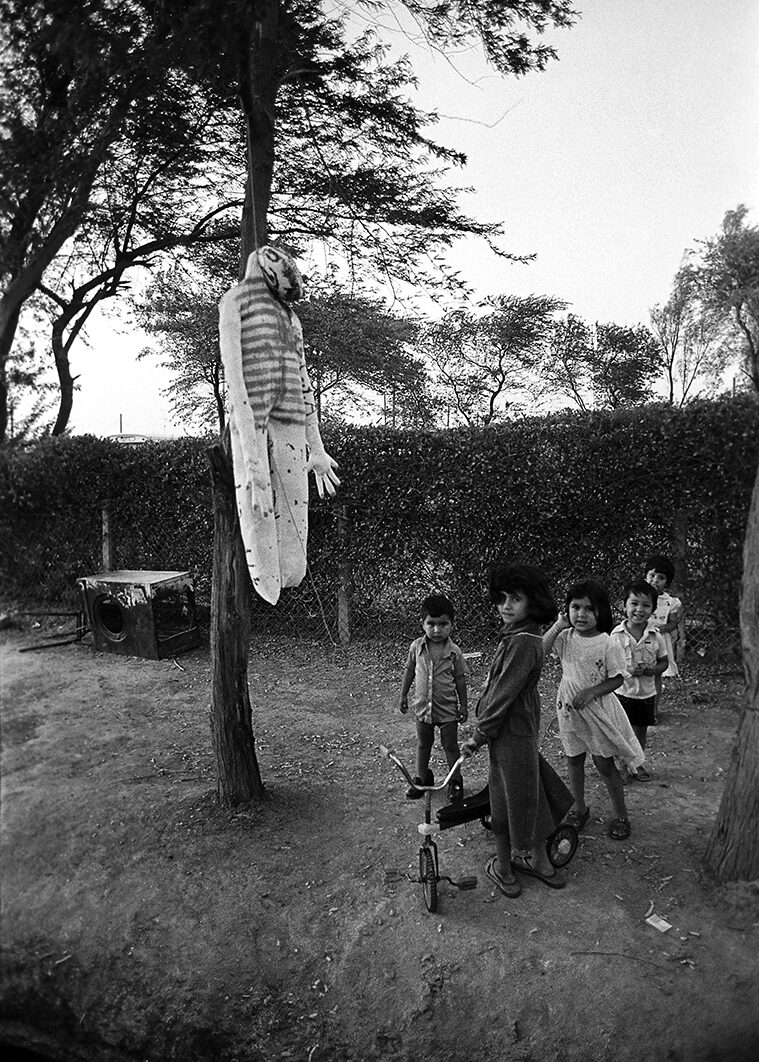
“How kings played, how they became enemies of one another, and how they murdered one another is found accurately recorded in history, and, if this were all that had happened in the world, it would have been ended long ago.” So Gandhi described the writing of history, which he thought was unable to account for human flourishing and served only to record interruptions to it. Simon Sebag Montefiore seems mindful of this possibility in The Cauldron: The Making of the Modern Middle East, when writing that his book is “a celebration of this region’s rich confection of sects, tribes, cultures and ethnicities – the shape of its cities, the splendour of its poems, the beauty of its shrines, the cadence of its songs, the delicacy of its food”.
Yet, apart from some fragments of poetry deployed as epigraphs, none of these subjects receives attention in the book, which is a record of the rivalries and battles between kings, presidents, generals and ideologues who, along with their henchmen and the occasional wife, comprise its cast of characters. Ordinary people appear largely as statistics, as victims of violence, or as violent mobs. Conscious of the book’s focus on violence, Montefiore writes in his conclusion: “The Cauldron may seem to argue that the Middle East is irredeemably more bloody and turbulent than anywhere else… but it is worth putting this into the wider perspective of world history.” We are then told how the history of other parts of the world might be even more violent than that of the Middle East. Hardly a page goes by without mention of violence. It is like a horror story but, as we shall see, told by way of amusing anecdotes.
Gandhi’s point was that violence cannot make human societies – though it may destroy them. He thought violence had become inseparable from history in modern times. Collective identities and passions have been built up through historical narratives of victory, defeat and revenge. In addition to lending existential depth to conflict, moreover, such narratives were crucial in making hierarchies between people – some being understood as backwards, others more advanced, in the scale of civilisation. For the Mahatma, history was not innocent.
For Montefiore, the history of the Middle East is a tale of disappointment and failure, for which the region’s own irrational and anti-Western people are held responsible. He goes on about the threat of the Muslim Brotherhood, even though it has lost most of its power after being crushed by dictatorships; he describes the Qatari media network Al Jazeera as anti-Western, as if this perspective alone means it is unreliable and wrong (even were it to be true). In other words, the book assumes the inherent virtue of the West. This is comfort food at a time of transformation within the region itself and in public opinion among the citizens of Western countries.

This is not how historians tend to write these days. They know to question received wisdom; Montefiore’s task is the more difficult one of reinforcing it. Describing Iran’s Islamic Revolution in 1979, he writes: “When prisoners were tortured and girls mass-raped in atrocities that shocked many clerics, [Ruhollah] Khomeini declared, ‘Islamic Government which stems from the absolute power of the Prophet Muhammad, takes precedence.’” Except that the ayatollah’s statement was not about justifying violence: that exposition, made in 1988, was about overruling Islamic law in the name of state sovereignty to ensure more equitable labour laws. By claiming to suspend divine commandments, Khomeini was rejecting conventional Islamist thinking, in which the state could only follow what scripture laid down. Such details, which alter the story Montefiore wants to tell about an undifferentiated Islamism, remain invisible in his account.
How do you write such tabloid-style history without boring the Western reader already familiar with it? Montefiore avoids this pitfall with a fast-paced narrative festooned with amusing anecdotes that render his characters ridiculous, such as Colonel Muammar Gaddafi wanting to buy the body of the Egyptian leader Gamal Abdel Nasser for $500m. He has an ear for the telling quotation (“It’s a pity both sides can’t lose,” Kissinger comments on the Iran-Iraq War). Without footnotes, it is difficult to tell how accurate some of these anecdotes are, while the ideas of other writers – such as Olivier Roy on how the revolutionary tradition has been Islamised rather than Islam radicalised – go unattributed.
However exotic his anecdotes, Montefiore is unable to enliven the repetitive story of murders, tortures, rapes and massacres that make up The Cauldron’s brew. The book makes grim but familiar reading, with its heroes and villains clearly defined and predictable. All the pro-Western characters are allowed some complexity and appear relatively human, even if, like King Hussein of Jordan, the shah of Iran or Mohammed bin Salman of Saudi Arabia, they engage in the occasional atrocity. The anti-Western ones are routinely described as demented, nihilistic and barbaric. But such epithets don’t tell us anything about how and why these men came to be as they were, or what lent them political legitimacy among parties and people who are seen merely as their victims or dupes, and often both.
Describing historical characters as savages and lunatics not only suggests their violence is the only factor that counts in history, but also that violence alone can counter it. Inhuman violence, of course, only describes the history made by people like the Assads or Khomeini in the Middle East. European colonialism or American wars in the region are different, their protagonists condemned for being naive, mistaken or, at most, ruthless, their violence briefly noted or passed over. The war on terror gets short shrift. The fall of Baghdad in 2003 merits a laconic description: “No more than 9,000 Iraqis and 139 Americans had been killed.”
Only in The Cauldron’s concluding chapter, when Montefiore writes about the future, does he have something original to say. The Middle East is no longer confined to its geography; it has been globalised in demographic, economic and political terms. What worries him is the expansion of conflicts to Africa, Asia, even Europe. This is true enough, though not primarily by way of Islamism and immigration as he thinks. The Middle East’s violence is born out of its loss of sovereignty, its weak states. Every Arab country, not to mention Israel, is a political and military dependency, all of which are unstable and open to religious and other forms of radicalism, however rich, poor or heavily armed they may be. This situation results from their mutual fears and the outside support each receive.
From the viewpoint of Asian or African, if not European, policymakers, the region’s most dangerous export is its loss of sovereignty, which both foments violence and suffers it in new arenas around the globe. However brutal they may be, countries like Turkey and Iran at the region’s edge, both of which Montefiore distrusts as Islamist, represent a model of independent statehood much desired in the postcolonial world. The difference between these two kinds of government is structural not ideological, since those possessing autonomy would continue acting as they do in geopolitics even with a change of leader, government or alliance.
Islamism is a spent force – as demonstrated by Hamas’s brutal 7 October terror attack on Israel, a naive and nihilistic act of tactics rather than strategy. Islamism was a Cold War method predicated on the making of a revolutionary state – now in power only in Iran and Afghanistan. Al-Qaeda and Islamic State (IS) emerged in the weak and non-sovereign countries of a post-Cold War Middle East dominated by the US. Their appearance indicated the waning of Islamism in the region. In Iran and Afghanistan, the ideology is under new management, after being appropriated by the clerical classes against whom the lay ideologues of Islamism fought. Rather than the vanguard of Islamism, they are latecomers to it, having emerged at the tail end of the Cold War. It’s an open question how long those governments will last. Their populations seem uninterested in Islamism, with the new administration in Iran having already sidelined the clerical class from political power to create a military-civilian state. The individualised militancy of IS, in the meantime, continues to roil weak states, from the Arab world to West Africa and Central Asia, though its threat is much diminished.
For Montefiore it is Iran, to some degree Turkey, and even little Qatar that pose the greatest threats to the region, due to their support of Islamism – his idée fixe. He favours the kind of pro-Western Islam propagated by other Gulf principalities. But is religion of any kind the issue here, or the array of weak and dependent states that Montefiore would support and from which both dictatorship and militancy arise? After all, the United Arab Emirates is complicit in the genocidal violence in Sudan, which Montefiore sees as a tragedy unjustly ignored by Gaza protesters, some of whom he considers to be inspired by Islamists. Yet there is something despairing about the choice Montefiore offers us, between Tehran and Abu Dhabi, as if he senses it is no longer one the West can make for the Middle East.
The Cauldron: The Making of the Modern Middle East
Simon Sebag Montefiore
Weidenfeld & Nicolson, 528pp, £25
Purchasing a book may earn the NS a commission from Bookshop.org, who support independent bookshops
[Further reading: Medieval masculinity under the microscope]
Content from our partners



Related

This article appears in the 07 Oct 2026 issue of the New Statesman, The Suspicious Relationship
Join the debate
Subscribe here to comment