
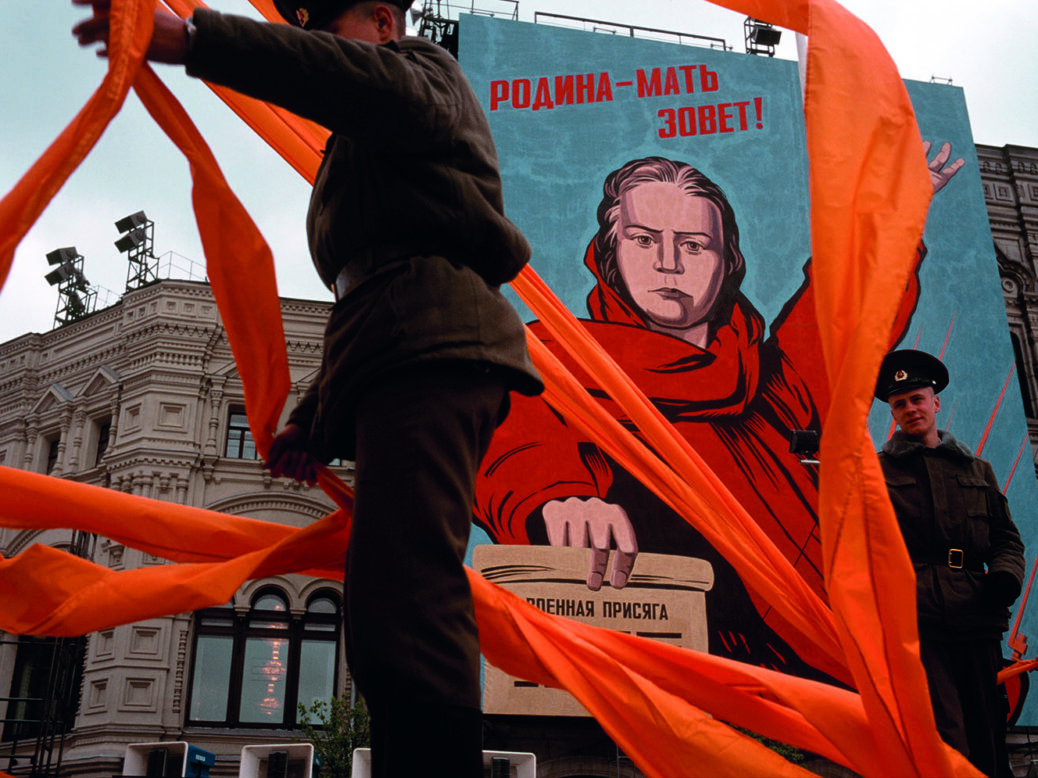
When Vladimir Putin first came to power in 2002, he spoke a rapid, halting Russian. It betrayed a certain nervousness at emerging from the shadows of his KGB training into the limelight of political power. But the Kremlin’s key resident soon learned on the job that language is a powerful tool and a fearsome weapon. Today, he can still deploy the “gutter” language of his hardscrabble St Petersburg upbringing and KGB past, deriding journalists who enquired into his secretive personal life as “snotrags” and branding European allies of Ukraine “piglets”. In formal settings, however, he adopts a higher register of “pure” Russian, cloaking an oppressive nationalist mission in the language of sophistication and defence of Russian culture.
The Kremlin’s daily website update is an illuminating guide to what the Putin system wants people to know about its priorities. We get sporadic emissions on the war in Ukraine, but no regular updates on casualty figures or the state of the front line. There are, however, details of the “anti-Latinisation” push: edicts requiring the return of official and commercial signage to Cyrillic script and banning developers from using the Latin alphabet for naming new residential complexes, to signal greater separation from the West and its pernicious influences.
This a telling part of a larger story with deep historical roots and winding linguistic tracks that Simon Franklin, professor of Slavonic studies at Cambridge and expert on the development of early Russian, explores in his book Troublesome Words: A Cultural History of Russian. The text ventures through the evolution of Russian and its cultural and political significance until the present day in a magnificent and erudite sweep. As Franklin notes early on, the roots of modern Russian began in schisms when Church Slavonic and East Slavonic – the tongue of multiple dialects – vied for precedence, with shifts of meaning and power struggles about usage resonating across centuries. The subsequent chapters are a dense, absorbing account of how the Russian we recognise today came into being.
The account has its gory moments. Avvakum, a renowned Old Believer preacher and central figure in the great schism in the Russian Church in the 17th century, declared worshipping in Russian was a sign of holiness: “God loves us no less than the Greeks”, he declared in an early assertion of Russian as a language of culture and identity. His autobiography, written under dire conditions while in Arctic exile, detailed the torments doled out at the behest of his rival Patriarch Nikon and the tsar for apostasy against their reforms: “the guards merciless, the cudgels big”. He was executed by burning in 1682. It all sounds horribly familiar when we think of the fate of Alexei Navalny.

In the following century, Peter the Great thought that clearer separation of Russian from the Church was needed. Peter tended to get his way, and issued edicts to make sure that official administrative language was prostoi (plain-speaking). In 1789, the first volume of the monumental Dictionary of the Russian Academy was published. At more than 3,500 pages, it was, as Franklin notes, “the culmination of the mid-18th-century project to establish a version of the Russian language that might stand alongside other imperial languages”. Russian was to be elevated by the creation of official grammar – quite a chore given the complexity of a language with six cases and dazzling verb variations – as well as clarification of meanings. The scholar Mikhail Lomonosov declared that: “Without grammar, rhetoric is blunt, poetry stutters. Philosophy is unfounded, history is displeasing, jurisprudence is dubious.” He dedicated his endeavours to the infant Tsar Paul as a signal of his intention to future-proofing linguistic matters. The habit of producing official dictionaries continued with a Soviet version in the 1950s; regular edicts update lexicography and whether foreign borrowings are in or out.
There is a lot to pack in here, and Franklin occasionally moves awkwardly between registers.The section on Alexander Pushkin, whose verse-novel Eugene Onegin and poetry gathered cult status in its own time, might have benefited from more examples to enlighten the non-expert.
As significant as the great writers and chroniclers were, the majority of citizens in the tsarist realms could neither read nor write. As such, all of this focus on “pure” Russian was overlaid by an oral tradition. In the census of 1897, 70 per cent of those surveyed had no literacy in any language – the figure in Ukraine was 80 per cent. The path to progress boosted the primacy of a single, official Russian language at the expense of Ukrainian. A hard-line interior minister decreed that the publication of books in “Little Russian” (ie Ukrainian) should be halted, declaring: “there was not, is not and should not be any distinct Little Russian language”, as it was “spoken by the peasantry, corrupted by the influence of Poland”. It is not unusual to hear similar dismissals from Moscow’s propagandists today.
Soviet-speak is easily parodied for its stodgy Marxist-Leninist jargon, but Franklin grapples with its underlying purpose. He focuses on specific examples, such as the role of Moscow radio in bringing standardised Russian into millions of homes across the empire. He is well versed too in the significance of mat – rude, Soviet-era slang to express distance from or indifference to the state and its proprieties. But the wildest leaps in the story of Russian occur in the 1990s, when Franklin witnesses the raw impact of capitalism on the structures of Russian society and its mother tongue. Seks-shop chains flourished; the weight-conscious went for lyposuktsia; the oligarchs bought up shares, made out like bandits and took the “bus” (slang for Aeroflot flights) in and out of Moscow.
Russian speakers love a language challenge, and Total Dictation, an annual education event, was launched in 2004 by the University of Novosibirsk. In 2024, almost 1.3 million Russophone players across 24 countries signed up. The authorities have understood that attachment to the language has its uses, with the Kremlin supporting the creation of institutions like the Russki Dom (Russia houses), educational centres with a Putin-y bent. German authorities long deliberated over whether to close Berlin’s Russki Dom for fear of reprisals against the few German official institutions remaining inside Russia; it was finally shut down last month. When I had visited, I had to pay in cash for a bowl of lukewarm borscht, as card payments fell under sanction arrangements.
There is much fun to be wrung out of Russia’s changing wordplay, and Franklin’s text is replete with current examples. We learn that the rise of texting and digital slang led to a parallel iazik padonov “slimeball-speak” (“an abundant use of obscenities plus some inventive euphemisms for obscenities”), though we might have been braced for a few of the juicier examples. We also learn that occasionally, the snarky loyalist political press and social media pick up an English phrase and twist its meaning: enter the wonderful khaililaikli, a word used to signal that something is speculative or possibly fake news, derived from Theresa May’s intelligence assessment as “highly likely” that the Salisbury poison attack on Sergei Skripal was a Russian secret-service operation.
The status of Russian in Ukraine could certainly have been given more attention: it has so markedly changed since Volodymyr Zelensky, in his days as a television comedian, spoke Russian in Sluzhba Narodu (“Servant of the People”), his show about a hapless centrist politician. Russian was Zelensky’s preferred language before he rose in politics, and he had to polish his fluency in his country’s own tongue.
Now the war has deepened the desire of Ukrainians to hear their own language, and Russian has been banished from the official sphere. Yet it is not unusual in some parts of the country to hear one person speaking entirely in Ukrainian and the other replying in Russian. Like many of the twists and turns in this fascinating account of the story of Russian, it is a linguistic dance to the many and varied tunes of time – with more to come.
Anne McElvoy was the Times correspondent in Russia and Ukraine in the 1990s
Troublesome Words: A Cultural History of Russian
Simon Franklin
Reaktion Books, 304pp, £21
Purchasing a book may earn the NS a commission from Bookshop.org, who support independent bookshops
Further reading: Possessed by Edgar Allan Poe]
Content from our partners



Related
This article appears in the 07 Oct 2026 issue of the New Statesman, The Suspicious Relationship
Join the debate
Subscribe here to commentIn 1897, the adult literacy rate in Britain was around 95% to 97% for both men and women.