
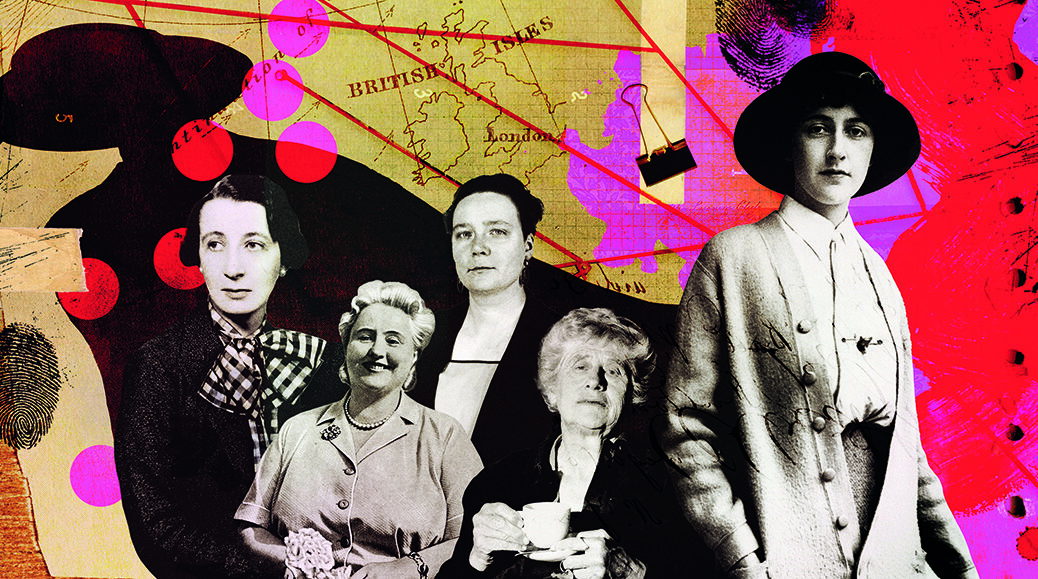
It’s hard to imagine Agatha Christie coming back as a ghost (supernatural interventions, in her novels, prove to be red herrings) but if she did, she’d be pleased: 50 years after her death, brand Christie is booming. Her books sold more than 200,000 copies in the UK last year. A Christmas staple as reliable as Quality Street, she is a nostalgic shorthand for a lost world of luxury train travel and afternoon tea at the vicarage. Spin-offs abound: a biopic is in the pipeline, plus a BBC series, Hercule (seemingly based on the courageous premise: what if Poirot was young and hot?). A British Library exhibition now invites visitors to peer reverently at relics like a chemistry textbook once owned by the “Queen of Crime”.
Except, there wasn’t one crime queen: there were five. The Christie myth – that a cheerful-looking woman in cat-eye spectacles reinvigorated the puzzle-cracking pleasures of detective fiction in interwar Britain, kicking off a golden age – is a mangling of literary history. Her influence on the genre was profound, and her afterlife indomitable, but like the killer on the Orient Express, she did not act alone. Christie sprouted from – as much as she helped to shape – a dazzling generation of British female crime writers. Too often these days, the rest disappear into her dense, overpowering shadow.
The brilliant bluestocking Dorothy L Sayers (1893-1957), three years younger than Christie, was an epicurean and a witty theorist of detective fiction, whose cartoon-dandy sleuth, Lord Peter Wimsey, developed over the years into an almost Austen-worthy romantic hero. The New Zealand-born thespian Ngaio Marsh (1895-1982) satirised Britain’s bohemian aristos with an outsider’s eye. The teenage prodigy Margery Allingham (1904-66) was the dominant half of a fruitful wife-husband writing team – a model for several later crime writers. Lastly, there was Josephine Tey (1896-1952), the greengrocer’s daughter who became a celebrity West End playwright. Her linked series of six crime novels are distinguished by cool realism and psychological acuity.
While they never cohered into a formal movement, the crime queens certainly knew, admired, influenced and competed with each other: Marsh said that she began her first novel, A Man Lay Dead, on a rainy afternoon in 1931, having just finished “either a Christie or a Sayers”. They corresponded and socialised at the Detection Club, a silly, semi-secret dining society for crime writers, which is still thriving. Founding members included GK Chesterton, Arthur Conan Doyle, Christie and Sayers; Allingham, Marsh and Tey would all join or drop in as guests. It was Sayers who penned the club’s oath: “Do you promise that your detectives shall well and truly detect the crimes presented to them using those wits which it may please you to bestow upon them and not placing reliance on nor making use of Divine Revelation, Feminine Intuition, Mumbo Jumbo, Jiggery-Pokery, Coincidence or Act of God?” which is sworn with one hand resting on a real skull.

The crime queens’ lives mirrored each other. Partway through their careers, Sayers, Marsh and Allingham all introduced free-spirited, bohemian love interests for their stolid male detectives, each of whom is tempting to read as an embedded self-portrait. Their novels might be cosy but their lives were unconventional. Marsh spent hers criss-crossing the Atlantic, while Tey (real name: Elizabeth MacKintosh) led a strange triple existence between theatrical London, popular fiction and keeping house for her widowed father in Inverness.
The story of Christie’s 11-day, possibly amnesiac disappearance in 1926 has been told to death, but what about the equally dramatic case of Sayers’s secret 1924 love child? At 30 she had just published her first detective novel, Whose Body?, and was working as a copywriter. The child’s father wanted nothing to do with it. Sayers told no one but her doctor, worked until she was eight months pregnant, then checked herself into a nursing home, where she gave birth to a son during a lonely Christmas. Three weeks later, she deposited the baby with her cousin Ivy, a professional foster-mother who brought him up (financially supported by Sayers), and went quietly back to work.
British fiction had been creeping towards the criminal from the late 19th century: Dickens, a relentless moderniser, died in 1870, leaving an unfinished whodunnit, Edwin Drood. Seventeen years later, Beeton’s Christmas Annual published a story by a cash-strapped young Scottish doctor, A Study in Scarlet. But not even Sherlock Holmes could account for the rash of unexplained deaths that afflicted British fiction in the years after the First World War.
The timing was no accident: the flowering of the whodunnit was a response to war. But not a direct one. It’s tempting to cast crime writers as artists grappling with the reality of violent death, but anyone who’s read a golden-age mystery will feel the absurdity of this. They are books of the bathtub, not the battlefield (the body in Sayers’s first novel is literally discovered in a bathtub). Writers and readers turned to mysteries for comfort and escape, drawn to their charm, their lightness and the fantasy they offered of a world governed by rational motive – of sensible, rather than senseless, killings.
The “golden age of detective fiction”, a term coined in 1939 by the Marxist critic (and future Labour minister) John Strachey, lasted from roughly the 1920s to the 1950s. For Strachey, the genre “glowed with vitality”, its inventiveness the result of the constraints imposed by a “rigid and limited” form. But he also seemed depressed by its flourishing. “To say that the detective story is the only vigorous, thriving branch of English fiction, is the most bitter criticism of English fiction.”
Why was the golden age dominated by women? It’s surprising that a genre notable for violent death and human malice should have proved so accommodating to the fairer sex, half a century before women’s lib. Propelled into munitions factories by a wartime government, with the bribe of emancipating legislation, women in the 1920s enjoyed unprecedented freedoms. At the same time, thanks to the mass felling of their men (Tey was attached to a soldier who died), they were also precarious. The return of the troops, coupled with economic shocks, soon drove many of this “surplus” generation of spinsters out of the workforce. Sayers, an unmarried mother at 30, was so anxious about losing her job she concealed her pregnancy and gave up her child. An innovative solution for the financially vulnerable, intellectually confident flapper? Writing detective fiction. Perhaps the domesticity of the whodunnit (“I specialise in murders of quiet, domestic interest,” Christie said) – the deadly reimagining of household items such as wasp killer or tennis racquets – made it more amenable to the female imagination.
The greatest mystery of all when it comes to Britain’s crime queens is why only one achieved immortality. Christie’s popularity can be partly explained by her long career (The Mysterious Affair at Styles came out in 1921; her final novel, Sleeping Murder, in 1976), her memorable heir-and-spare detectives, her inventive, near uncrackable solutions, and her smooth, emotionally undemanding prose.
Her fellow consorts were more formally ambitious. Sayers and Tey, in particular, were superbly experimental. Tey’s novel, The Daughter of Time (1951), voted the best crime novel ever written by the Crime Writer’s Association, is barely a crime novel. In it, her quiet, thoroughly-modern-feeling detective, Alan Grant, decides to tackle an unsolved, 500-year-old double murder: the princes in the Tower. It’s a beguiling piece of historical revisionism, defending Richard IIIagainst Shakespearean slander, Trojan-horsed into whodunnit: more Mantel than Marple. Suddenly, you find yourself weighing the provenance of a speech made by the chancellor of France at Tours in 1484 against the timing of the suppression of the Act of Titulus Regius.
For me, the great novel of Britain’s crime queen generation is a relatively early one: Sayers’s 1935 Oxford-set mystery, Gaudy Night. Inspired by a reunion at her old college, the plot involves her female sleuth (and Wimsey’s love interest), the pragmatic and likeable crime writer Harriet Vane, trying to unmask a malicious nocturnal poltergeist terrorising the female dons. But the mystery is just a convenient guise beneath which to dramatise Harriet’s passionate internal struggle about how to live a fulfilled life. Can intellectual rigour coexist with romantic satisfaction – and if not, “between one desire and another, how is one to know which things are really of overmastering importance?”
Gaudy Night is that rare thing in modern fiction, a romance for grown-ups. In one of the all-time literary love letters, equal parts bitter and sexy, Wimsey tells Harriet, “I should like to write you the kind of words that burn the paper they are written on – but… you will burn the paper in any case.” Beat that, Agatha.
[Further reading: China Miéville: “The supernatural is a vast source of cultural richness”]
Content from our partners



Related


This article appears in the 28 Oct 2026 issue of the New Statesman, Bin the Budget
Join the debate
Subscribe here to comment