
On the grounds of Beckett House, a Georgian manor in the village of Shrivenham, stands a white footbridge. Gently arched, with wooden criss-cross sides, its curve reflects like a set of grinning teeth in the lake below. This is Cradle Bridge – a crossing no longer from lakeside folly to ancestral pile for assorted barons, but for officials at what has long been a military site.
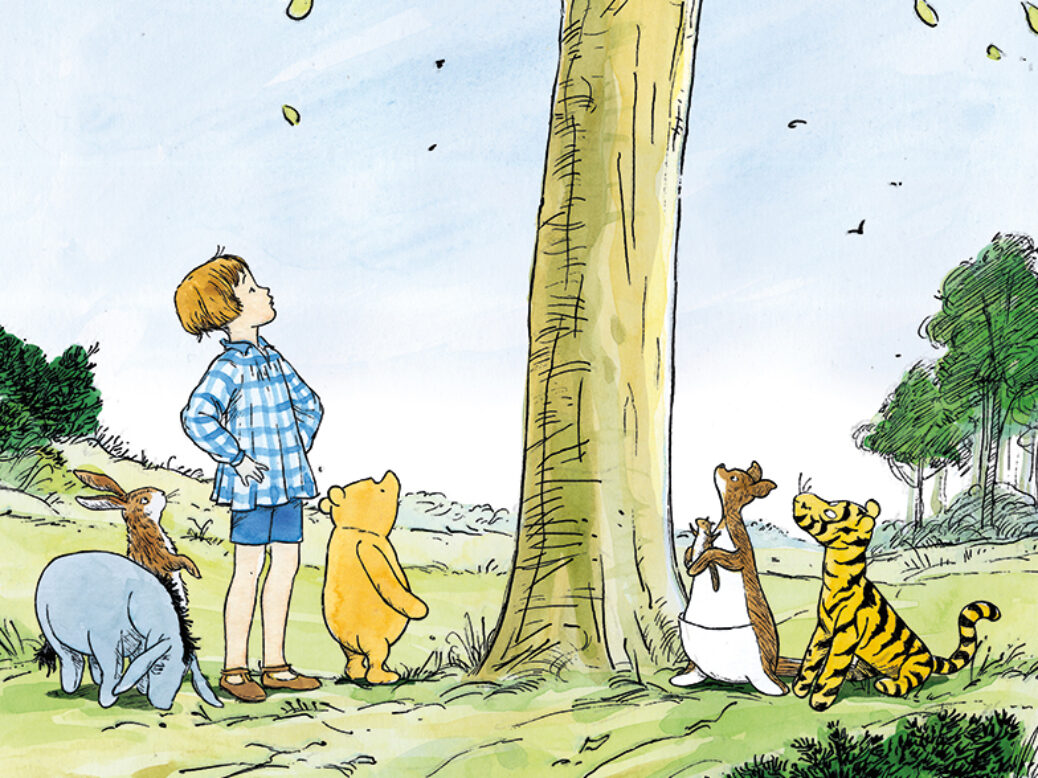
But to me, it was always Poohsticks bridge. It was where my Nana would take my sister and me – evacuated for half-term down from London to the peaceful Wiltshire-Oxfordshire border – to collect pinecones and sticks. We would throw them in from one side of the bridge, and race them to the other side. This is a game accidentally invented by Winnie-the-Pooh, the ever resourceful bear behind our doziest of national sports (“They always take longer than you think,” says Rabbit).
Many children brought up, as I was, on AA Milne’s Winnie-the-Pooh will have a Poohsticks bridge, and all the landmarks besides. A Hundred Acre Wood of their own. An Enchanted Place. A House at Pooh Corner. Ours were dens built from fallen branches leaning against the old oaks of Richmond Park in south-west London, like the house Pooh and Piglet build from a “heap of sticks” for Eeyore the donkey as, page by page, he is quilted in snow. But if it was a rainy day, we could always stay indoors racing raindrops, as in the poem “Waiting at the Window”:
James had just begun to ooze.
He’s the one I want to lose.
…
John has hurried quickly by.
(James was talking to a fly.)

It is hardly original to feel sentimental about Winnie-the-Pooh, least of all on its centenary. Much has been written about how this Ursa Major of children’s literature speaks for an England of bumbling modesty and small pleasures – our repressed emotional palette inked in by Pooh (easy-going, open-hearted), Piglet (nervous, sensitive, loyal), Tigger (energetic, optimistic), Eeyore (melancholic, deadpan), Rabbit (organised, practical amid the chaos), Owl (public intellectual, tedious company).
Returning to them for the 100th anniversary, though, I was reminded how far from some kind of cute Myers Briggs shorthand the premise actually is. None of the characters represent one set attitude to life. Pooh, for example, is no contented buffoon. He yearns for brain enough to understand Christopher Robin as his boy-master tells him unsettling real-world things about suction pumps and kings and queens. He silently wishes he could jump as far as Kanga, or knew what a Heffalump looked like. He is every bit as anxious as Piglet can be. He can be as woe-is-me as Eeyore too – when stuck in the entrance to Rabbit’s burrow, he harrumphs that “it all comes of not having front doors big enough”, and slopes into a corner when Piglet is more useful in the quest to capture Baby Roo.
Having read a great many bedtime stories over the past two years, I can report that it is rare to find picture-book characters with such depth, and such little purpose. “Nothing” with a capital N is their favourite pastime. Milne’s characters are more motivated to do things out of boredom or necessity than some moral teaching about the value of imagination or friendship from the hand of the author. That reticence is made explicit in the poem “Twice Times”:
There may be a Moral, though some say not;
I think there’s a moral, though I don’t know what.
When Pooh asks Christopher Robin what the North Pole is, as they prepare for an “expotition” there, he replies: “It’s just a thing you discover.” As Kanga and Baby Roo arrive in the forest, Pooh asks how they came to be there. “In the Usual Way, if you know what I mean,” is all he’s told. And one of the most paradoxically satisfying stories is surely the “Woozle hunt”, as Pooh and Piglet walk around in circles wondering whose footprints they’re tracking in the snow.
Like their woodland world, they are subject to nature’s moods – Tigger’s mouthful of thistle, Pooh vs the bees, Piglet watching and waiting as rainfall rises up to the window of his tree, and a “blusterous” wind that blows Owl’s house down. These injections of adversity into the narrative are treated as arbitrary, almost peripheral, even as they carry the story along. When rain pools around Piglet’s tree, any high drama is punctured by the author’s dry observation that “the only danger he had really been in was the last half-hour” of Owl’s anecdote from the branch outside.
Just as they are at the mercy of nature, red in tooth and paw, the passing of time presses upon them. This inevitability is confronted even in the understated titles of Milne’s poetry collections, When We Were Very Young (where Pooh first appears, in 1924, as “Mr Edward Bear”) and Now We Are Six. The final line of the last verse in the latter sighs above an illustration of Christopher Robin, his back to the reader, hovering mid-jump as Piglet and Pooh do the same, devoted eyes fixed on their old friend: “I think I’ll be six now for ever and ever.”
These are echoes of an ending no parent has ever read aloud without crying, as Christopher Robin appears to know what he doesn’t yet know. He won’t be doing Nothing any more: “They don’t let you.” He implores: “If I – if I’m not quite – Pooh, whatever happens, you will understand, won’t you?”
Ironically, AA Milne’s real-life son Christopher was never allowed to grow up and become a man in his own right; he was stuck in the public imagination as the boy in the books. That was his tragedy. Resenting the toys that eclipsed him throughout his life, he grew distant from his father, who in turn also became exasperated, as no one paid the books he wrote for adults – comic novels and mysteries – more attention than the beloved children’s stories. He eventually dismissed them as “trifles for the young”.
The toys that inspired Pooh and his friends were banished far from home. Rather than being displayed anywhere near Ashdown Forest or Cotchford Farm in Hartfield, the East Sussex locations behind the books, they’re behind glass at the New York Public Library, in a land where their legacy is in the hands of Disney. The British bequest, partly left by Milne to the Garrick Club and known as the “Pooh Trust”, led to years of infighting in the old London private members’ institution and legal wrangling over a huge windfall.
In its mundanity and happenstance, perhaps the most faithful memorial to Pooh’s true origins can be found just around the corner from where I grew up in Acton, a footnote in the sprawl of west London suburbia. A plaque for the “world famous teddy bear” marks the old home of the Farnell family, whose soft toy factory there produced the original 1921 batch of bears, sent to Harrods where Christopher Milne was bought a teddy bear for his first birthday.
While there was “no attachment left for the animals at all” in the Milne family, as Winnie-the-Pooh’s biographer Shirley Harrison once told me, they have come to represent all sorts in the modern English vernacular. A meme went viral following the Brexit vote illustrating a conversation between Pooh as a Remainer and Piglet as a Leaver: “Are we still friends?”/“Yes… yes, we’re still friends,”/“Good, let’s go and get pissed.” And, of course, they have all been diagnosed: according to one so-called study, Eeyore is a chronic depressive, Christopher Robin a “possible schizophrenic”, Kanga and Baby Roo have an unhealthy mother-son attachment style, and Tigger has ADHD.
But if Peak Paddington has manifested a story of progressive patriotism then Peak Pooh is surely the “philosophy” we’re told thrums among the pinewood spinneys of Hundred Acre Wood. You can fill your stockings with any number of companion guides to Pooh Brain: Pooh and the Philosophers, The Tao of Pooh, Pooh and the Psychologists, The Wisdom of Pooh. Enter the downstairs loo of any middle-class English household and you’re bound to make uncomfortable eye contact with Eeyore’s Nietzschean worldview.
Perhaps it is a tired and uncertain country that returns to the comfort of its bedtime stories in search of a national character. An easily referenced moral tale when children’s books – and no longer folk tales or religious texts – survive as our most commonly shared reading experience. I love the books for their quiet wisdom, of course. But it is an anti-philosophy that endures. An anarchy and randomness. A prose that mimics more than any other cadence the eternal question-answer-stop-start-tangents of a pre-schooler’s mind. Fragments of thought floating along a stream of consciousness, racing to the other side of the bridge.
[Further reading: How Wuthering Heights seduced its readers]
Content from our partners

Related
This article appears in the 14 Oct 2026 issue of the New Statesman, Fool Britannia
Join the debate
Subscribe here to comment