
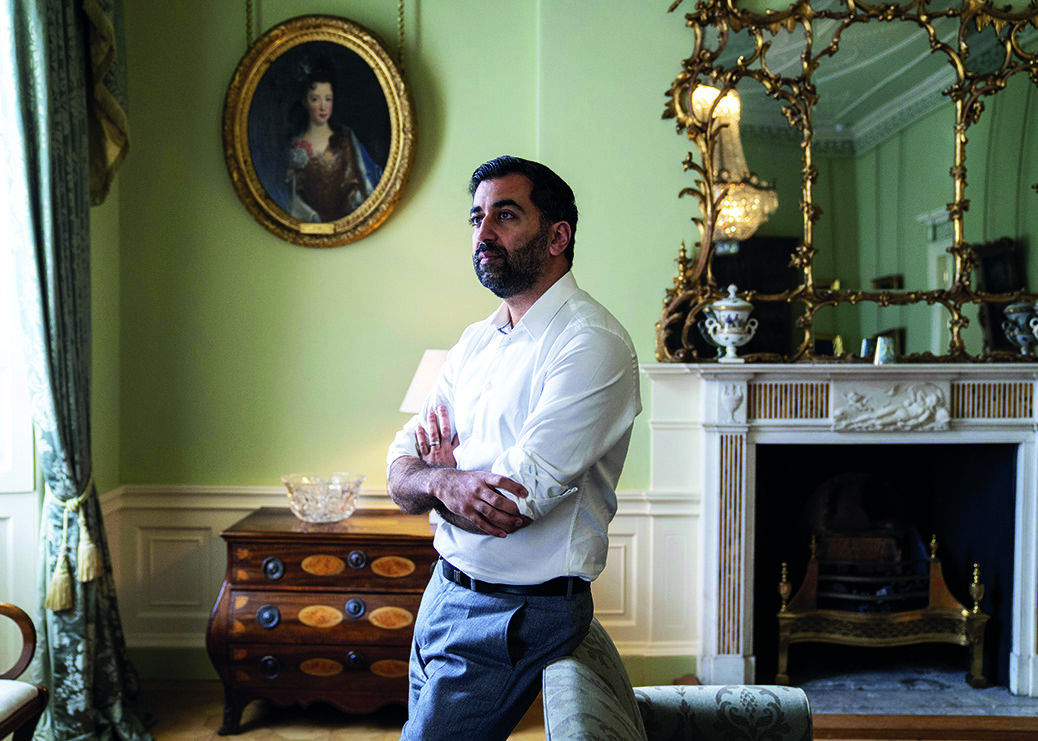
Humza Yousaf, author of Under Fire, an important and painfully honest testament, could never have flourished in Keir Starmer’s Labour Party, still less the Conservatives. As a proud Muslim and supporter of the Palestinian cause, that would have been out of the question. In the Scottish National Party, which embraced multiculturalism as its southern counterparts drifted towards coercive liberalism, he rose to the top.
Nicola Sturgeon encouraged him to stand for parliament and he became an MSP in 2011. Twelve years later, aged just 37, he was elected leader and appointed the youngest ever first minister of Scotland, making him the first Muslim leader of a western European country.
His book touches lightly on the domestic political impasse he inherited and failed to solve during his 12-month spell at Bute House. It concentrates instead on the intense personal and political drama that began on the morning of 7 October 2023.
Four days earlier, his parents-in-law, Elizabeth and Maged el-Nakla, had returned to Gaza in order to visit Maged’s sick mother. They were stranded by Israel’s bloodstained response to the Hamas terror attack.

The horrifying scale of the carnage inflicted by Israel during the weeks that followed 7 October was disgracefully under-reported in British media at the time and is still not widely understood. The British NGO Airwars, which monitors civilian harm from airstrikes in conflict zones, observed that by the end of October at least 5,139 civilians, including a minimum of 1,900 children, had been wiped out by Israeli actions. The rate of families being killed together, and of children being killed, was unprecedented in modern aerial warfare: 82 per cent of child fatalities occurred in strikes on residential infrastructure where no militants were publicly reported as killed. Airwars added: “By almost every metric, the harm to civilians from the first month of the Israeli campaign in Gaza is incomparable with any 21st-century air campaign. It is by far the most intense, destructive and fatal conflict for civilians that Airwars has ever documented.”
Elizabeth and Maged were at the heart of this horror, huddled together in their family home in central Gaza, where they were joined by around 100 family and friends who had already lost everything. Every night they tried to go to sleep to the sound of explosions, with the house shaking, drones buzzing overhead and children crying with every fresh bomb blast. Several times they made the perilous journey to the Rafah border in abortive attempts to escape. Communications constantly broke down, leaving Yousaf and his wife, Nadia, beside themselves with anxiety. Yousaf would lie awake “feeling like I was helplessly failing in my duties, both as a son-in-law and a father, unable to protect anyone in my family from the dangers they were facing”. Yet he had to carry on as first minister.
His first task was to condemn the Hamas terror attack. He explains that even this was not easy because Hamas “had been known to take vengeance against those who spoke out against them. I had to be clear with Nadia about the potential implications of my statement.”
He was then advised to follow the example of the British government (and almost every European country) and raise the Israeli flag above Scottish government buildings in a sign of solidarity. This Yousaf refused to do. He explains: “Hoisting a flag to support a government that had already signalled it would be cutting off food, water and electricity to Gaza – and therefore engaging in the collective punishment of over two million people – was a principle I was not prepared to compromise.” Within days he became the first European leader to call for a ceasefire, so that a humanitarian corridor could be opened.
An invitation arrived to attend a service of solidarity with the Jewish community. Yousaf records that virtually all his advisers, worried about a hostile reception, urged him to send a deputy. He ignored their advice, and this book publishes in full the fine speech he gave referencing both the Hebrew Bible and Koran and calling for mercy on Jew and Muslim alike. He received an ovation.
He is damning about the Tory government: “I would have thought foreign secretary James Cleverly, who was leading UK government efforts in the Middle East, would have had the decency to update me on the ongoing efforts to release all British citizens with family in Gaza, my own included.” Yousaf writes that he received private messages from Conservative MPs and ministers appalled at this failure to reach out to Scotland’s first minister.
When Cleverly finally got in touch, Yousaf writes that he produced “little urgency, or even a semblance” of a plan on how the UK government could get its citizens out of Gaza. When Yousaf spoke to Rishi Sunak, he lectured the prime minister “that his first responsibility was to British citizens, not to the state of Israel”. The claim that the UK government was more concerned with standing with Israel than helping British nationals trapped in Gaza is a recurring argument in this book.
Starmer, then leader of the opposition, did reach out: “Keir was not calling for publicity’s sake; in fact, he never publicised our call.” During the conversation Yousaf tried and failed to persuade Starmer to support an immediate ceasefire. In those days after 7 October, the Labour leader told LBC that Israel had the “right” to cut off energy and water into Gaza. “Despite his attempts to backtrack,” judges Yousaf, “Starmer’s perceived support for the collective punishment of the people of Gaza will haunt him for the rest of his life. Gaza will be to Keir Starmer, as Iraq is to Tony Blair.”
Throughout this period (and indeed, as the book documents, throughout his life), Yousaf was subject to Islamophobic abuse. Shortly after 7 October, in a disgusting and dangerous intervention, Elon Musk labelled him a “blatant racist” on X, which led to a wave of death and rape threats against the first minister, his wife and children by trolls. This prompted a call from his security team, and a painful wake-up conversation about safe rooms and panic alarms with his family.
There are other cases of political leaders who have suffered personal trauma while leading their nation in war. Abraham Lincoln’s son Willie died of typhoid in the White House in 1862, plunging the president and his wife, Mary, into debilitating grief. Theodore Roosevelt campaigned for the US to enter the First World War, then endured the agony of losing his airman son Quentin in a dog-fight over the Western Front: it is said that the grief killed the president.
Mercifully, Yousaf’s parents-in-law escaped from Gaza alive. Nevertheless, the intensity of family anguish means that the former first minister’s experience does bear comparison in terms of the impact on his leadership with Lincoln and Roosevelt’s bereavement.
He conducted himself with honour. Yousaf brings an unequivocal sense of moral purpose to politics, meaning that this book can be read on one level as a devastating indictment of the Westminster political class. “I remember the exact moment I knew that independence was a cause I supported and that the SNP was the party for me,” he records. “It was during the 15 February 2003 demonstration against the Iraq War, which at the time was thought to be the largest protest in UK history. As we marched past the House of Commons, the penny dropped. Why on Earth was I marching in London against a war the people of Scotland did not support?” The same question could be asked of Gaza.
Yousaf warns: “We can become drowned in morbid statistics. Beyond the numbers are real lives, people killed who were mothers, children, fathers, babies and grandparents – all for a crime they did not commit.” He notes in disbelief that even though Unicef estimates that more than 21,000 children have been killed, “not a single IDF soldier or Israeli official has been held accountable”.
He expresses his shock that so many governments, including the UK, continue to supply Israel with weapons and diplomatic cover. He writes: “International rules of behaviour were codified out of the ruins left by two world wars to prevent the mightiest superpower or a deranged leader – or, worst of all, a combination of the two – from inflicting mass violence and global chaos. Those rules now feel worthless.” It’s hard to disagree: in October, Benjamin Netanyahu, indicted for war crimes by the International Criminal Court, was allowed to fly through Greek, Italian and French airspace on his way to the United Nations General Assembly in New York.
Yet the book ends hopefully. Yousaf celebrates the millions who have taken to the streets to demand justice; praises the truth-telling film The Voice of Hind Rajab, about a young girl and her family killed by the IDF; lauds the election of Zohran Mamdani as mayor of New York City; and welcomes the protests against the proscription of Palestine Action.
Yousaf wants his book to be a “rallying call”, explaining: “The West is worth fighting for. Democracy is worth fighting for. Inclusivity and diversity are worth fighting for… That is the reality of the choice before us. Either we cohabit, based on some semblance of order, or anarchy will reign where the strongest are the ones who dictate the terms.”
Peter Oborne’s books include Complicit: Britain’s Role in the Destruction of Gaza (OR Books)
Under Fire: My Family’s Escape from Gaza and the Cost of Leadership
Humza Yousaf
Bridge Street, Press, 208pp, £25
Purchasing a book may earn the NS a commission from Bookshop.org, who support independent bookshops
[Further reading: Carlo Rovelli’s flitting perspectives]
Content from our partners



Related
This article appears in the 28 Oct 2026 issue of the New Statesman, Bin the Budget
Join the debate
Subscribe here to comment