
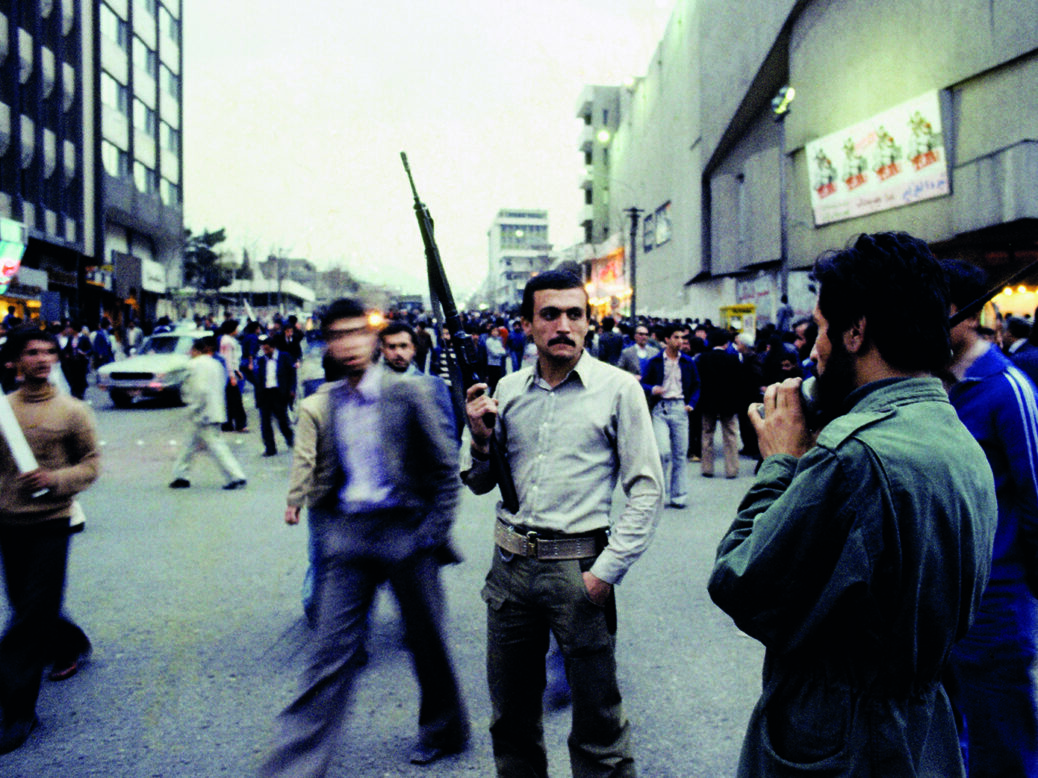
Back in 1978, I was living in Oxford writing a DPhil doctorate about Percy Bysshe Shelley. I was supplementing my student grant by teaching English as a foreign language for the Oxford Intensive School of English, which specialised in one-on-one two-hour tutorials. For three months, five days a week, I taught an Iranian petrochemical engineer called Farid who confidently told me, early on in what became a real friendship, that there would be a revolution in Iran and that the shah would be deposed. I was sceptical – there were too many Western vested interests in the country for that to happen, I argued. You wait and see, Farid said. A placid and good-natured young man, he longed for the end of the shah’s reign with untypical fervour, even though he was no great admirer of Ayatollah Ruhollah Khomeini. Farid was right. In January 1979 the shah fled his country for permanent exile and the ayatollah arrived.
That transformative Iranian Revolution is at the heart of Ben Macintyre’s fascinating and enthralling book, Redwood: The Untold Story of the Cold War’s Most Extraordinary Spy. One forgets what cataclysms erupted in and around Iran in the late Seventies and early Eighties: there was the internecine violence and regional destabilisation of the revolution, but there was also the Soviet Union’s invasion of Afghanistan. There were the 52 American diplomats in Tehran held as hostages, and Jimmy Carter’s presidency was undone by the failure and humiliation of the US’s rescue mission. And let’s not forget the beginning of the nine-year Iraq-Iran War which resulted in a million deaths.
In this maelstrom of geopolitical upheaval, Macintyre focuses on two spies, a Russian KGB officer named Vladimir Kuzichkin, and an MI6 operative called Ian McCredie, both of them stationed in Tehran. Kuzichkin had been in Tehran for several years running KGB agents. McCredie’s posting was recent and far more perilous. He was the sole British spy in the very reduced UK mission that occupied the embassy compounds, then under the aegis of the neutral Swedish diplomatic service. Nobody could ever know that he was MI6’s solitary man in Tehran. A measure of his isolation and his jeopardy was that he could communicate with the UK only through the use of the rarest (there were only two in existence) and most fiendishly complicated encrypting machine, the so-called Rockex.
The global escalation in tension was further inflamed by the Red Army being, at that point, in Afghanistan and, therefore, at Iran’s north-eastern border. It seemed viable that the Soviets would invade, and that the ayatollah would be deposed and replaced by the Tudeh, the Iranian communist party. Russia’s sphere of influence would extend to the Persian Gulf – and the Strait of Hormuz. And there was the potent lure of Iran’s oil. In the Pentagon, plans were drawn up to use tactical nuclear weapons to halt any Russian advance. The old cliché about the “powder keg” was particularly apt.

Just at this moment, October 1981, Kuzichkin presented himself at the British embassy and said he wanted to defect. Kuzichkin was clean-cut and exceptionally tall – 6ft 4in – hence his eventual code, “Redwood”. McCredie was appointed as his handler. When asked why he wanted to defect, Kuzichkin offered three reasons: a disenchantment with Soviet society and corruption within the KGB; two of his agents had been arrested in Switzerland and so he feared that he would be exposed; and, most bizarrely, because he was sexually dysfunctional. He could not maintain an erection and his marriage was on the point of collapse. For some reason he had complete faith that British doctors had the know-how and medication to return his virility. The two men began to meet clandestinely and forged a bond of friendship. McCredie gave him a camera and Kuzichkin began to pass on photographs of pages and pages of secret KGB documents. For MI6 this was a huge coup: to have a senior KGB officer as a double agent was remarkable, particularly with tensions mounting in the Gulf.
But Kuzichkin was feeling the strain of his duplicity. Always a heavy drinker, his boozing started to spiral out of control. It was only a matter of time before he cracked up or was discovered. Galina, his wife, returned to Russia to see her parents and Kuzichkin used her absence as the moment to demand his exfiltration from Iran. McCredie came up with a plan that would involve a very risky border crossing into Turkey. Fake documents were provided, but McCredie was forbidden to travel with him. Kuzichkin would have to exfiltrate himself.
The pages that Macintyre devotes to Kuzichkin’s fraught trip to the Turkish border are gripping, as tense as in any first-rate spy thriller. Macintyre conveys elaborate espionage and historical and political information with great fluency – and makes shrewd use of the punchy single-line paragraph. With the aid of several strokes of good luck, Kuzichkin made it into Turkey.
His subsequent debrief in the UK produced a huge haul of information, not least all the details of the members of the Tudeh, with whom Kuzichkin had been the lynchpin and communicator. The Tudeh was the largest opposition party outside the ruling theocracy but was allowed to exist as it was regarded as staunchly anti-Western.
MI6 shared this information with the CIA and an elaborate plan was hatched between them to thwart the KGB’s aims of expansionism. A meeting was set up between Kuzichkin and members of the Iranian secret service in Islamabad, Pakistan, and all the information regarding Tudeh was handed over. The implication was clear. The Tudeh, with KGB collusion, was planning a coup d’état. Russian forces in Afghanistan were on hand to support any new government they managed to form. This joint MI6/CIA subterfuge was designed to foment Iranian distrust of the KGB and the Soviets. “Furnished with concrete proof of a conspiracy,” Macintyre writes, “the ayatollah would move decisively against the Tudeh Party. Communism in Iran would be snuffed out. The brazen extent of Soviet espionage would be exposed.” It succeeded devastatingly well.
To put it simply, the Iranian communist party soon ceased to exist. Many thousands of Tudeh members were arrested, tortured and executed. It was a bloodbath. All KGB agents in the Tehran embassy were ordered to leave. Iranian-Soviet relations hit a new low. Macintyre deftly summarises the contradictory achievements: “The recruitment, management and exfiltration of Vladimir Kuzichkin was a superb example of agent-running, a textbook human intelligence case and a significant Cold War victory… But, it was also a calamity. Thousands of people were imprisoned and killed… Kuzichkin gave the Islamic Revolutionary Guard the weapons to smash the last organised opposition and sow a fear of internal subversion that has been used by the mullahs to subjugate Iranians for almost half a century.” The US and the UK, through the CIA and MI6, inadvertently helped to create the monster that is the present-day Iranian regime. We are still reeling from that whirlwind. Macintyre’s conclusion is unforgiving and sombre.
And what of Vladimir Kuzichkin? He was given a new English identity (Alexander George Larkin), money, a safe house, and became, astonishingly, a successful acupuncturist. His sexual dysfunction seems to have been cured after he was circumcised at the military hospital in Aldershot. His libido may have returned but he suffered from double-agent paranoia and his drinking soon got out of hand. He went to rehab. He came out and started drinking again. Two subsequent marriages collapsed. One evening in 2009, so Macintyre relates, Kuzichkin/Larkin settled down in front of the TV with a bottle of vodka in his hand to watch Miloš Forman’s Amadeus and, at some point during the film, suffered a large heart attack. He was 62 years old. But at least he died listening to Mozart.
Cold Sunset, the third volume in William Boyd’s Gabriel Dax spy trilogy, is published by Viking
Redwood: The Untold Story of the Cold War’s Most Extraordinary Spy
Ben Macintyre
Viking, 464pp, £25
Purchasing a book may earn the NS a commission from Bookshop.org, who support independent bookshops
[Further reding: Why nothing happens in Amit Chaudhuri’s novels]
Content from our partners



Related
This article appears in the 28 Oct 2026 issue of the New Statesman, Bin the Budget
Join the debate
Subscribe here to comment