
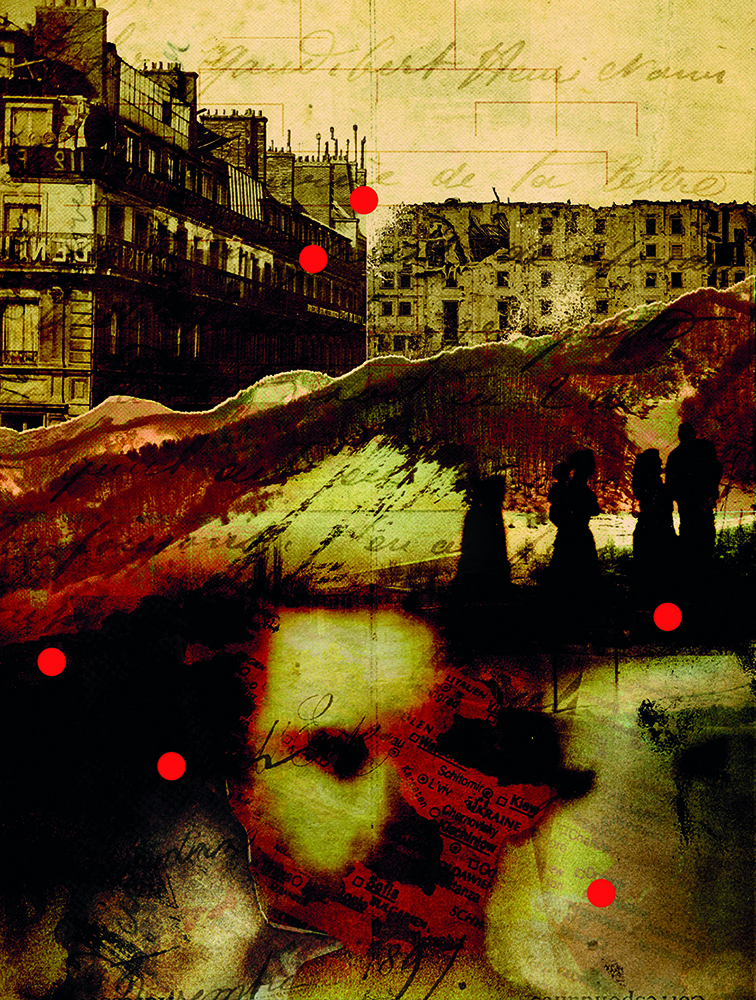
In January 1993, a man called Jean-Claude Romand killed his wife, their two children, his parents and his parents’ dog, then took an overdose of sleeping pills and set fire to his home in eastern France, just outside Geneva. Firefighters pulled him out alive. It soon emerged that he’d killed his family because a bizarre deception had started to unravel. For 18 years he’d mimicked a successful career, telling everyone he was a senior doctor at the World Health Organisation. In reality, he’d dropped out of medical school, lived off money embezzled from friends and relatives, and spent his days in motorway service areas and airport hotels, where he read up on the places he was supposedly visiting for work.
The Romand case electrified the French media. It also caught the attention of Emmanuel Carrère, then an up-and-coming Parisian writer in his mid-thirties. The author of one short novel that he considered a success, The Moustache (1986), and three more that he wasn’t so sure about, Carrère was already interested in alternative realities and morbid states of mind. Feeling stalled as a novelist, he had just written an imaginative biography of Philip K Dick, the paranoid visionary whose stories were behind Blade Runner and The Man in the High Castle. He sent a copy to Romand, who eventually agreed to cooperate with his effort to write a book about his own case, a book modelled on Truman Capote’s In Cold Blood.
Six years and innumerable drafts later, Carrère considered giving up. As a good student of French literature – he was “steeped”, he would later say, in the “influences and inhibitions” of his high-class intellectual family – he took it for granted that his job as a writer was to conceal his role from the reader. On the page, as Flaubert famously put it, an author should be “present everywhere and visible nowhere”. Capote had followed this advice. But Carrère was starting to feel that writing impersonally made the story he was telling too convincing, too authoritative. Who was he to imply that he had access to the objective truth about Romand? He also had an uneasy feeling that there was something unwholesome about his interest in the case, and that keeping himself out of the book was a way of concealing this.
After checking an old diary, Carrère found himself writing: “On the Saturday morning of 9 January 1993, while Jean-Claude Romand was killing his wife and children, I was with mine in a parent-teacher meeting… Then we went to have lunch with my parents, as Jean-Claude Romand did with his, whom he killed after their meal.” These sentences were “my exit from my writer’s adolescence”, he told an interviewer from the Paris Review in 2013: “It’s the first time you hear my adult voice.” The book started writing itself, or so he says, and, as The Adversary (2000), it brought Carrère to an international readership as well as making his name in France.

Why were those sentences so important to Carrère? On one level, they got him out of a local difficulty. Romand had turned out to be a bit of a blank, a man so fixated on avoiding self-knowledge that it was hard to speak of an authentic self behind his imposture. If Carrère had effaced himself, as he’d originally planned, the book would have had a personality-shaped hole in it. But breaking his taboo on the first person freed him up in other ways as well, and in later books – among them A Russian Novel (2007), Other Lives But Mine (2009), Limonov (2011), The Kingdom (2014), Yoga (2020), V13 (2022) and now Kolkhoz – he has developed a mode of writing in which memoir, biography, reportage and fiction flow in and out of one another under the guidance of the same central character, Emmanuel Carrère.
His working method is to give the impression of being disarmingly honest about his working methods. As he sees things, Capote’s failure to write anything of substance after In Cold Blood is a lesson about bad faith: consciously or not, Capote was undone by guilt over befriending and manipulating two convicted killers and then erasing the relationship from his book. Carrère, by contrast, tries to be open about his identification with his subjects, starting with Romand, whose empty days spent making his story hang together struck a chord with the depressive novelist. He’s similarly open about his own motivations, including a hunger for literary fame. But there’s also an element of sympathetic magic. To avoid the moral contagion of exploiting other people’s suffering, Carrère offers up some of his own.
As a result, whether he’s writing about the origins of Christianity, the Russian poet and extremist Eduard Limonov, or the 2004 Indian Ocean tsunami, which he witnessed, his readers have learned a lot about his life and obsessions: his family’s Russian background; his childhood as an uptight bookworm in the Parisian equivalent of Kensington; his depressions and periods of wild enthusiasm (successively for Philip K Dick, Catholicism, martial arts and yoga); and his hospitalisation for bipolar disorder a little over ten years ago. They’ve also become familiar with such recurring figures as his now ex-wife, Hélène; his wise friend Hervé, with whom he goes on calming hikes in the Swiss Alps; and, above all, his mother, Hélène Carrère d’Encausse (1929-2023), an academic and politician who became a regular on French TV screens after predicting the collapse of the Soviet Union 13 years before it happened.
How much does this shade into him being a self-involved raconteur? Carrère asks the question himself from time to time, but his performances are so assured and seductive that he doesn’t need to as often as you’d guess. A filmmaker and screenwriter as well as a former novelist (he worked on the first season of The Returned, among other things), he knows how to tell a story and isn’t abashed about wanting to hold the reader’s attention. Less sociological than the writing of other French non-fictionists, such as Édouard Louis and Annie Ernaux, but more intellectually ambitious than Anglo-American “creative non-fiction”, his body of work is difficult to classify. Still, Karl Ove Knausgård and Javier Cercas are fans, and he has probably eclipsed Michel Houellebecq – now an openly far-right figure – as his country’s most prominent male writer. (France’s most recent Nobel winner, however, is Ernaux.)
Kolkhoz, which was published in France last year and now appears in a skilful, idiomatic English translation by John Lambert, may strike British readers as a French equivalent of Martin Amis’s Experience. Like that book, it’s a personal and political reckoning with a deceased parent who was, as Carrère delicately puts it, “what’s known as a right-wing intellectual”. It begins in 2023 at a state memorial for the late Mme Carrère d’Encausse (the aristocratic apostrophe was his father’s addition, Carrère reveals), then loops back through Carrère’s entire family history to show how the former Hélène Zourabichvili became the first woman to head the Académie Française. We’re also filled in on Carrère’s own formation, and, in particular, his anguish over Russia’s invasion of Ukraine, which his mother – convinced that Vladimir Putin was a rational if thuggish actor – told the public wouldn’t happen.
There’s no shortage of colourful material. Carrère’s forebears on his mother’s side came from a Nabokovian world of Russian aristocrats and Georgian intellectuals who had to shift for themselves in Germany, Italy and France after the Bolsheviks seized power. He isn’t sentimental about the “air-headed souls” among them: “Their only agenda was the complete restoration of a society that aside from them no one wanted anything to do with any more.” But his bottomless fund of marvellous anecdotes about them provides a forgiving context for the shaping event of his mother’s life: her malcontented, Dostoevsky-loving father’s collaboration with the Germans during the war, and his abduction and killing by the Resistance after the liberation of France, when she was 15.
As he reminds us (the book is filled with sentences starting “Remember…” to help the reader keep track of all the callbacks), Carrère has dealt with this episode before in A Russian Novel, which caused a temporary rift with his mother. This time the betrayal, if that’s what it is, is more comprehensive. In addition to detailing her postwar friendships with various unrepentant fascists (Maurice Bardèche, a founding father of Holocaust denial, once helped the young Carrère with his homework, on Balzac), he offers an unsparing portrayal of her relationship with his father. A provincial bourgeois who didn’t have the intellectual firepower or force of personality to make a success of their marriage, Louis Carrère d’Encausse seems to have had a sad life, and Carrère’s descriptions of his elderly parents barely pretending to be able to stand one another are chilling.
Yet Kolkhoz doesn’t come across as a vengeful book. Instead, Carrère’s clever sequencing and control of tone somehow make it seem like an act of filial piety. Although he doesn’t go into it in detail, his mother became a vehement culture warrior in her later years, blaming polygamous “Africans” for the French riots of 2005, considering le wokisme a greater threat than climate change, and holding – Carrère hints – alarming views on Muslim immigrants. (As it happens, her 1978 prediction about the USSR was based on the idea that demographic pressure from its Muslim population would destroy it.) Carrère’s storytelling unwraps this Iron Lady of French foreign affairs commentary to reveal a more appealing, complicated figure. It also contrives a touching posthumous resolution for his father’s character arc.
Some of the strongest parts of the book concern the murky moral atmosphere of postwar France, where his mother’s character took shape. Justice didn’t always have much to do with who was and wasn’t punished for collaboration, and all kinds of morally compromised people were making themselves over as 11th-hour Resistance fighters. At the same time, it was entirely possible for a clever, damaged daughter of penniless immigrants to become as French as Joan of Arc. Carrère traces the silences and evasions of those years through his parents’ lives and his uncle’s life all the way to his own. But he does so with a light touch – in part, perhaps, because there’s so much else going on in the book, including trips to Russia and Ukraine and Carrère’s rediscovery of his Georgian roots. (Salomé Zourabichvili, Georgia’s anti-Putinist fifth president, is his cousin.)
As is traditional with Carrère, there are some outrageous lines (“I have a soft spot for women who starred in Bresson’s films at a young age”) and some details that probably wouldn’t get past American-style fact-checking (he admits to taking a few “liberties” here and there). But his strange mixture of intellectual playfulness and emotional directness is also on full display. There may not be an easy label for what he does, but there’s no question that he’s very good at it.
Kolkhoz
Emmanuel Carrère, trs John Lambert
Fern Press, 416pp, £20
Purchasing a book may earn the NS a commission from Bookshop.org, who support independent bookshops
[Further reading: Joyce Carol Oates contradicts herself]
Content from our partners



Related
This article appears in the 07 Oct 2026 issue of the New Statesman, The Suspicious Relationship
Join the debate
Subscribe here to comment