
Carlo Rovelli, an Italian physicist, emeritus professor at the Centre de Physique Théorique in Marseille, has in the last 15 years or so established himself as a leading populariser of science. Although his specialist field, quantum gravity, is one of the most inaccessible areas of contemporary thought, he has reached an astonishingly wide audience through his public lectures, YouTube videos and popular books, several of which have become bestsellers. He writes well (“Physics has found its poet,” the novelist John Banville said of him), and brings to his discussions of abstruse theoretical physics references to an impressively broad range of writers and intellectuals, including philosophers (both western and eastern), historians, economists and political thinkers, as well as poets, writers and social critics. He seems to have read everything.
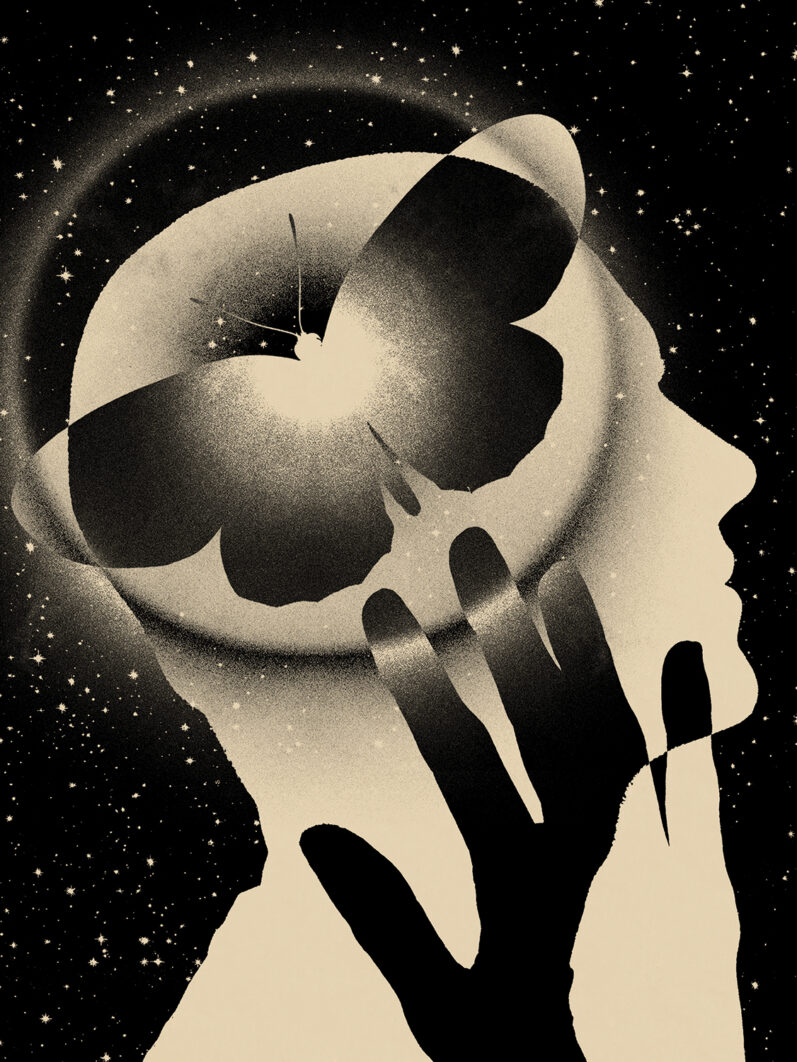
The title of his latest book, On the Equality of All Things, comes from the Zhuangzi, an ancient Chinese collection of allegories, anecdotes and fables that is regarded, along with the Tao Te Ching, as one of the foundational texts of Taoism. The point of many of the stories is to break the hold on us of certain fixed dichotomies between, say, life and death, good and bad, or human and nature. Two of the most famous, both cited by Rovelli, are “The Butterfly Dream” and “The Debate on the Joy of Fish”. In the former, the philosopher Zhuang Zhou, traditionally regarded as the book’s author (in the same way that Homer is said to be the author of the Iliad and the Odyssey), dreams that he is a butterfly that didn’t know that it was Zhuang Zhou. He wakes up suddenly and is unsure whether he was Zhuang Zhou who had dreamed he was a butterfly, or a butterfly dreaming that he was Zhuang Zhou. In the second story, Zhuang Zhou is walking with his friend and fellow philosopher Huizi on a bridge over the Hao River, when he remarks on how happy the fish are swimming in the river. “You are not a fish,” Huizi objects. “How can you know how it is to be a fish?” “You are not me,” Zhuang Zhou replies. “How do you know what I know about how a fish feels?” Huizi concedes that he is not Zhuang Zhou, but insists that he knows at least that Zhuang Zhou is not a fish, which is enough to deduce that he does not know what a fish likes. “Let’s go back to where we began,” says Zhuang Zhou. “When you said, ‘How do you know how a fish feels?’ you knew it was I who knew. I knew it, here, above the Hao River.”
What attracts Rovelli to these fables, he says, is that they illustrate “the anti-foundationalism to which I believe modern science leads us”. The stories play with perspectives – of the butterfly, Zhuang Zhou, Huizi and the fish – suggesting that we should not take any one of these perspectives as fundamental. Or, as Rovelli would put it, we should not take any of them to be absolutely fundamental. “‘Fundamental’ is a relative word,” he writes. “We say that a carburettor ‘exists’, and so does an atom, and so does a soul.” From different perspectives, one of these might be regarded as a more fundamental notion than the others. Is a description of a car that speaks only of atoms more fundamental than one that speaks of carburettors? Yes, in one sense, but, if what you want is to fix your car, then the one that mentions carburettors is the baseline you should be looking for. “In each case, we use appropriate criteria of reality, slightly different in different cases. This is the equality of all things.” This leads Rovelli to a remarkably forthright statement about the philosophical pretensions of his own discipline: “To say, as I often hear, that if we know the world’s fundamental physical equations then we know everything about the world, is, I believe, nonsense… Physics is less useful than it is sometimes said to be. Physics is overrated.”
In this rejection of foundationalism there is a distinctly Wittgensteinian echo, and, indeed, Rovelli cites Wittgenstein with approval throughout the book. However, while Wittgenstein’s rejection of scientism (the view that natural science is the only correct way to discover truths about reality) is explicit and thoroughgoing, Rovelli’s view seems somewhat wavering if not straightforwardly inconsistent. Thus, on page 148 he says: “I often hear that scientific knowledge would show that our usual knowledge is ‘wrong’. This is nonsense.” And yet, just a few pages later, he says: “There is much that seems obvious to us: facts, opinions, moral judgements, concepts, an entire worldview. It is obvious that at sunrise the sun moves around us: the very word itself, ‘sunrise’, says as much. But we are wrong.” The same wavering, or inconsistency, appears in his accounts of progress within science. For example, on page 151, he says: “I hear people say that ‘Newton’s gravitational force does not exist: Einstein’s curvature of space does’. What nonsense!” And yet, readers of Rovelli’s popularisations of relativity theory would naturally think that Newton’s gravitational force was indeed a fiction. Take, for example, this account in the first of Rovelli’s Seven Brief Lessons on Physics (translated into English in 2015): “Newton had tried to explain the reason why things fall and the planets turn. He had imagined the existence of a ‘force’ which draws all material bodies towards one another, and called it ‘the force of gravity’.” The point of those scare quotes, surely, is to indicate that this “force” existed only in Newton’s imagination.

[Further listening: Carlo Rovelli on the New Society podcast: Can we know how it feels to be someone else?]
Indeed, throughout his popular books, Rovelli delights in telling us the ways in which “scientific knowledge would show that our usual knowledge is ‘wrong’”. His introduction to quantum gravity announces in its very title that Reality Is Not What It Seems (2016), and in that book and in several others he tells us flatly that “time does not exist”. Even in On the Equality of All Things, he spells out a sense in which physics is fundamental. “All the phenomena we observe,” he writes, “are also physical phenomena. We have no evidence, not even hints, that any phenomenon violates physical laws. Indeed we have ample evidence that these laws are always respected. This is the specific universalism of physics.” A few pages later: “No evidence suggests that these processes do not also admit, in principle, a physical description. There is ample evidence for this equality of all things.” This seems to be a very different use of that Taoist phrase to the earlier one. Perhaps Rovelli does not think physics is so overrated after all?
Is this a simple oversight on Rovelli’s part? I do not think so. I think he believes that physics is foundational and universal, but that what it has taught us is that everything is relative.
To understand this (assuming it is intelligible) one has to understand something that appears in all Rovelli’s books with an almost evangelical fervour: the relational interpretation of quantum mechanics. Rovelli has expounded this interpretation in several academic articles, but the most satisfying attempt he has made to explain it to the public is in what is, in my view, his very best popular book, Helgoland: The Strange and Beautiful Story of Quantum Physics (2021). The book opens with a beautifully written and wonderfully accessible history of quantum mechanics, beginning with Werner Heisenberg’s famous retreat to the North Sea island of Heligoland (as we usually spell it in English) in the summer of 1925 to work on problems arising out of Niels Bohr’s theory of the atom.
What Heisenberg created was a new approach to the problem that used a matrix system of mathematics to model what was observed about the behaviour of subatomic particles such as electrons. The approach worked mathematically, but it seemed impossible to visualise the behaviour of the particles thus modelled. This problem has bedevilled quantum mechanics – as Heisenberg’s theory was called – ever since. It is, on the one hand, extraordinarily successful (“The only fundamental theory about the world that until now has never been found wrong,” Rovelli writes) and, on the other, seemingly impossible to understand. It seems to compel us to accept that the laws of physics are probabilistic rather than deterministic, a view that Einstein famously rejected with the objection: “God does not play dice.” More troublingly still, it seems to suggest that particles, instead of being in a particular, well-defined position at any given time, can, before they are observed, be in a “superposition” – ie, in more than one position at the same time. When the particle is observed, however, this superposition collapses into one of its possible well-defined positions.
[Further reading: Carlo Rovelli: “Einstein made more mistakes than anyone”]
Worse still, superposition does not just apply to position but to any measurable quantity, such as momentum, energy or even the life or death of a cat. Thus, a famous example of quantum weirdness is Erwin Schrödinger’s thought experiment in which we are asked to imagine a cat trapped inside a box with a tiny amount of a radioactive substance, a Geiger counter, a hammer and a vial of poison. If the radioactive atom decays, the Geiger counter detects it, drops the hammer, which breaks the vial, releasing the poison and killing the cat. If the atom does not decay, the cat lives. According to quantum mechanics, until it is observed, the atom exists in a superposition of decayed and not decayed states, which seems to suggest that the cat is both alive and dead.
There are several ways of interpreting quantum mechanics that try to make sense of this. One of the most popular is the “many worlds” interpretation, which suggests that to every superposition there corresponds a branching of the world. Thus, Schrödinger’s cat is indeed both alive and dead, alive in one world and dead in another. “Does this sound crazy?” Rovelli asks. “It sounds crazy because it is.”
The relational interpretation is his preferred alternative. On the Equality of All Things, like all his popular writings, is an attempt to persuade the public that a) it is not as crazy as the many worlds interpretation, and b) it is true. At the heart of Rovelli’s relational interpretation is the idea that quantum mechanics is “the discovery that the properties of any entity are nothing other than the way in which that entity influences others. It exists only through its interactions.” So, we should not ask whether the cat is alive or dead, but whether, to you, to me or to anything else it interacts with, it is alive or dead. Outside of those interactions, the cat does not exist. “The properties of an object are the way in which it acts upon other objects; reality is this web of interactions.” This has the far-reaching consequence, Rovelli insists, that facts are relative: “Facts that are real with respect to an object are not necessarily so with respect to another.”
Rovelli tells his readers that the relational interpretation is not the only interpretation of quantum mechanics and that it does not command universal assent among physicists. However, I don’t think he conveys accurately just how controversial it is. The most searching examination I have found of it is an article by three physicists – Ricardo Muciño, Elias Okon and Daniel Sudarsky – at the National Autonomous University of Mexico called “Assessing Relational Quantum Mechanics” which was published in 2022 in the leading academic philosophical journal Synthese. “We find,” they write, “that it fails to address the conceptual problems of standard quantum mechanics – related to the lack of clarity in its ontology and the rules that govern its behaviour – and that it leads to serious conceptual problems of its own… We conclude that RQM [relational quantum mechanics] is unsuccessful in its attempt to provide a satisfactory understanding of the quantum world.” One of the chief problems the authors have is making sense of Rovelli’s suggestion of prioritising relations over objects: “It is not at all clear whether the idea of having ‘relations without relata’ is even coherent… Without there being things to be correlated, the notion of a correlation is fully empty.”
Of course, Muciño, Okon and Sudarsky are responding to the idea as expounded in academic articles in journals of physics and philosophy. As put forward in On the Equality of All Things, it has an additional problem. Not only is it difficult to see how it clears up the puzzles of quantum mechanics, but it’s also unclear what it has to do with the anti-foundationalism of Zhuang Zhou and Wittgenstein. Rovelli’s view seems to be that quantum mechanics provides us with a fundamental truth, namely that there are no fundamental truths. One does not have to be a physicist or a philosopher to see a flaw in that view.
Despite its subtitle, in 85 Seconds to Midnight: A Physicist’s Argument Against Rearmament, Rovelli writes primarily not as a scientist but as a human being. Rather than urging us to accept the unreality of time, he writes as if time is of the essence – his very title is taken from the Doomsday Clock, a device used by the Bulletin of the Atomic Scientists to warn us how close we are getting to nuclear war. Early this year, the clock was set to 85 seconds, the closest it has ever been to midnight. Rovelli’s book quotes from and echoes an earlier warning of the risk of nuclear annihilation: the “manifesto” issued by Bertrand Russell and Albert Einstein in which they famously urged us to “remember your humanity, and forget the rest”. In this spirit, Rovelli reminds us that the world is increasingly unstable and that it contains far too many nuclear warheads. Russia alone, he tells us, has “just over 4,000”. This might be an underestimate. The website of the International Campaign to Abolish Nuclear Weapons (ICAN) gives the figure as 5,429, with the US just slightly behind at 5,177, followed by China, France, the UK, India, Pakistan, Israel and North Korea. It is not difficult to envisage a situation in which these weapons are used.
Most of the book consists of a brief history of how we got to this situation, emphasising the culpability of the US and the moments when we have come closest to worldwide conflagration. He has an interesting chapter on “the bad conscience of physicists”, but it is largely taken up with a defence of Heisenberg against those who criticise him for staying in Germany throughout the war and putting his expertise to work on the (mercifully unsuccessful) attempt to provide the Nazis with an atomic bomb. Rovelli is more critical of his fellow Italian Enrico Fermi, who made very considerable contributions to the Manhattan Project and who in 1945 was a member of the committee that advised President Truman to use the bomb against a war facility surrounded by workers’ homes, giving no warning or demonstration.
In the end, however, his concern is not to castigate scientists but to encourage them to play a part in reducing rather than increasing the horrific dangers. “I write this,” he says, “because I think that today we desperately need everyone, and all of us scientists in the first place, not to remain locked in our new worlds but to work to stop the current race to war. To avoid millions of humans being burned by nuclear fire.” It is the voice of someone concerned, not to convince us that there are no objective facts, but to urge us to face the reality that we are in danger of rushing headlong into a series of conflicts that endangers us all, a voice that should be listened to, not because he is a renowned physicist but because he is speaking the (objective) truth.
On the Equality of All Things
Carlo Rovelli
Allen Lane, 192pp, £20
85 Seconds to Midnight
Carlo Rovelli
Allen Lane, 112pp, £9.99
Purchasing a book may earn the NS a commission from Bookshop.org, who support independent bookshops
[Further reading: Tolkien’s legends are truer than our own]
Content from our partners



Related



This article appears in the 21 Oct 2026 issue of the New Statesman, Sally Rooney is a writer, not a terrorist
Join the debate
Subscribe here to comment