
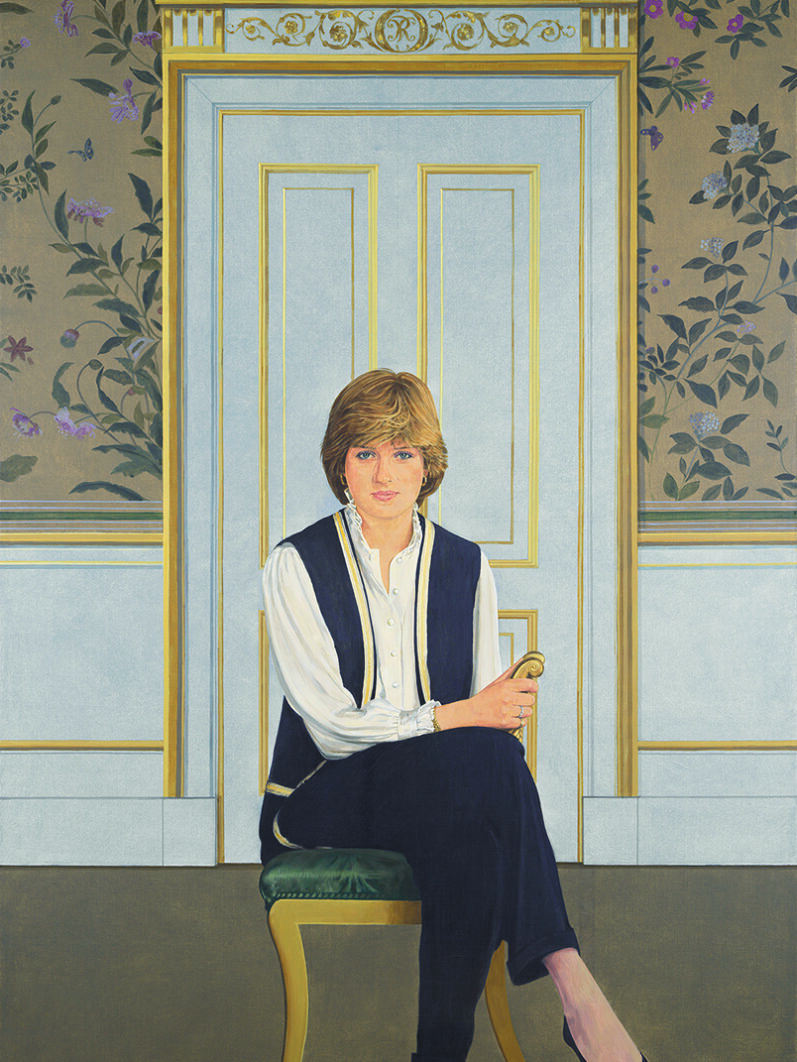
If you review books, you get to throw out a lot of questions without hope of having them answered. Here’s one I asked last summer, in relation to the upbringing of Diana, Princess of Wales: “It is now almost impossible to imagine the insignificance of a third daughter, born between two prayed-for boys – the elder dead in infancy, the younger living – in a primogeniture-practising family at the middle of the last century, yet this lowly person became the most famous woman in the world. How must her brother have felt?”
Well, now we know. People have been wondering why Charles Spencer decided to write a book about his dead sister, Diana. Money? Attention? Revenge? We cannot know; and it’s fair to believe that he acted, according to his own beliefs, on the conventional motive of setting the record straight. But the question is, for whom, and to what end? Maybe the most useful way to look at Swan Song is through the lens of the paragraph above: for it exposes a long-restrained desire to restore the status quo ante Princess Diana, which is, to its writer, the natural order of things.
Here he was, a boy at last, a genetic miracle, born to inherit the beautiful Althorp estate and its splendid house, where the great picture gallery is lined on each side with the suite of paintings of Carolean court ladies known as “Lely’s beauties”, where his framed Spencer ancestors look down with anticipation and approval, where the history and renown of the Spencers was dinned into his ears every day of his youth. And here was his third sister – an individual of no consequence whatsoever in this system, and to whom he would reasonably expect to condescend for the remainder of their lives – who then grows up and eclipses him utterly. Eclipses him, moreover, on his own consecrated patch of inherited status. When Diana Spencer married the Prince of Wales, she came into not only a higher title and worldwide stardom, but also more extensive lands and houses (none as pretty, it must be said, as Althorp); a more important lineage; a deeper archive, housed in the library at Windsor; and better pictures, including the original set of Lely paintings, of which those at Althorp are copies. As a child, Spencer perceived that the most important person in the Althorp world, his father, the then Earl Spencer, was not at ease when talking to members of the royal family: “He seemed desperate to please those he viewed as his superiors.” Now, when he and Diana met in public, he was expected to bow.
It is only in this context that the book, with its strange, apparently unconscious contradictions, makes sense. He claims he wishes to protect Diana’s memory and “speak on (her) behalf”; and yet the book abounds in stories that she would never relate, because they diminish her. If it’s true that prince Charles “sounded elated” when she died, and said to Spencer, in the days after, that “we’ll forget her soon enough”, are these things that would magnify her memory or comfort her ghost? We also know, because he tells us, how much she minded about her academic failures as a child, which looked especially weak in comparison with his own strengths in this field (at the age when she was working as a nursery-school assistant, he was reading modern history at Magdalen College, Oxford). When she was alive, he once alluded to her “classroom toils” and she took it badly, “as a terrible betrayal, and told me how hurt she was”. So why regale the reader with further examples of her academic misery – how she couldn’t learn French at a French school, how she cried when she received her O-level results, or how her stepmother, Raine, whispered in her ear, “I have always felt so very sorry for the Prince of Wales, marrying somebody quite as stupid as you”(to her credit, she then pushed Raine down the stairs)?

Then there is this business of her HRH title, which the Queen removed when Diana and Charles divorced. Spencer knows, and claims to share, her indignation and distress at such an unkind and peremptory demotion. But when, after her death, the Queen offered to restore it for posterity, Spencer unaccountably declined. His rationale for the decision is at the bedridden end of lame. “I felt especially protective of Diana at this moment,” he says. Funny way of showing it: we’ll all be dead far longer than we’re alive; had he agreed to this, the only people who would know there was ever an interim period without the “HRH” that meant so much to her would be royal historians. As it was, he rejected the offer, and also refused a burial place among the royal tombs at Frogmore. Instead, he placed her body on an island in the middle of a lake on his own estate, without a connecting bridge. As the coffin was lowered, he had the royal standard removed and replaced with “a flag emblazoned with the Spencer crest”. She was, literally, back in her box.
This crest also appears on the eulogy he delivered at her funeral. It was a very good speech, one of the few memorable public utterances of my lifetime. Even so, it is not an exaggeration to say he seems obsessed with this piece of writing: to the extent that he organises his book around chapter headings taken from it, and devotes two chapters, at least, to telling us exactly how it came about, analysing its composition with an attention to detail that would be a bit much, even if it were the “Gettysburg Address”. For example: “On reading this through, the only alteration I made was to add the word ‘the’ before ‘representative’.”
The reason for this, I surmise, is because it is the foundational document of Diana’s rehabilitation as a junior member of his clan. As his own account shows, he appears to know surprisingly little about his sister. Although they were close as children, she was older than him, their lives soon diverged, and he had his own troubles to contend with. He doesn’t even seem to know, or want to know, what it involved to be Princess of Wales. He suggests here that were it not for her own constitutionally charitable nature, she would have been “a princess sitting in a palace, eating chocolates and really doing very little”, which seems to imply a curious misunderstanding of royal public duties.
In Diana’s lifetime, it appears Spencer did not act as generously towards her as he could have, especially after the divorce, when she was driven to distraction by the lies emanating from Martin Bashir in his quest for a television interview: lies which he rightly connects to her early death in the Alma Tunnel.
The eulogy marked the start of his work to reclaim her for “her blood family”. It rewrote the story, with the tabloid press and the royal family as the villains (and they were indeed villainous enough), and himself as the one who “saw” her. But this book suggests that he perceived her no more clearly than any of the multitudes – blood or no blood, friend, hack, politician, saint or stranger – who used her for their own, largely unworthy, ends.
Swan Song: Diana, My Sister
Charles Spencer
Michael Joseph, 384pp, £28
[Further reading: Charles Spencer is part of the revolution]
Content from our partners



Related
This article appears in the 01 Oct 2026 issue of the New Statesman, Sunshine and Rain
Join the debate
Subscribe here to commentthis sounds so much like the autor here has an agenda too…..low on substance yet full of sardonic inferences…..not very helpful for us attempting to discover the truth