
Sebastian Faulks has never believed in God, though his novels skirt around the edges of faith. “As you grow older and more friends die,” he told an interviewer recently, “your thoughts turn increasingly towards death, belief and the afterlife.”
Farewell to Eden, Faulks’s 17th novel, is full of such contemplation. Most of the book dips between Palestine just after the Second World War and an English girls’ boarding school in the 1950s. Philip Deval is a soldier who has watched friends die in Normandy and is stationed as a peacekeeper in Haifa, just before the British mandate expires and full war erupts. Already, Zionist terrorists are attacking soldiers and civilians, bombing a British oil refinery and leaving wires stretched across roads to behead despatch boys on motorbikes. In a year’s time, hundreds of thousands of Palestinians will be expelled from their homes. At one point, Philip looks at the mixed clientele of a Jerusalem bar. “Soon they would be killing one another,” he thinks.
The British can’t do much now. “We’re all morally bound to work for peace, aren’t we?” says Matthew, an army priest. “But on the other hand, we’ll be out of here soon.”
Faulks’s own father was in Palestine with the British Army when, in 1946, Zionist terrorists bombed the King David hotel in Jerusalem, killing 91 people. “There are thousands of books about Israel and Palestine,” Faulks writes in an afterword to this novel, “though the public response to the events of October 2023 and the Gaza war suggested that few of them had been read.”

He notes that the atrocities described in the novel, or very similar ones, really happened.
Philip spends a lot of his time in Palestine wandering around looking for a miracle. His parents were Catholics who never missed mass, but “seemed offended” when anyone asked about their faith.
“I don’t think they believed in God,” he reflects, “I think they believed in going to church.” He himself has sought, but never found, faith. Yet in Nazareth’s busy markets, he finds himself searching for “a clear-eyed child with the sawdust of his father’s carpentry shop caught in the folds of his robe”, feeling a creeping thrill in his scalp as he imagines Christ.
The other half of the novel depicts Philip’s post-army life as a French teacher in Witchelm, a gothic girls’ boarding school. A lot less happens here. Frances Darwood, a timid music mistress, invites him into her music room to listen to Bach and eat ginger nut biscuits. One of Philip’s 15-year-old students, Helena, is convinced she will eventually marry him. “It was clear to her that deep in the forest where human souls were made they had been formed together, side by side.”
This makes for uneven reading. The Palestine scenes are full of assassinations, secret meetings with terrorists, a staged production of The Importance of Being Earnest with Arab, Jewish and British actors. Every time the action moves back to Witchelm the plot grinds to a near-halt, with none of the romantic tension of Birdsong, Faulks’s 1993 hit, to propel it along. Miss Darwood just blushes a lot and fiddles with her gramophone. “She had changed out of her suit jacket into a camel-coloured sweater, which made her look less uncomfortable,” is about as erotic as it gets. Things only heat up a little after an odd-job man dies, possibly of a heart attack, possibly of a blow to the head. It’s Philip’s duty to help the school avoid bad press.
But Faulks isn’t telling us everything. Near the end of the book, after a few chapters summarising Philip’s long and unfulfilling post-Witchelm life, Faulks reveals a huge plot twist. We’ve spent pages examining Philip’s politics, his desires and beliefs. Meanwhile, hugely dramatic parts of his life have been left out of the narrative until the final pages. You can’t help feeling that Farewell to Eden would have been a better book if Faulks had let us in on what was really going on.
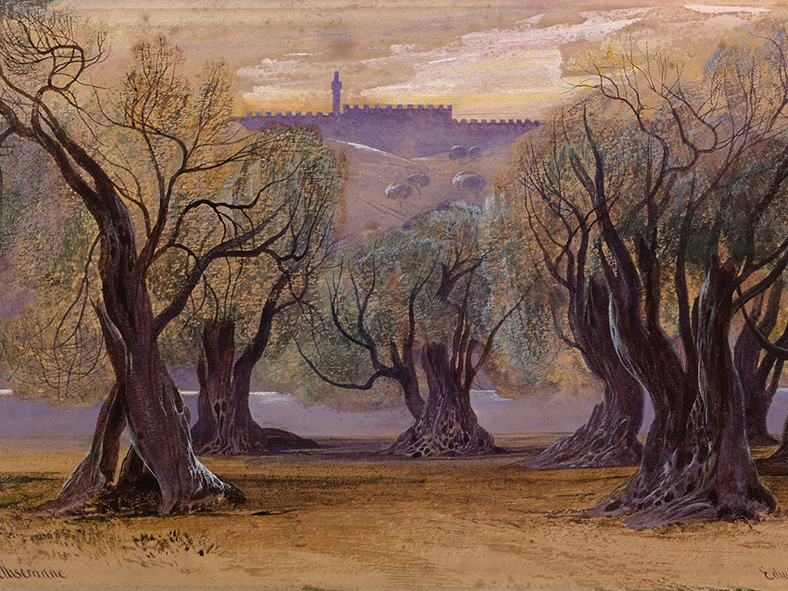
The most thrilling moments, instead, are Philip’s spiritual agonising and a few brief encounters with the supernatural. One day Matthew, the priest, is wandering in Gethsemane, which no longer looks like the garden of Christ’s last night. He sees “a bearded monk in a brown robe, who was humming to himself as he trimmed some candle wicks.” Matthew asks a woman to look for the monk. “There is no one there,” she tells him after searching. Perhaps it’s Christ, Faulks suggests. Then again, perhaps not.
[Further reading: M John Harrison’s catastrophic memory]
Content from our partners



Related
This article appears in the 24 Sep 2026 issue of the New Statesman, A Sense of Power
Join the debate
Subscribe here to comment