
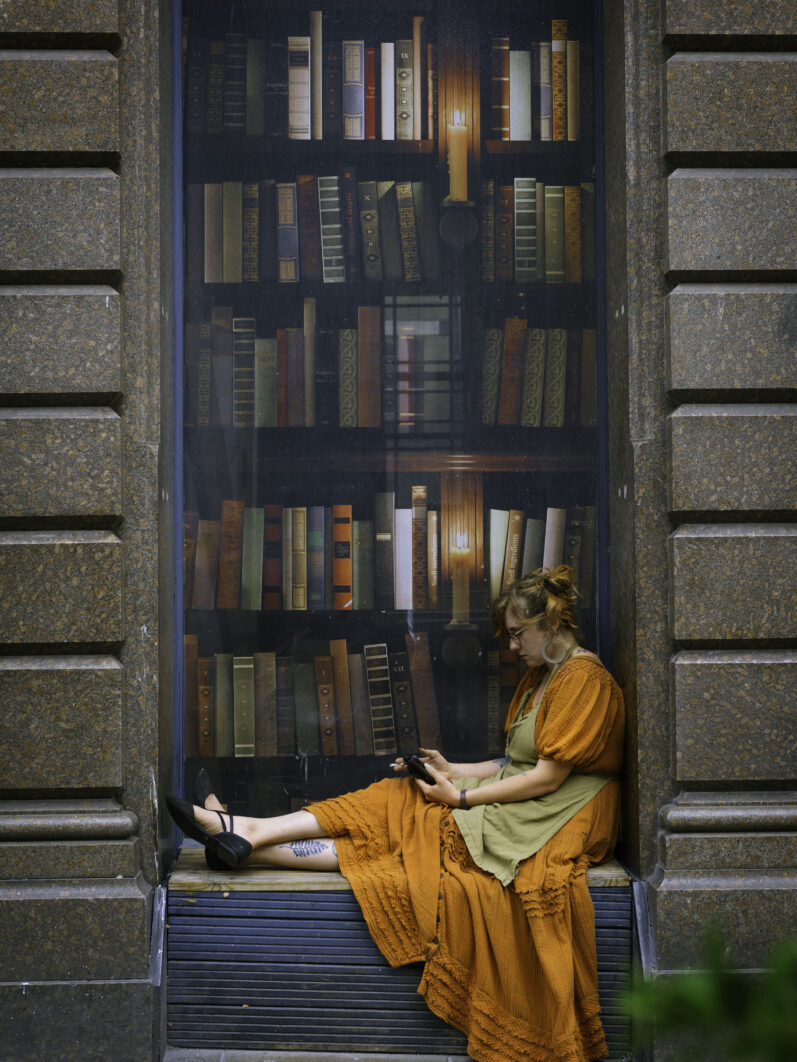
Last week I discovered The Quayside Bookshop in Teignmouth, Devon. In its storybook premises, which mix second-hand and fashionable new books, it’s almost impossible not to buy something. Just before I left its cosy confines, I peered at a shadowed doorway, and the shop’s friendly owner offered to show me the back room. She flicked on the light, and I entered such a cave of sea books that I heard the heaving mid-Atlantic in my head. Tudor Rigging, Kipping’s Elements of Sailmaking, Atlantic Algae, Salvage Law…
This shop has no website but is on Facebook and the website “Caboodle”. There’s a lot of talk of a decline in reading and attention spans, but we word-beasts have survived the five big challenges to focus: the coming of language, of writing, of print, then of screens, then of AI. Shocks like these send us to bookshops the way Spotify has got us buying vinyl and even cassettes again. Malcolm Gladwell says he “dicks around onscreen”, but has to go into a bookshop to unshackle his mind from algorithms.
Independent bookshops, in particular, are flourishing. Although 41 closed in the UK in 2025, 77 opened, so there are now over 400. The US, which with India has the most book readers per capita, has 3,000 indie bookshops, a 70 per cent rise since 2020.
Bookshops have always survived societal changes by morphing themselves. In the era of stuffy backstreet bookshops, Slaney & McKay, the Chelsea indie I worked at in the Eighties, had a “Style and Gender” section which ignored Dewey classification rules to offer works on tattoo, graffiti, high art, punk, leather jackets, Hermann Hesse, gay rights and reincarnation. Regulars included Francis Bacon, Anthony Hopkins, Brian Eno and the Rolling Stones. Bookshop cafés had only just started. The Waterstones Canterbury I managed for 30 years had such a good top-floor café that people from all over the world asked for our secret scone recipe. Tim Waterstone gave me the new Canterbury shop in 1990, and I blush to write that when he asked why I should have such a sought-after four-floor shop, I said: “I’ll set Canterbury on fire”. Well, I did get more than 2,000 authors down for in-person conversations, from Edward Heath to Roy Jenkins, Bonnie Garmus to Sebastian Faulks. I phoned Umberto Eco’s Milan publisher to get him as well; he said no, but he wanted to work in my shop for a day. Someone is out there who unknowingly bought Foucault’s Pendulum from its author: Eco shook his head slightly while making the sale to indicate that he wanted it kept anonymous.

Bookshops are justly romanticised in books, from 84 Charing Cross Road to Days at the Morisaki Bookshop, and in films, from Funny Face in 1957 to Notting Hill in 1999. But they are also crucial bastions of free speech, canaries in the democratic coal mine. NYU academic Andras Kisery says bookshop history is a burgeoning discipline, involving the “theoretical decentring of the author”: cultural history has lopsidedly excluded not only the way booksellers arrange and promote books, but bookshops as meeting places and event spaces: Habermasian fora. Authors are heroic, but they are nothing without the window display, the till, the fearless and often impoverished bookseller.
When Shakespeare died, people couldn’t buy his plays. It was as late as 1623 that Edward Dering bought a Shakespeare First Folio at Blount’s Bookshop for a quid. Unsurprisingly Edward Blount ended up a pauper. Samuel Johnson met James Boswell in a bookshop, William Wilberforce held anti-slavery meetings in Hatchards Piccadilly, The Fabian Society met in Dillons Gower Street, Hermann Hesse and George Orwell were booksellers, Franz Kafka gave just one bookshop talk in Prague which brought them to tears and reset Kafka’s own view of his oeuvre. Shakespeare and Company in Paris got Ulysses published, gave F Scott Fitzgerald till-work, and when the Gestapo told owner Sylvia Beach to close the shop, she simply hid all the books upstairs until liberation day. Christina Foyle was also contemptuous of Hitler, writing to tell him to send her books rather than burn them. He replied that he didn’t want to corrupt a nation he was about to invade. She wrote back (this is all in the unpublished Foyles archive) that she’d bought 1,000 copies of Mein Kampf to line her roof against bomb damage. Meanwhile in Berlin the Polish Jewish bookseller Françoise Frenkel braved arrest and Kristallnacht to run her shop as a hub for free discussion: her memoir was only rediscovered in 2010 in a flea market. City Lights in San Francisco fuelled the Beat Generation. Diana Gravill’s Compendium Books in Camden was chakra-opening in the Eighties; the Guardian said it was the destination shop for “anarchism, poststructuralism, feminism, Buddhism and psychology” and my friend Ingrid insists its energy was so powerful that she spontaneously orgasmed while browsing there. Stonewall simply would not have happened without that wonderful bruiser Craig Rodwell’s pioneer gay bookshop in New York. Gay’s the Word in Bloomsbury survived firebombing and still champions the cause. There are temporary defeats: the status of Samir Mansour’s long-established Gaza bookshop is unknown but the worldwide funding for previous multiple rebuilds implies it will rise again.
Since I started bookselling, the industry has faced the coming of the internet, of Amazon, of chains and of steep parking charges. After Tim Waterstone hired me I relished the early pirate years in London, but unfortunate takeovers followed: WH Smith told us we should be ruled by stockturn and uniformity. HMV said we were “too in love with the product”, banned “recommends” cards as unprofessional and put us in uniforms. Fortunately these days James Daunt has reinstated branch independence. The Blackwell’s and Foyles heirs both asked him to save their historic operations, which he did with wit, economies of scale and his ex-banker acuity. He has even saved Barnes & Noble in the US from its corporate shabbiness, freeing its more than 700 shops to buy locally and letting staff wear jeans. He is Beethoven to Tim Waterstone’s Bach.
And then there is Stravinsky: Robert Topping’s five big shops have enviable stock and industry-leading events, and his magnetic confidence in books makes his shops bustle with all ages. Chain stores get a lot of criticism. But they are accessible havens for the young, for children and mothers, they open in tough towns like Chatham where no indie would dare, and without them publishing would contract drastically and lose much diversity. In 1960s London I got books from WH Smith; independents and Hatchards seemed too forbidding for working-class kids.
Far from dying out, bookshops are in a golden era of reinvention and democratisation – with the help of coffee, stationery, author events and Samuel Beckett’s advice to authors: “find your strangeness” (be more Teignmouth). James Daunt thinks that TikTok is the best thing for bookselling since Harry Potter. Information from social media manipulates us; bookshops free us. When I was working at Waterstones Canterbury recently, I met a schoolgirl from Venice. “Here,” she said, pointing around her, “is like a dream for me.”
[Further reading: Don’t blame AI for bad writing]
Content from our partners



Related
Join the debate
Subscribe here to comment