
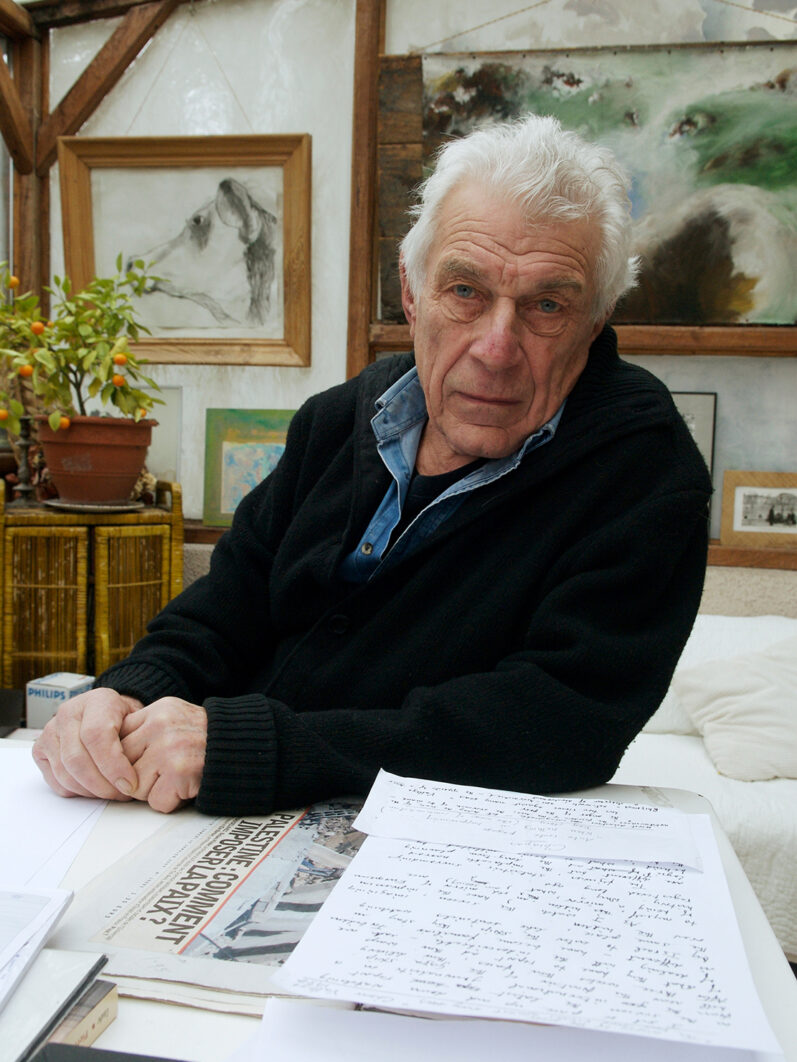
In the 1950s, the New Statesman was a front in the Cold War. The letters pages were filled with both communists, in and out of the party, and their enemies, on and off the payroll of the CIA. It was the magazine’s art critic who started many of the fights: a combustible 20-something ex-painter, John Berger.
This was an era when the Statesman had established the idea, much to the annoyance of the conservative commentator Malcolm Muggeridge, that “to be intelligent is to be Left”. As Frances Stonor Saunders points out in Who Paid the Piper? (1999) – her revelatory book about the CIA’s covert influence on postwar culture – Muggeridge was an associate of British intelligence’s Information Research Department, which clipped up bits of Tribune – which was then further to Labour’s right, and where Orwell had worked – to distribute as a countermeasure. He and his associates kept up a running fire of correspondence in the Statesman’s letters pages too.
In 1951, Berger started writing for both papers. The Statesman proved to be the longer-lived job, and its editor, Kingsley Martin, was instrumental in making Berger a lifelong anti-imperialist; it helped that they spent time together as Berger gave him drawing lessons. Unsigned reviews quickly became columns initialled “JB”, and then a full byline. There was the feeling that the incumbent art critic, the painter Patrick Heron, was starting to bore readers with his “abstruse ruminations” on pictorial space, according to one New Statesman editor, and Berger was hired for his views and temperament, not despite them.
Those views were an idiosyncratic mix of anarchism, romanticism and a Marxism that was too unorthodox for the Communist Party of Great Britain but often further left than those who were in it. It was Berger’s first mentor, the Jewish Hungarian art critic Frederick Antal, who taught him to ask “the very important question of patronage”, and to see “art for art’s sake” as a recent, market-driven fad: in the Florence of the Medici, artists had been skilled craftspeople, working to commission, fitting their style and subject to the job. As an art student in wartime London, Berger had seen Old Masters returned, one at a time, to the National Gallery from safekeeping in the Manod quarry in Wales, to hang alongside works commissioned as part of the war effort. The patron of the future seemed to be the state. 1951 was also the year of the Festival of Britain; a bankrupt country nevertheless built houses, hospitals, nuclear bombs and funded an Arts Council.

But it was also the era when, as Stonor Saunders shows, the CIA became a grant-giving body on the scale of the Rockefeller, Mellon and Carnegie foundations. Through organisations such as the Congress for Cultural Freedom, it tried to be subtle about bankrolling the idea that only in the West was speech free and that art exists for art’s sake. The notoriously anti-intellectual Joseph McCarthy could not be relied upon to see the value of funding left-liberal artists as a bulwark against communism.
Antal argued that an era’s different artistic styles reflect who pays for them. In the 1950s, Berger thought Francis Bacon, Alberto Giacometti and, particularly, abstract expressionists like Jackson Pollock sold well because they gave form to the placeless nihilism of financial markets. But he also rejected the official socialist realism of the Communist Party of the Soviet Union – academically rendered images of Stakhanovite workers achieving a communist future.
What Berger argued for instead was social realism: work made by people who felt themselves a part of the life around them, commissioned by their peers, not their dealers. Work which built on the discoveries of modernists such as Picasso to show modern life. His commonly quoted yardstick was whether a work helped “men to know and claim their social rights”, but the better line comes from a later translation of Brecht he made with his partner Anya Berger: “Give us the world of men as it is,/Made by men and changeable.”
Berger’s greatest success as a critical advocate came in 1955, when he wrote the catalogue preface for an exhibition by the Italian expressionist painter Renato Guttuso, and a dialogue in the Statesman with the critic Benedict Nicolson, agreeing that “art is being re-born”. Guttuso was a committed communist, a partisan against the Nazis, a peer of neorealist filmmakers and a creator of images recognised by the working classes as well as the bourgeoisie – such as with his illustrations for Elizabeth David’s book Italian Food (1954). For Berger, Guttuso’s work had learned from the discoveries of modernism and moved on to something more democratic; art with such a confidence in its community and location that it opened generously to the outside world. He desperately hoped that “kitchen-sink realist” painters such as Derrick Greaves, John Bratby, Edward Middleditch and Jack Smith would become English Guttusos, but they themselves were less keen.
In September 1956, with a piece titled “Exit and Credo?”, Berger announced he was taking a sabbatical from journalism. If his approach had made him “a political propagandist”, he wrote, then “I am proud of it. But my heart and eye have remained those of a painter.” He was starting on his debut novel, A Painter of Our Time, which satirically refracted his experience of the London art world through a fictionalised critic called John, and caricatured his fellow critics Kenneth Clark and David Sylvester. He sent the proposal to his publishers eight days before the Observer published a transcript of Khrushchev’s “Secret Speech” which acknowledged Stalin’s crimes.
That – and the Soviet Union’s decision to invade Hungary in November, just as Berger turned 30 – brought on a nervous collapse and ended his second marriage. In the novel, the fictional John discovers the diaries of his Hungarian artist friend Janos, which end with him heading off to fight. It is left unclear whether he is fighting for or against the Soviet Union, and the novel has aged into a document of socialist ambivalence about how to remember 1956.
British communists such as Eric Hobsbawm and Doris Lessing distanced themselves from the Soviet actions in Hungary by signing an open letter in the New Statesman. Berger did not. But he did surface in the letters pages. In November, he wrote in response to a piece on the Icelandic sagas in which WH Auden had puckishly suggested that the term “social realism” should be “disinfected of all polemical associations”. Berger also could not resist taking issue with the way John Golding, his temporary replacement as art critic, dismissed Guttuso’s politics. The argument rolled on into 1957, by which time Berger complained that “Truth, Christianity, Suez, Budapest and my soul have all been dragged in”. Nevertheless, Berger gave the impression of support for the Soviet line.
A Painter of Our Time was eventually published in 1958, just after Berger made his debut on both the BBC and Independent TV. The most famous response to the book was a review by Stephen Spender in the Observer, comparing it to Goebbels’s novel Michael. Spender happened also to be the editor of Encounter, and apparently the only person who claimed not to know it was a CIA front.
The novel ended up being remaindered. Berger’s suspicions that it had been “virtually, practically suppressed” for political reasons were given fuel by the revelation of Secker & Warburg’s financial connections to the Congress for Cultural Freedom. It is hard to prove anything: my requests for surveillance files on Berger have so far received “neither confirm nor deny” responses, although the critic David Caute found an enigmatic note suggesting Berger’s complex relationship with the Communist Party was “for the sake of his position as art critic of the New Statesman”.
A Painter of Our Time found its audience eventually, and is among the books republished for his centenary this year. But the initial response pushed him to start the next phase of his life in Geneva with the translator Anya Bostock, later Berger. He wanted to become “a European writer”. The European element was partly a frustration with English cultural life, partly an atavistic pull to his own European Jewish heritage. The writer part – as opposed to critic – was an acknowledgement that the realism he’d been seeking in British art was actually happening in literature, drama and cinema.
In Switzerland, he swallowed his pride about the Spender episode and began writing for the Observer. Unlike the Statesman, it let him earn extra by syndicating his articles, paid him more because of ballooning broadsheet advertising budgets, and regularly gave him illustrations for his articles. These were mixed blessings, and Berger quickly developed misgivings about the increasingly glossy media landscape of the 1960s, which became one of the targets of his criticism in his 1972 BBC television series Ways of Seeing.
In 1966 he started writing for the New Society (which was to merge with the New Statesman in 1988), a publication he believed attracted a new audience after the Robbins Report had dramatically expanded higher education; he told the writer Philip O’Connor that only “aunties” still read the Statesman. But it was this magazine that first gave him the space to make his arguments, and those arguments made him famous.
Tom Overton’s John Berger: From Life is published by Allen Lane
[Further reading: The Venice Biennale and the society of the spectacle]
Content from our partners



Related
This article appears in the 05 Nov 2026 issue of the New Statesman, Nigel Farage's bastards
Join the debate
Subscribe here to comment