
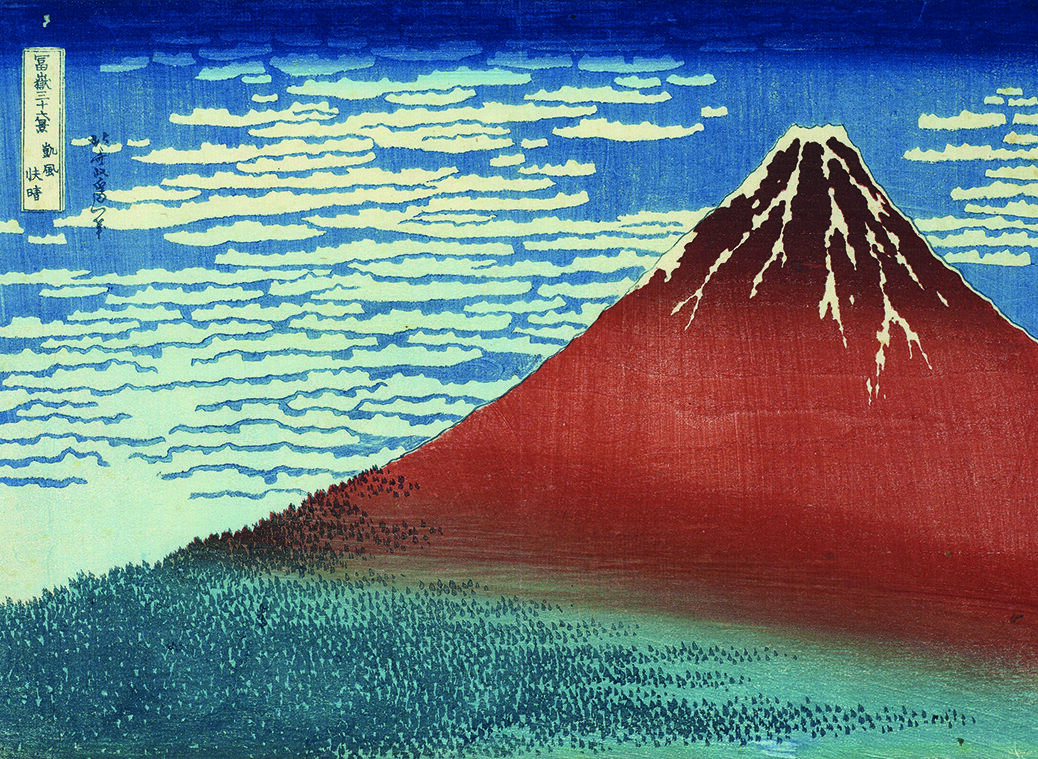
The inventiveness of the great Japanese printmaker Hokusai was never in doubt. Over the course of his long career – he was born in 1760 and died in 1849 – he made more than 30,000 drawings. Famously, he was once summoned to the court of the shogun Ienari to take part in a drawing competition with another, more conventional artist. In front of the bemused and then amused shogun, Hokusai picked up his brush and painted a curving blue line on a piece of paper, then took a chicken, dipped its feet in red paint and chased it across the sheet, its scuttling claws leaving prints. The resulting image, Hokusai said, was a landscape showing the Tatsuta River from above with red maple leaves floating on it. He won the contest.
This gift for invention applied to his personal life too: during his lifetime he went by 30 different names (Hokusai means “north studio”) and moved home 93 times. He was, as this restlessness suggests, never satisfied. When he published three illustrated books under the title One Hundred Views of Mount Fuji, he appended a wordy colophon: it wasn’t until the age of 50, he explained, that he “began producing works that won some reputation, but nothing I did before the age of 70 was worthy of attention”.
The Views were started when he was in his early seventies and fresh into artistic understanding, and he claimed that it wasn’t until he reached 73 that he “began to grasp the structures of birds and beasts, insects and fish, and of the way plants grow”. And the best was still to come: “If I go on trying, I will surely understand them still better by the time I am 86, so that by 90 I will have penetrated to their essential nature. At 100, I may well have a positively divine understanding of them, while at 130, 140 or more I will have reached the stage where every dot and every stroke I paint will be alive. May heaven, which grants long life, give me the chance to prove that this is no lie.” The name he was then working under was “Old Man Crazy to Paint”.
Before he came of age (late) artistically, he had served a near 50-year apprenticeship. In his teens he worked as a wood carver, cutting designs for other artists, before joining the studio of Katsukawa Shunshō, a leading artist of ukiyo-e – “pictures of the floating world”. At the heart of the style were images of everyday entertainments – the courtesans, sumo wrestlers and Kabuki actors who were celebrities in Japanese culture: Hokusai’s first independent prints, of actors, were published when he was 19.

He then expanded the repertoire of ukiyo-e, making innumerable pictures of landscapes, such as Famous Sights of the Eastern Capital and Eight Views of Edo, and scenes of everyday life. Until the arrival of Commodore Perry and his “black ships” in 1853, Japan was a society closed to the outside world; Hokusai’s pictures showed his fellow countrymen some of the wonders of their land.
Hokusai also sought to divert and instruct his audience. In 1814, he published a 15-volume collection of manga, not comic books but containing some 4,000 lively and often humorous sketches of animals, people and folk interactions. They were meant as source material for other artists as well as amusements. Having seen prints and drawing manuals brought to Japan by early Dutch traders (the first of whom arrived in 1598 while later merchants were confined to an island in Nagasaki harbour), Hokusai made 15 “how to draw” books of instruction of his own.
In his Quick Guide to Painting (Ryakuga haya oshie), for example, he showed how the world could be represented using a basis of circles, triangles and squares (in Europe, just a few decades later, Cézanne preached a similar method). “If a mountain is one shaku [ten feet], then a tree must be one foot, a horse an inch, and a man the size of a bean,” he wrote in the introduction. “All things, however, originate in squares and circles. Here Old Hokusai will teach you how to become skilled in paintings of all kinds by using the compass and square.”
The shape that defined his most celebrated set of images, however, was the triangle. In his Thirty-Six Views of Mount Fuji, made circa 1830-33, the conical form of the mountain – in snow, sunshine, storm and rain – appears in every one. In some it is tiny, a mere accessory to the human action in the foreground, in others it is the sole, adamantine focus of interest.
A pristine, early set of prints, plus the additional ten images Hokusai produced as a result of the series’s popularity, is now on show at Dulwich Picture Gallery. Despite the prints being published in their thousands – between 3,000 and 5,000 impressions of the most popular images, each costing the equivalent of a bowl of noodles – there are fewer than ten complete sets known. Because the carved wooden blocks wear down after repeated use, the crisp lines and clear colours of the Dulwich pictures, on loan from the Iuchi Collection in Japan, offers a rare chance to experience one of art’s great projects as Hokusai meant it to be seen.
The lines are clear, the colours vibrant, and Hokusai managed to extract every shade possible from Prussian blue, an imported chemical dye that offered greater longevity and flexibility than indigo (Hokusai’s original intention was to make prints entirely in blue). Human figures feature in all but a handful of the prints and they offer the viewer endless entertainment. Here is a terrapin being led on a lead like a dog; workers mend the roof of a temple; a barge-dweller tips away the water used to wash rice; a traveller loses sheets of paper (and his hat), blown away by a sudden fierce gust of wind; a man beats the soles of his straw shoes to make them more flexible. Tourists point at the mountain, travellers pass by oblivious, pilgrims climb it, farmers work in its shadow.
Fuji is glimpsed through the hoop of a cooper’s giant cask, it is there in the background as a fisherman nets in a turbulent river, and as a mute presence as a group of tourists links arms to measure the circumference of a huge tree. It is there too in the red glow of the dying light and illuminated by flashes of lightning (apocryphally, aged 50, Hokusai was himself struck by lightning). The mountain was a witness to all life around Edo (Tokyo).
The prints don’t just show Hokusai’s brilliance as a designer, but also his role in a communal enterprise. Once he received the commission from the publisher, he drew each image in detail; a block-cutter would place the drawing face down on cherrywood and cut away the excess, leaving the outlines in relief; a new block would be made for each element of the design, which were then inked and printed in sequence on to dampened paper: 200 prints could be made each day. They were so ubiquitous that they were even used to wrap pottery for export, one of the ways they ended up in the hands of artists such as Van Gogh and Degas, who found them revelatory.
One of the 36 views would become among the most famous images in art, The Great Wave off Kanagawa, in which the mountain, the shape and colour of the waves, looks at first like another crest. There are three versions in the exhibition, two of which still have the remains of the pink sky Hokusai initially envisaged. The pigment was made from the safflower and in most prints the colour has faded. Here, however, it gives an elegiac hue to the inundation: those three boats and their hapless oarsmen, it suggests, are unlikely to bob to the surface after the wave has crashed down on them. But live or die, shows Hokusai, the mountain doesn’t care.
Hokusai: Thirty-Six Views of Mount Fuji from the Iuchi Collection
Dulwich Picture Gallery, London SE21
Until 17 January 2027
[Further reading: Romancing the French Riviera]
Content from our partners



Related
This article appears in the 28 Oct 2026 issue of the New Statesman, Bin the Budget
Join the debate
Subscribe here to commentGreat piece from the might Prodg –