
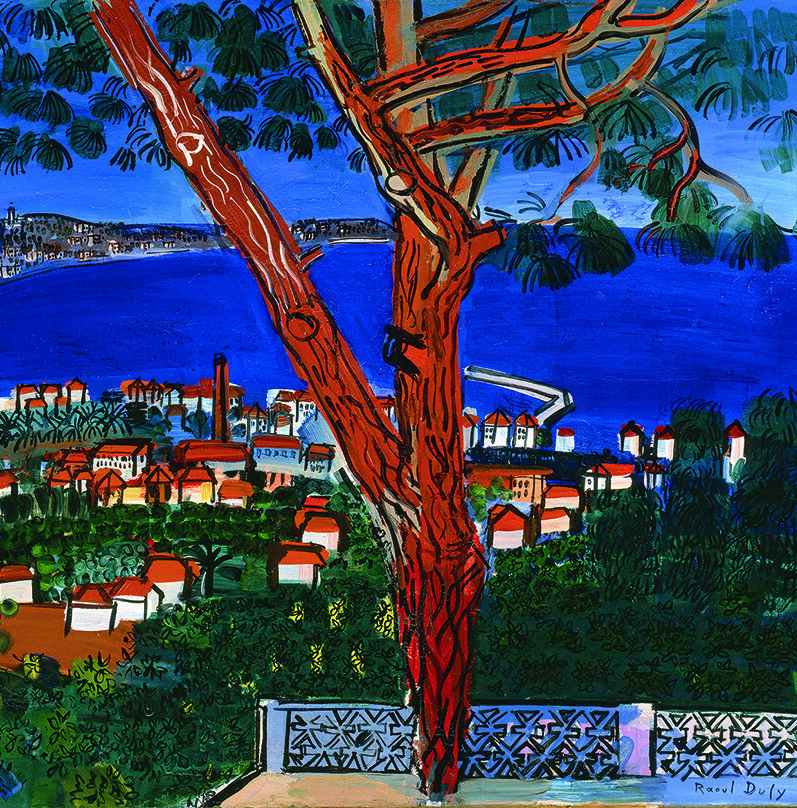
In 1892 Paul Signac helmed his small sailing boat into the harbour of the small port town of Saint-Tropez. On mooring, the wide-eyed painter wrote to his mother: “I have enough here to work for a lifetime,” he declared. “I’ve just discovered happiness.” In this he spoke for many artists of the late 19th century. The coastline between Marseille and Menton was largely untouched and sparsely populated, certainly when compared with France’s northern shores. A man of strong socialist leanings, Signac found in the south not just sunshine and sea but echoes of the Mediterranean’s classical heritage. “The Golden Age is not in the past, it is in the future!” he declared, and this prelapsarian coast with its cliffs, beaches and fishing villages was where this future could be founded.
Other painters headed south for less utopian reasons. Not least because, for the first time, they could get there rapidly. The opening of the Paris–Lyon–Méditerranée railway in the 1860s revealed a region that had long attracted well-heeled foreigners but which, for many French men and women was terra incognita. As Graham Robb noted in The Discovery of France (2007), in 1800, almost a third of the population still lived in near-autonomous “village states” with fewer than 35 inhabitants, almost all of whom had rarely strayed more than 15km from their birthplace. France was both an ancient country and one ripe for exploration.
Painters also went to the southern coast because some of their artistic heroes had. One of the first Frenchmen to take the region as a subject was Claude-Joseph Vernet, who, in 1754, painted the port of Marseille. However, Vernet’s sea- and coastscapes were more often generically “Mediterranean” and imaginative rather than topographical and particular. It wasn’t until Cézanne, a native of Provence, began painting at L’Estaque in the 1860s that the area became an artistic destination.
In the sea and littoral, Cézanne found a topic suited to his near-architectural method of building pictures from diagonal lozenges of paint. And, although his art remained incomprehensible to the public, it was scrutinised by his impressionist friends. Looking for a change from their normal haunts along the Seine valley and Normandy, they followed his example. In 1882 Renoir joined Cézanne at L’Estaque and painted on the cliffside alongside him (and retrieved some of Cézanne’s discarded sketches that had blown among the rocks: “They are beautiful, but he was so intent on others – better ones that he meant to paint – that he forgot these, or threw them away as soon as he had finished them.”) In 1881 Berthe Morisot paid her first visit to Nice; two years later, Monet travelled to the Côte d’Azur (a name coined in 1887 by Stéphen Liégeard in a book of that name) and would go on to make Antibes (“a small, fortified town, baked to a golden crust by the sun,” as he wrote) his own, painting it serially as he was later to do with his haystacks and views of Rouen Cathedral.

Just what Cézanne started is the theme of a joyous and sometimes thrilling exhibition at the Royal Academy, “Painting the French Riviera”. The artists represented amount to a roll-call of late-19th-century and early-20th-century French art – from Monet to Yves Klein – with a dusting of foreigners too, such as Picasso, the German Max Beckmann, the Scot John Duncan Fergusson and the Russian Marc Chagall. The exhibition even includes Alfred Hitchcock, who drew on the glamour of the Riviera in films such asEasy Virtue (1928), which was partially set in Monte Carlo, and To Catch a Thief (1955) with Grace Kelly, who the following year would become Riviera royalty as Princess of Monaco.
If there is a homogeneity to what all the artists found, it is understandable: they recognised what Monet described as the coast’s “fairy-like air” and revelled in its revelation of colour and shape. In fact, most of the painters were willingly duped by the true nature of the south. “One swims in blue air” (Monet again), but in fact, for most of the time, the sunshine there bleaches colour rather than intensifies it, so they substituted the shades they thought they perceived rather than the actual ones they saw.
Nevertheless, all felt what Baudelaire in his poem “L’Invitation au Voyage” called “luxe, calme et volupté” (luxury, peace and pleasure), words which in 1904 became the title of Matisse’s most important early work. For all the heat, the rockiness and desiccated foliage, the coast was an arcadia too. While the geology and fauna suited many styles, from the rapid brushstrokes of the impressionists and the painstaking dots of neo-impressionists (pointillists) such as Georges Seurat and Paul Signac, to the saturated colour of Matisse and André Derain and the classicism of Picasso, a sense of warmth-in-the-bones wellbeing was universal. There is no social commentary about the hardscrabble reality of coastal life in any of their paintings.
Rather there is ease. It is there in Matisse’s study for Luxe, Calme et Volupté, showing a cluster of silent bathing figures gathered on a chromatically vivid shore; in Cézanne’s own group of male bathers of 1890-92, warming in the sun and fresh from the cool of the sea; in Monet’s soft and foliage-rich Villas in Bordighera (1884) showing houses built for the most effortless of lives; and in Pierre Bonnard’s panoramic Landscape at Le Cannet (1928), a picture – almost a tapestry – of lassitude, complete with resting shepherd as a nod to the dreamscapes of Claude Lorrain.
For Picasso, there was more too. In the 1930s in Antibes, the ancient Greek town of Antipolis, he sensed antiquity close to the surface. “It’s strange,” he said, “in Paris I never draw fauns, centaurs or mythological heroes like these… they always seem to live in these parts.” In a series of watercolours he showed classical busts and ruins against the shoreline, a goatherd piping to his animal, fauns disporting themselves against a background of coastal mountains, and doves with a blue bay behind them. Although, almost as a corrective, he also painted paradise lost: Landscape (1965) and Bay of Cannes (1958) are rare landscapes, and they show the high-rises that had taken the place of the fishermen’s cottages he first knew.
Meanwhile, at the age of 19, Yves Klein, who was born in Nice, claimed the Mediterranean sky itself as a signature work. Its blue became an obsession so that: “as I lay on the beach in Nice, I began to hate the birds which occasionally flew in my pure, unclouded blue sky, because they tried to bore holes in my greatest and most beautiful work of art”. Later, when he coated his female models in his patented shade – IKB, International Klein Blue – and made them roll around on canvases, the marks they left, such as in Untitled Anthropometry (ANT, 29) (1960), resemble mermaids. It was as though he was recalling-imagining such creatures as he swam in the Baie des Anges.
The most exciting works in the exhibition, however, are those made by Matisse, Derain and Georges Braque in the first decade of the 20th century. It was in 1905 that Matisse went to Collioure, a fishing village near the border with Spain, and invited Derain to join him. Over the course of nine weeks they reinvented genteel neo-impressionist dots as bold stabs of paint and gave new importance to colour itself. “Colour for me is a force,” Matisse said. “When I apply green, that does not mean grass. When I apply blue, that does not mean sky.” It meant instead sensation as expressed in red sand, purple and green waves, vermillion shadows. When the two men showed their work at the Salon, startled critics called them les fauves (“wild beasts”).
Braque was so taken by this new method that he too adopted it briefly, producing a series of kaleidoscopic landscapes comprising patches of pure, unmodulated colour. These were a form of automatic painting, a rapid transition from eye to paint tube to brush to canvas, with no stepping back to consider the effect. It makes his transition to cubism – low-toned, deeply theoretical, structured – just a couple of years later all the more of a leap. The paintings he made around La Ciotat, between Marseille and Toulon, in 1906-07 reveal Braque to have been an unexpected colourist, and in holiday mood.
This is, at heart, an exhibition simply about pleasure. Almost every picture here reflects F Scott Fitzgerald’s ecstatic comment that: “When your eyes first fall upon the Mediterranean, you know at once why it was here that man first stood erect and stretched out his arms toward the sun.” Fitzgerald was one of those responsible for popularising the South of France and therefore complicit in destroying the thing he loved. It lives on, however, in paintings.
The pictures Renoir made with Cézanne in 1882 were just the first emanations of what was to be a long relationship with the southern coastline. He became a frequent visitor, not just for the artistic possibilities but also because the climate ameliorated the arthritis which would become so severe that, later in life, he needed an assistant to wedge his paintbrush between his twisted fingers before he could work, hands clasped together. In 1908, he bought a seven-acre farm at Cagnes-sur-Mer near Nice and built a large modern house there where he lived with his wife, Aline.
By happy coincidence, a new exhibition, “Renoir and Love”, has just opened at the National Gallery. It centres on the people who mattered to him, rather than the places. Unusually for an impressionist, love in its many forms – romantic, sexual, familial, friendship – was a recurring motif for Renoir. While all of the group sought to reflect the modern world in their paintings, he was the only one to do so not through landscapes and cityscapes, or café and theatre scenes (although he painted those too) but through observing contemporary human interactions.
What Renoir recognised was that in and around late-19th-century Paris, intimacy was no longer confined to the domestic realm but was everywhere in public. He had only to look and there was a small drama taking place. He turned these into genre paintings – multi-figure compositions of daily life, often depicted on a large scale and containing the likenesses of people he knew but not as traditional portraits. Between 1864 and 1885, the span of the exhibition, he painted 397 works, 161 of which fall into this category. They were rarely commissioned but intended for general sale as reflections of the France their purchasers could see for themselves.
This was not a stable time; the Franco-Prussian war of 1870-71 and the Commune with the bloody repression that followed, were existential moments. Renoir’s paintings were a distraction and proof that the verities of human existence continued regardless. “I know it’s hard to get people to admit that a painting can be a great painting and still be happy,” was his immodest but heartfelt claim.
Later in life, Renoir said that “when you want to paint a milieu, you have to… get under the skin of your characters”, and this is what he did. The people in his pictures are his familiars – fellow painters, critics and writers, models and family members. The cast that peoples his celebrated Dance at the Moulin de la Galette (1876), for example, is not a group of imagined Parisians but includes the art critic Georges Rivière, the artist Paul Lhote and the Cuban painter Don Pedro Vidal de Solares y Cardenas who is dancing with a model named Margot. The intimacy, camaraderie and flirtatiousness in the painting were there in real life too. Berthe Morisot’s mother warned her daughter about such casual gathering places: “If you go there alone, you’ll come back with at least one other person.”
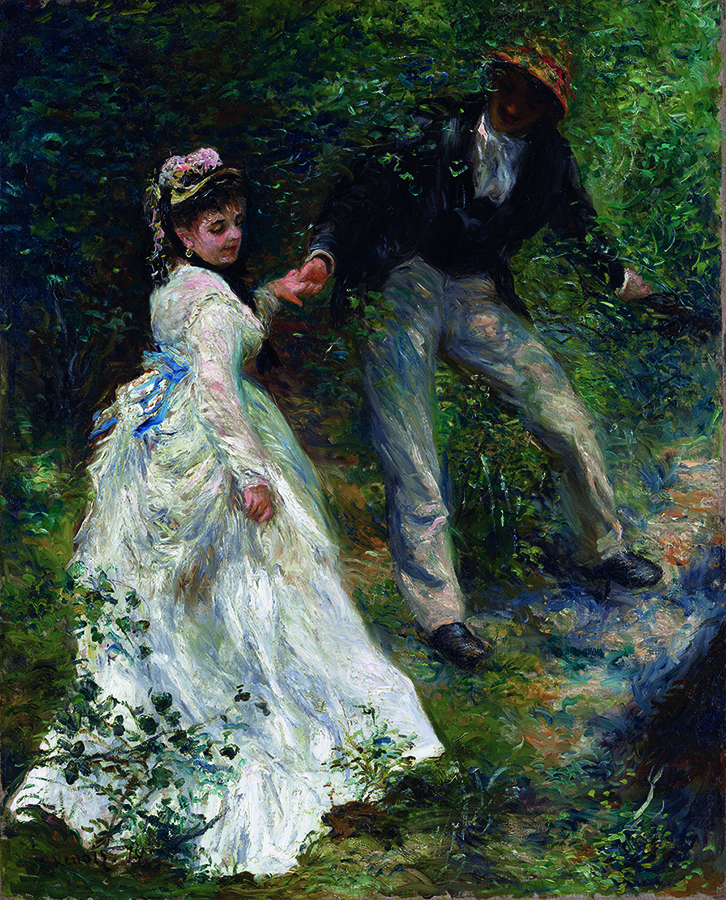
Part of Renoir’s inspiration came from the 18th-century painter Jean-Antoine Watteau (1684-1721) whose fêtes galantes – scenes of gentle dalliance in bucolic settings – gave him a template. Echoes can be felt in paintings such asThe Promenade (1870) in which a man takes the hand of a young woman to help her along an overgrown path. There is a charge to the scene: the couple are clearly intimates and for all the hint of coyness in the woman’s face what might or might not happen in the undergrowth is clearly consensual.
The model for the woman was the 22-year-old Lise Tréhot, who was by then Renoir’s established lover and mother to a son who had been given away at birth and died in a foundling hospital. At the time of the painting, Lise was pregnant with their daughter Jeanne: Renoir would keep his parentage secret until his death. Renoir and Lise’s union libre – unmarried but cohabiting – was far from unusual in this circle; Manet, Cézanne, Monet, Pissarro and Sisley all had children with their models.
And in 1879 he took up with Aline Charigot, a seamstress (who also did Monet’s laundry) 18 years his junior. Renoir refused to acknowledge that he lived with her until they finally married in 1890, five years after the birth of their eldest son, Pierre (and he never told her of his children with Lise). Aline and Pierre are the subject of his ineffably tender painting Motherhood (1885), one of a series on the theme begun that year, in which she sits on a log suckling the infant and looking out at the painter, her lover. As well as being a hidden family portrait, the picture is also Renoir’s homage to Raphael’s Madonnas which he had encountered in 1881 on a trip to Florence.
The pleasure he took in Aline is also evident in his paintings of dancers made in 1883. In a series of full-lengths he showed women mid-twirl; one, Dance in the Country, shows the round-faced Aline. (She would grow ever plumper, leading the painter to write to her gracelessly: “I cannot imagine a radical solution for reducing the size of your waist.” He, meanwhile, would grow ever thinner, becoming so diminished that he couldn’t sit for long because, as he wrote, “the bones pierce the skin”.) She was a natural dancer, he was not, but he enjoyed watching her being pirouetted in the arms of another man. To complicate matters, one of the other paintings, Dance in the City, shows the painter Suzanne Valadon, who may also have been his lover.
However, moral murkiness and bourgeois judgements were not his theme. The paintings in this exhibition, as with the Royal Academy show, were meant to transmit bonhomie, pleasure, contentment and lightness of spirit. “There are enough annoying things in life,” Renoir wrote, “for us not to make more of them.” Whether Lise, Aline, Suzanne and others agreed with such a blithe declaration is not known.
“Painting the French Riviera” is at the Royal Academy of Arts, London W1, until 31 January 2027. “Renoir and Love” is at the National Gallery, London WC2, until 31 January 2027
[Further reading: The return of orientalism]
Content from our partners



Related
This article appears in the 07 Oct 2026 issue of the New Statesman, The Suspicious Relationship
Join the debate
Subscribe here to comment