
Outside the sleek midcentury Nordic Pavilion in the centre of the Giardini della Biennale, a severed head made of raw untreated bronze is supported by a tripod of reinforced steel piles – like the stakes used to brace Venice’s trees against the slow subsidence of the lagoon – while wooden spikes shoot from its closed eyes. The gargantuan face recalls the stoic anguish of the mannerist sculptures adorning the city’s many churches. Inside the pavilion, the tiled floor has been torn up to accommodate a colossal body in clay – around six tonnes of it – propped up by a maze of scaffolding. Over the course of this year’s Biennale, which runs until November, the surface of this work by the London-based Finnish sculptor Benjamin Orlow will continue to dry before slowly cracking and disintegrating. It will be the supports themselves that ultimately destroy it. “I find myself torn between the idea of gradual collapse, inherent in the way the work is constructed,” Orlow told me, “and the personal bond I’ve formed with the character that has emerged, which I feel a need to protect and care for.” It’s a compelling metaphor for the state of the Biennale itself.
The Biennale edifice has been on insecure ground for the past year. This edition’s artistic director, the Swiss-Cameroonian curator Koyo Kouoh, died in May 2025 at the age of 57, just days before she was due to announce her organising vision. That vision, “In Minor Keys”, proposed an exhibition attuned to quieter tonalities, built around what Kouoh called “intimacy” and “poetic persistence” – always in danger of being drowned out by the pre-pre-opening racket. A little over a week before the Biennale opened its gates to the armada of water buses carrying the global art world and its influencers-elect, the five-member international jury resigned en masse, objecting to states whose leaders face charges of crimes against humanity. Russia and Israel were effectively excluded from competition.
It is said that one must separate the art from the artist, and so the pavilion from its nation’s foreign policy (many countries have their own permanent buildings for exhibition). But on aesthetic grounds alone, neither of the condemned pavilions were at risk of winning the Golden Lion. During opening week, by the time I got to the Russian Pavilion it was ringed by the cigarette smoke of 20 idle carabinieri officers stationed against an incursion by feminist activist groups Pussy Riot and Femen. The exterior offered little except a shallow film about flowers on upturned flatscreens. The Israeli Pavilion in the Giardini left a note on the window citing the need for renovation (whatever it was could not have been fixed in the last 18 months, apparently). The Israeli presence fled from protesters to the fortified Arsenale, where sculptor Belu-Simion Fainaru put together an installation that had the look – and significance – of rain tapping into a small muddy lake. The US Pavilion fared little better: visitors drifted through the works of Mexico-based sculptor Alma Allen with bewilderment. When an affable Midwesterner asked what he was looking at, all the hands-in-pockets invigilator could offer was that “they are, um, about mystery”.
When the great powers arrived in Venice, they had surprisingly little to say. The most talked about national pavilion this year was Austrian, combining a tank of sterilised urine, an explosive sewage treatment plant, and a jet-ski on which a naked woman undertakes endless laps of a water tank, every hour ascending a rope into a large bell, somersaulting upside down, and becoming the clapper. In “Seaworld Venice” – its title playing on the overtourism that throttles the lagoon every summer – women have replaced the whales. The installation imagines how capitalism, in the guise of a theme park, would continue selling tickets once Venice had flooded and raw sewage seeped into every facet. With her background in avant-garde theatre, the installation’s creator, Florentina Holzinger, is the heir to the Viennese actionists – their self-mutilations and blood-soaked rituals. Their pursuit of pain and fortitude in art forced bourgeois audiences in Austria to ask what separates witnessing from complicity. It’s a question we’re still asking.

As thousands queued for hours in the midday heat to witness naked women performing wincingly difficult acrobatics and cleaning up a routine sewage spill, I wondered whether the rows and rows of smartphones raised like semaphores were capturing the right message. The 20th-century critic Guy Debord argued that in the society of the spectacle, lived experience is perpetually displaced by its own image. Holzinger had made a work so visceral, so bodily, that it resisted that displacement – then watched the audience immediately attempt it anyway.
To look into the eyes of the three harnessed performers ascending and descending a rotating weathervane (and to point our phone cameras to them, too) is to come face to face with the victims downstream of our pleasures and our consumption, unmediated through screens. We have all become accustomed to genocides, ecological catastrophes and sexual violence playing out on our social media feeds; within this context, it feels only natural that our instinct is to reach for our phones, to place the comfort of a screen between ourselves and the violence we are witnessing.
Amid all the spectacle and bodily fluids, a sombre elegiac note sounded across several pavilions, and not only because of Kouoh’s death. Henrike Naumann, who died in February aged 41, left behind a spectacular immersive installation at the German Pavilion: an “archaeological prehistory of the present”, as she described it, filled with the personal everyday aesthetics of the German Democratic Republic, objects splayed and often sawn in half across the walls. Gabrielle Goliath’s Elegy – formerly the official South African Pavilion representation before the country’s culture minister, Gayton McKenzie, cancelled it for commemorating the Palestinian poet Hiba Abu Nada, who was killed in her home in the Gaza Strip by an Israeli airstrike in October 2023 – is now beautifully staged offsite as a kind of sonic vigil at Chiesa di Sant’Antonin in Venice’s Castello district. In the video work, seven women singers sustain a single haunting tone for an hour: as one voice falters, another takes up the note, passing it between them in a continuous cycle of shared breath. It says much about the censorship and climate of permissibility of our time that a pavilion commemorating a murdered 32-year-old poet through an act of collective, sustained mourning was deemed too political to show, while a degrading spectacle of female endurance was the talk of the Giardini. Our society, it turns out, can tolerate abjection more readily than it can tolerate grief, provided grief is for the wrong kind of victim.
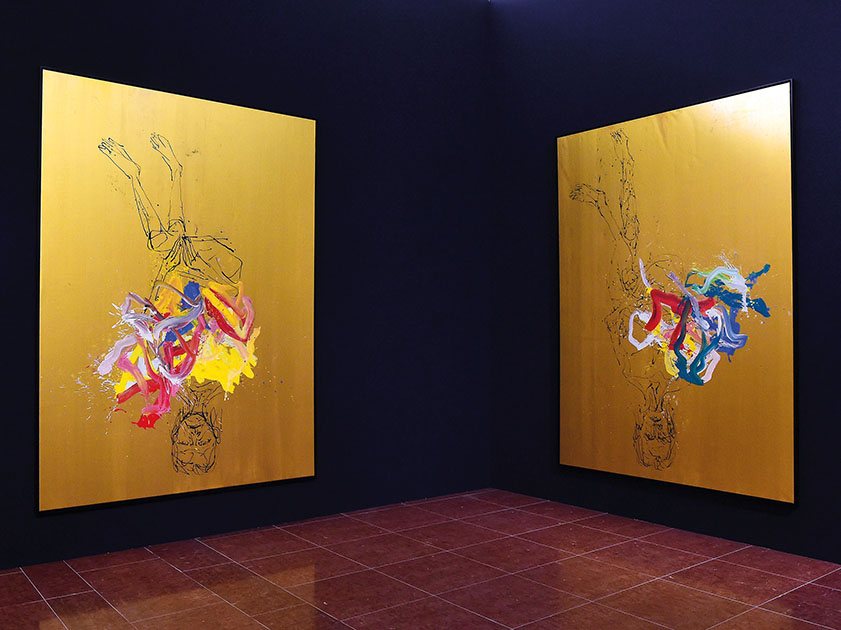
But the most prominent elegy was for Georg Baselitz, who died days before the opening of his “Eroi d’Oro” (“Heroes of Gold”) exhibition at the Fondazione Giorgio Cini. The final works of the octogenarian German painter – inverted and thin-lined portraits of himself and his wife, Elke, on gilded golden backgrounds that recall the flatness of Renaissance artist Stefan Lochner – were a point of calm in the storm. The best works this year were those that offered a sense of history or a warning for the future. With Venice heading underwater, and so much of what was shown here either mourning the recent dead or imagining futures already foreclosed, this was a Biennale that had the decency, finally, to look like what it is: a magnificent ruin. For the first time, it felt like no one was pretending otherwise.
The 61st Venice Biennale runs until 22 November
[Further reading: Nigel Farage’s oyster politics]
Content from our partners



Related

This article appears in the 10 Sep 2026 issue of the New Statesman, The World According To Ed
Join the debate
Subscribe here to comment