
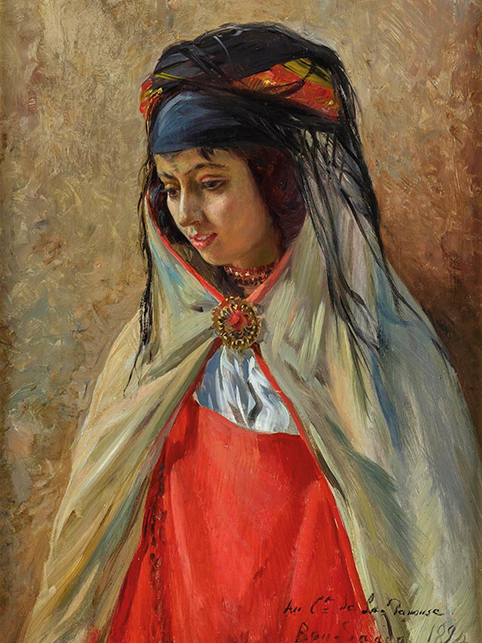
Orientalism is having a moment. In June, “Orientalism: Between Fact and Fantasy” opened at the Metropolitan Museum of Art, a comprehensive exhibition dedicated to the genre at the New York institution. Closer to home, Leighton House Museum has celebrated its centenary with an exhibition on Lord Leighton’s Arab Hall, an extension to his Kensington house bedecked in intricate Damascene, Turkish and Iranian tiles collected by the Victorian artist on his travels, and others reproduced by the ceramic artist William de Morgan. In “Beyond the Threshold” earlier this spring, Colnaghi Gallery in London considered the ways in which entrances, archways, doors, and other liminal spaces recur as compositional devices in orientalist paintings – points of entry which serve as literal junctures of cultural intersection, where the European painter, on his travels through souks and city gates, might have encountered his subjects.
Darnley Fine Art, a little gallery on London’s Cecil Court, now presents “Visions of the Orient”, an exhibition of orientalist paintings that spans a remarkable number of schools of the genre: the Austrian, the Italian, the French, the British, the Belgian, the German and the Spanish. But it was the French school, the exhibition suggests, led by masters such as Eugène Delacroix, Jean-Léon Gérôme, and Jean-Auguste-Dominique Ingres that trafficked in the fantastical tropes indicative in the seminal critiques of the genre in the late 1970s and 1980s by the art historian Linda Nochlin and, most memorably, by the postcolonial theorist Edward Said. The English, on the other hand, were seemingly more interested in faithful renditions of what they saw: architecture, tribal life, desert landscapes. When producing imagined scenes, they were reliant on accounts from inside the harem. If the French fetishised the sensational and sensuous, the English were apparently sincere documentarians beholden to a strict Victorian moral code.
It is to the work of a French artist, Jean-Joseph Benjamin-Constant, that significant wallspace at the gallery has been given: Scene of a Massacre, a fictitious tableau of a victorious sultan, having suppressed an uprising, surveying the corpses of rebellious subjects. Beginning in 1870, Benjamin-Constant spent considerable time in Morocco, where he collected artefacts for later use in his paintings. And the French school may be regarded as the first and most significant school of orientalist art to emerge.
The dawn of 19th-century orientalist art is conventionally traced to the French invasion of Egypt in 1798, memorialised in Gérôme’s Bonaparte Before the Sphinx (circa 1863-86) and Napoleon in Cairo (circa 1863-68). In the former the artist imagined the emperor astride an Arabian war horse in front of the cityscape with the Sphinx in the distance. In bringing with him scholars, scientists, artists and engineers – an undertaking that resulted in the multivolume, encyclopedic work Description de l’Égypte (1809-29) – Napoleon’s colonial venture marked “the beginning of the hegemonic Western gaze over the east,” writes the art historian and Met curator Maryam Ekhtiar. In the decades following 1798, advances in transportation and imperialist expansion in the region facilitated travel to destinations eastward, with the former Arab dominion of Andalusia in southern Spain often a first port of call on a tour of the “Orient”. Further afield lay North Africa, the Ottoman empire and Iran. Artists, some accompanying military or scientific expeditions, created studies that they would expand upon returning to their studios, or drew on photographs, a nascent technology, as an aides-memoire. Other artists would never travel to the region, instead utilising collected artefacts or travellers’ souvenirs to conceive scenes that would tantalise patrons, who felt in these works a nostalgia for pre-industrial life – a quaintness that no longer existed in imperial metropoles choked by factory smoke.

In revisiting orientalist painting, exhibitions seek to complicate our understanding of the movement. While it’s true that they embodied an exotic fantasy of the east, these presentations suggest orientalist works represent a broader phemomenon still worthy of consideration: their aesthetic reach went beyond artists and collectors, influencing a larger European and American audience for whom Islamic art and design principles filtered into domestic interiors – courtesy of the English textile designer William Morris, who described Persia as a “holy land”, and designer Owen Jones, whose fascination with the Alhambra resulted in him recreating elements of it for the interiors of the Crystal Palace during the Great Exhibition in 1851. (Jones’s racialised hierarchy of art and design from the Islamic world placed Persians at the top.)
And what of the local interlocutors who appealed to the sensibilities of insatiable foreign buyers, or developed their own take on the orientalist style? At world fairs, Islamic nations contributed ornate and decadent pavilions, such as at the 1873 exposition in Vienna, at which the Ottoman government presented its crown jewels. One component of Ekhtiar and her fellow curators’ treatment of the genre is their focus on the Ottoman painter Osman Hamdi Bey, whose “insider” perspective and mastery of European technique complicates narratives of a one-way extraction. Trained under Gustave Boulanger in Paris, Hamdi made works that veered away from eroticised representations of women in the imagined harem and instead depicted Ottoman female figures as intellectual and sophisticated. The proverbial gaze, or a more noble version of it, could be produced, and emerge, from within.
There seems to be a cyclical cadence to the recurrence of exhibitions of orientalist art. Is it coincidental that these presentations are often simultaneous with interventions in the Middle East? Or, rather than any cynical effort on the parts of museums to capitalise on the news, is it a testament to the long-running, constant nature of these interventions, permanently embedding the Middle East in the Western imagination? In 2008, as the United States military and its Nato counterparts continued their campaigns in Iraq and Afghanistan, Tate Britain presented “The Lure of the East”, an exhibition focused on British orientalist paintings by John Frederick Lewis and Edward Lear, among others.
The orientalist gaze has hardly subsided since; it has merely revitalised itself with a new wellspring of tropes. If the old orientalists were drawn to hyper-realistic portrayals of imagined custom, or fantasies of harems or battlefields spilled with the blood of their local subjects, the new orientalists, active in the creation of digital imagery, envision petroleum-slick shopping malls and skyscrapers constructed at an intense pace, an aesthetic that artists Sophia Al Maria and Fatima Al Qadiri have described as “Gulf Futurism”. These are the AI-generated images of Dubai-style rivieras built over mass graves and rubble, and brown locals (or expatriate workers recruited from South and South-East Asia) pressed into the service of the Western tourist. Elsewhere, the original works end up serving new purposes. In a 2019 campaign advert, the far-right Alternative for Germany party (AfD, recently triumphant in Saxony-Anhalt’s state elections) made use of Gérôme’s The Slave Market (1866), emblazoned with the words: “So That Europe Won’t Become Eurabia.” The painting depicts men in traditional garb surrounding a fair-skinned, nude Abyssinian woman in an imagined North African slave-market setting, inspecting her teeth.
In the catalogue for “Visions of the Orient”, the gallery director Adrian Pett writes, “With the lamentable conflict in the Middle East a regular feature of current news, it is of the utmost importance to be reminded of the joy, happiness, beauty and liveliness of this part of the world.” It’s striking, Pett notes, how cohesive the people and societies in these images were, and it’s a subject of curiosity what it might have been like for these European painters (and their compatriots in imperial service) to “pack up and head so far from home, ready for a marvellous adventure to gain fame and fortune”.
One element of the appeal of these works, to their original European and American audience, was the bygone quality of the places they represented, unsullied by industrialisation. It is worth asking what their appeal is now, as they reappear on the walls of contemporary museums or as items for auction through galleries. There is of course the academic focus on their technical achievements or the historical context in which they circulated. But beyond that, and even with regard to those works deemed innocuous and ethnographic, do they represent something like the obverse of our present moment? Do they provide a kind of soothing absolution to the Western viewer? Does the idyllic world depicted mislead us into thinking of a Middle East yet untouched by war or genocide? Look at how beautiful they were, a prospective buyer or museum-goer in New York or London might sympathetically tut at Frederick Goodall’s joyful depiction of an Egyptian marriage procession, complete with its retinue of musicians and dancers, the camel decorated with vibrant bells. It is as though culpability lies with the native other; the Western bombs, drones and mapmaking that have been the undoing of an entire region are invisible. What, then, does it mean for us still to be looking?
“Visions of the Orient” is at Darnley Fine Art until 3 October
[Further reading: The Venice Biennale and the society of the spectacle]
Content from our partners



Related
This article appears in the 24 Sep 2026 issue of the New Statesman, A Sense of Power
Join the debate
Subscribe here to comment