
Do you really like watching the news? Do you most like watching when the news is bad news? Do you miss those characters from the news who have been dropped over the past few series? These range from the obvious (Nicola Sturgeon, Michael Gove, Penny Mordaunt) to the half-remembered (Christopher Steele, the former intelligence officer who compiled an compromising dossier about Donald Trump; Kim Darroch, the former ambassador to the US) to certain individuals who have dropped out of the Trivial Pursuit question box altogether (former leader of Scottish Labour Jim Murphy? Former co-chairman of the Conservative Party Sayeeda Warsi?).
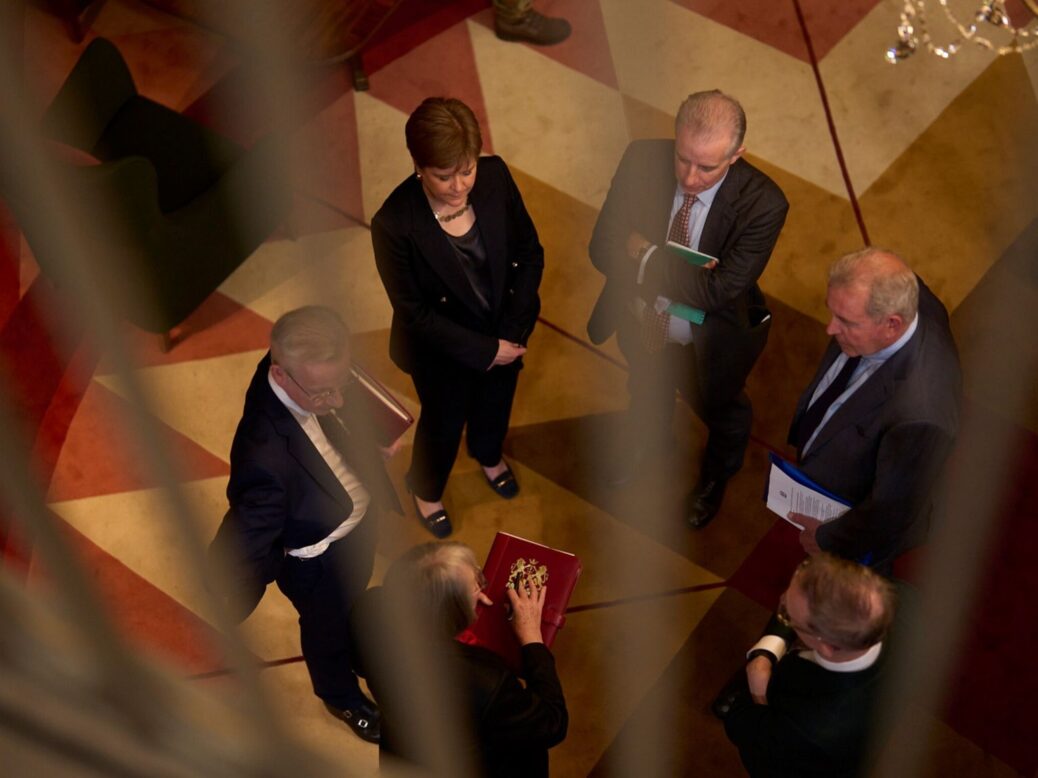
If you answered yes to all three questions – and it really must be all three; I can’t really imagine anyone normal getting on with it – then you’ll love The Wargame. This is a rather strange but not totally unenjoyable series on Sky, in which these veterans of statecraft play recreate a diplomatic-political-military crisis in what the broadcasters are calling a “constructed documentary”. They play themselves, but in more senior roles than they ever attained in life – Michael Gove is prime minister, which must hurt, and which means that this series gives us the closest insight possible into what a Spectator editorial conference must look like (quite a loose chairmanship style, with most contributions met with an inquisitive grunt).
We begin in a mock-up of a Cobra meeting, but in a much nicer location than No 10, a giant boardroom where the entire cabinet is ring-lit and made-up. They quickly fill Gove in: two RAF pilots have been assassinated outside a pub, the Yorkshire ambulance service has been cyber-attacked and a Russian ship is lingering suspiciously over some undersea cables just off Orkney. Could it be Russia? (It is Russia.) How should Britain respond? (Cautiously, but firmly.) The cabinet chews over these questions in a stylised flurry of quite bad serious acting, hanging pens out of their mouths, clicking ballpoints, worrying their chins and temples, and turning their heads to camera.
The path they choose is escalatory, and Britain quickly finds itself on a war footing (the cabinet ministers never change their clothes, giving us the strange sense that this all takes places over a matter of hours). Most of the action is confined to the cabinet room, with a few diversions to ante-rooms for underlings to brief upperlings. But we also get drone shots of housing estates and wheat fields to remind us that the nation is at stake, as well as, more oddly, fake TikToks from concerned citizens harassed by screeching government phone alerts, who vlog their way through the crisis. (“At least there’s no work in the morning – I mean that’s an awful thing to say, do you know what I mean?” says one, after a stay-at-home order is issued, which at least feels realistic.) But despite these attempts to tense up the context, the series can’t help but seeming faintly ridiculous and oddly camp. There’s a touch of Austin Powers when Murphy, the “foreign secretary”, phones up Russia, and we know Russia answers because some guy who may as well be called “Ivan the Accented” picks up and wheezes down the line. And when Darroch and Steele withdraw to a sort-of sitting room to assess the situation, they can’t help but look like two retirees out of Le Carré at a Pall Mall club (which, I suppose, is what they are).

Some cultural products feel like they were designed as gifts to future historians, and some distant Alwyn Turner will thank the producers of The Wargame. The geopolitical fears of the decade are all here. Anthony Scaramucci, playing the American secretary of state, tells Britain: “You have to accept your middle-power status, whether you like it or not.” The general staff panic over our fleet, our frigate shortage and our depleted stockpile of cruise missiles. Abandoned by the US, Britain is forced to sink its differences with Europe in order to protect itself. In the end, the programme suggests, Britain at war may look rather like Britain during Covid, with yellow warning billboards screaming instructions from the pavement.
These are all stark conclusions about the present state of the country. But I feel like I could have got most of them from watching the news.
[Further reading: Rupert Lowe confronts, dissects and destroys]
Content from our partners


Related

This article appears in the 24 Sep 2026 issue of the New Statesman, A Sense of Power
Join the debate
Subscribe here to commentHaving just watched this I am extremely thankful that Michael Gove did not become PM.