
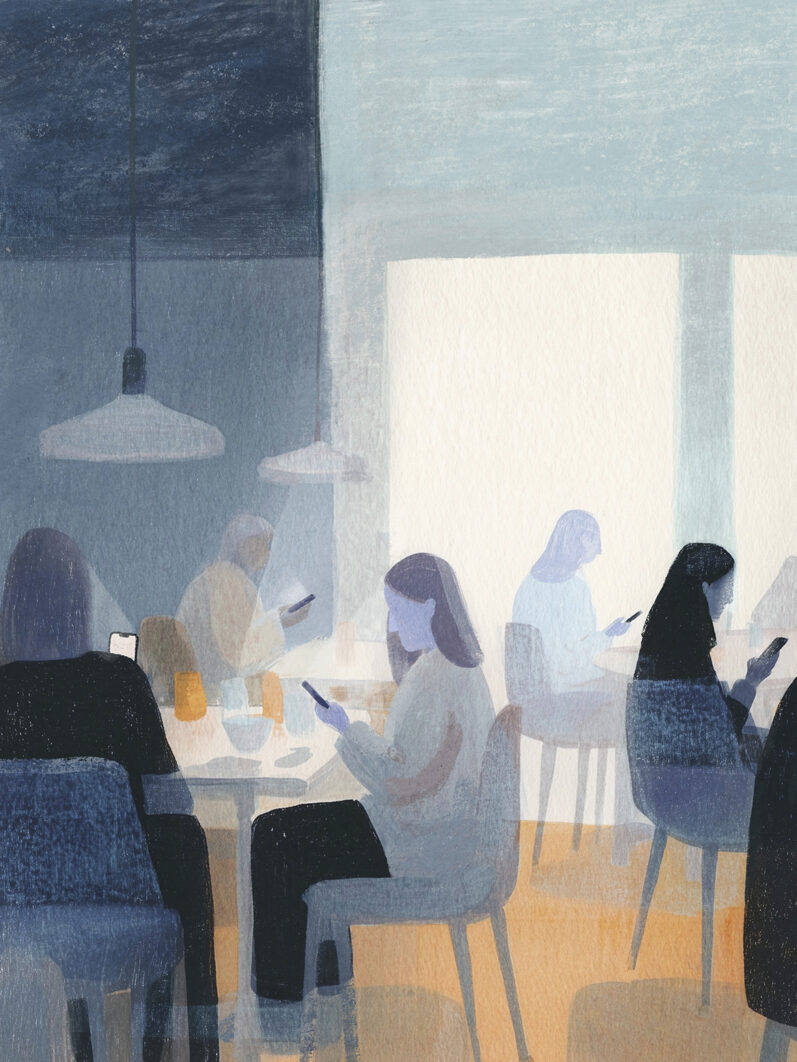
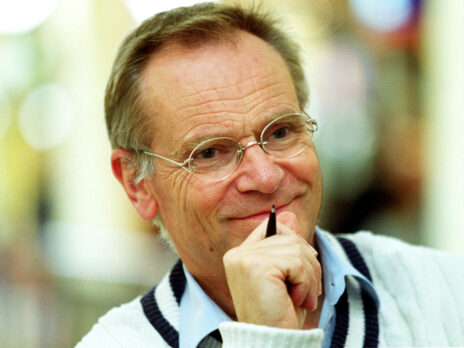
James Marriott is one of the most successful British journalists of his generation. A literary critic, cultural essayist and weekly columnist for The Times, he is known for his wit, independent mind and literary sensitivity. Born and raised in the northeast of England and educated at Oxford, he has become a fixture of intelligentsia chatter and debate, especially online and not always pleasant.
I first got to know James when he was working as a bookseller, just before he had begun to make a name for himself as a reviewer. In the years since I have seen him consume books like no one else I know, or perhaps the books have been consuming him; he gets through them like cigarettes, and in such quantities they may well be a vice. These are the reading habits of a Grub Street man of letters; fortunately, he also has the table-talk to suit.
In recent years, from his perch in literary London, he has observed with alarm what he sees as the diminishing value of literature and reading in contemporary society, and has decided that he must intervene. Fittingly, this has taken the form of a book. The New Dark Ages: The End of Reading and the Dawn of a Post-Literate Society has just come out and – happily contradicting its author’s pessimistic worldview – it is now a certified bestseller.
He joined me on The New Society podcast this week to talk, as we so often do, about why the end is nigh…

Tanjil Rashid: The first dark age led to the contraction of literacy to a small clerical elite – monks in their little islands of literacy – while the masses apparently lost the culture of reading that apparently had flourished in the Roman world. Is this what you’re saying we’re living through now?
James Marriott: If I’m being rhetorical, perhaps. Within the book itself, I tried to play it down a little bit. Academics get offended when you harp on too much about the Dark Ages being a time of illiteracy and lack of culture because people argue that different sorts of arts flourished and classical manuscripts are being passed down in libraries. But I think the idea of a Dark Age has hopefully a kind of cultural resonance.
People did write fewer books; people read many fewer books. I think even the most optimistic historian of the Middle Ages would acknowledge that literacy fell in the early Middle Ages. As historians will tell you, the Dark Ages were an invention of Enlightenment historiography. Enlightenment thinkers in the 18th century wanted to define themselves and what they were living through – this explosion, as they saw it, of reason and knowledge and literacy and science. They were pitching themselves against this partly imagined, but I think also true, picture of a medieval past that was darker, less literate, less innovative, less culturally vibrant.
Writing the book, I realised that I am at heart an Enlightenment bro. I radicalised myself back into a quite fervent pro-Enlightenment position. One of the ideas in the book is that the decline of literacy is running us back through a reversal of the Enlightenment and into something that would’ve looked, at least perhaps to Voltaire, like a dark age.
You’ve mentioned the decline of literacy, the pillar on which your book rests. What’s the data on this? Can you tell us for a fact that literacy is in decline?
Yes, I can. The two stark statistics that you see quoted for the decline of literacy in the 21st century are these. There’s the American Time Use study, which studies how American adults are spending their leisure time; it found a 40 per cent decline in reading from the beginning of the 21st century to the early 2020s. A similar study from the National Literacy Trust in Britain found that a third of British adults who said they were once regular readers now no longer read for pleasure.
That’s the habit of reading, which is not necessarily the same as literacy.
That’s true. The other statistic that is usefully stark and is an actual measure of literacy is a report from the OECD published at the end of 2024, which found that literacy was declining or stagnating in most developed countries. That measures not whether people are reading books regularly, but what their literacy level is.
And these things are actually connected ultimately. The ability to read and the habit of reading, and in a way, you’re actually more interested in the decline in the habit and culture of reading.
That’s definitely a good way to put it. One of the cases the book makes is that this decline of reading is a longer term story that can really be traced to the 1950s probably with the rise of television. The decline of reading that we’re talking about in the 21st century is almost the death blow or the sort of final act of perhaps a much longer story.
But if something as important as reading can so easily be replaced by something that’s just a little bit more exciting, doesn’t that make you wonder how how much people are really getting out of reading anyway, if they are so quick to replace it with television and short form video? Do we know how valuable the reading material that people were consuming actually was?
I think we do. The origins for these ideas about the importance of literacy come originally from thinkers like Marshall McLuhan in the 1960s. For Marshall McLuhan and Walter Ong, another great hero of the book, there are certain spheres of human intellectual activity that only exist because of literacy. You can’t have philosophy as we know it, history as we know it, certainly mathematics and logic, without literacy. Those require us to perform this extraordinary act of externalising our minds onto the page, organising our thoughts, reorganising our thoughts, refining them, and require from the reader an act of quite cognitively challenging interpretation. As neuroscientists now tell us, interpreting a written text, absorbing language through our eyes, is a highly unusual thing to do for an animal, and in itself is cognitively taxing.
One of the points that Marshall McLuhan made about literate cultures was how eerie they might have seemed to people from non-literate or pre-literate societies. McLuhan’s descriptions of life in non-literate tribes might not always pass every modern standard of political correctness, but his case was that if you live in a pre-literate culture, you’re living in this much more boisterous environment, much more emotional. When you discuss politics, you’re talking about politics face-to-face. When you discuss the law, you’re talking about law face-to-face. And emotion and charm and charisma and anger and tears – this rich human world of feeling plays a much greater role in communication in those non-literate cultures. What literacy does is desaturate this emotional environment. It means that people making a case in the written word are forced to rely much more on logic. You don’t have access to these non-logical charismatic or emotional appeals.
One of the core arguments in your book is that reading makes a society more rational, and the loss of reading we’re witnessing will unleash forms of irrationality about which you’re very pessimistic in terms of the political effects that it will have. Did reading really make society more rational? In so many ways, the history of reading is the promulgation of irrationality. You’re an atheist. The most widely disseminated books of all time are the Bible and the Quran. Has reading only ever made societies more rational? Can’t it also have made societies more irrational by spreading irrational ideas and ideologies?
It absolutely can. I’m far from being unlimitedly optimistic about literacy as a mode of communication. Fundamentally, even writing is communicating the ideas of human beings who are fundamentally irrational animals. The argument is not that all books are perfect or that every single inference of a book has been perfect. But I think literacy as a whole, and books and newspapers and magazines on the whole, are probably overall more rational than spoken communication.
On the one hand, we’re talking about books like Newton’s Principia. At the same time we’re also talking about books like Hitler’s Mein Kampf, not a particularly rational book, which did spread, in a more literate age, the kind of irrational arguments that you’re worried about being unleashed in the future.
I think the example of Mein Kampf is an interesting one because although many copies were printed, I think we can be much more sceptical about how many people read Mein Kampf and how many people enjoyed reading it. We have reports from senior Nazis – people who really should have been endorsing this book and believing in everything it said – saying, “Oh my God, this book is utterly unreadable. I can’t bear it.”
There are perhaps two very culturally prominent arguments made for Nazism. One is this book Mein Kampf, Hitler’s memoir, widely agreed be a rambling, ranting, incoherent, quite unconvincing expression of fascist ideas. Perhaps the other important cultural expression of German fascism are the films of Leni Riefenstahl – the famous one is Triumph of the Will. And where Mein Kampf as an expression of Nazi ideas is viewed as rambling, deranged, ineffective, probably not read by most of the people who were given or bought a copy, Triumph of the Will is still taught on university courses today as a masterpiece of cinema, even though we disagree with the ideas that it promotes. The difference there is that an evil and irrational idea translates much more effectively onto a screen and into the medium of the image than it does into the medium of the written word.
Nazi ideas are hard, they’re hard to set down logically in a book because they’re not logical. They’re irrational and they’re evil ideas. If you surround those ideas not with words, but with searchlights, and marching soldiers, and dramatic music, suddenly the whole thing seems much more emotionally convincing, even if it’s not intellectually convincing.
It’s no coincidence that a lot of early media theory, and a lot of these anxieties around democracy that begin with people like Marshall McLuhan, were inspired by the influence of cinema and radio on the politics of the mid-20th century.
What do you think will be the influence of the form of media that you say will be the most prevalent: short-form video? Why are you so opposed?
When ideas are communicated through a screen and through conversation or through images, it’s much easier to smuggle bad and irrational ideas into that medium than it is into print. Print, for all its imperfections, imposes a certain minimum of logical argument that you have to meet if you’re going to make your case convincingly.
The written word and books are the medium we use to join things together. You know this from writing yourself; so much of what you’re doing as a writer is making connections. You’re taking one event or book or thought and joining it to another one, and you’re creating a coherent picture of the world. It’s very hard to do that through the medium of visual images. How can you join a picture of a tree to a picture of a waterfall and make that say anything? These things flash in on us independently.
Writers can also handle abstractions and generalities. It’s much easier to generalise about the world in a written text than it is in a moving image. A writer can talk about liberty or nature as an abstraction. It’s very hard to do that if you’re just showing individual pictures of the world.
Is it, though? This is what painters have done. Painters have managed to reach levels of abstraction about nature. And if we’re talking about preliterate societies, many of them were very rich in their visual cultures. Are you perhaps underrating the sophistication of what such forms of art can convey?
I hope not. You go too far down this sort of argument and you can become a bit of an Enlightenment bro… logical argument is not the final value of anything’s worth, obviously. But it’s a sophistication that’s less to do with logic and logical argument and more to do with emotional richness, which is what Marshall McLuhan himself would have said that Western literate societies lack. Literate societies have not really produced an Iliad, for instance, and we will never know the experience of listening to an oral poem. We lack that richness, and we might mourn its loss. But what we gain from the loss of that emotional richness is a more logical picture of reality.
When you talk about logic you’re really talking about nonfiction here, aren’t you? The reading of nonfiction books which are rich in information and knowledge. But you’re also a literary critic. You’re a great advocate of fiction, and the great novelists and poets. What they are offering the reader can’t really be spoken of in terms of logic?
If a novel was trying to logically argue you into agreement with an idea, it would be a very poor novel. It would be absurd to say that all writing is totally emotionless and makes no appeals to our feelings. That would obviously be nonsense. The appeal that the written word makes to our feelings is more subtle and harder to grasp than the appeal that an image makes to our feelings. Images are immediately viscerally powerful. You only have to see the image of, say, a dead body or a massacre in a horrible foreign war, and you’re immediately viscerally moved by this. The written word can’t do that. Nobody becomes enraged or infuriated by glancing at the text of an opinion column.
Newspapers have caused huge amounts of hysteria and have been instigators in public scandals and controversies and have changed the fate of societies. The written word does have a certain dangerous power there as well.
It certainly does. Not every instance of the written word is supremely logical. The general bias of a written culture, for all its obvious flaws, is marginally but importantly more in the direction of logic and reason than is the direction of a visual culture.
Maybe the important thing is that to move someone with words requires great effort on the part of the writer. It’s much harder to move you by writing a story or by writing an essay than it is to just show you a devastating picture. It also requires great effort on the part of the reader. To be moved by an essay or a book, I have to devote considerable time, concentration, and cognitive energy to it. The emotions that books make us feel are, I think, more hard-won, probably more nuanced than the immediate emotional appeal an image can make to us.
Thinking about it now, I might even go perhaps even further than you and say that the novel, especially the modern realist novel, the genre which has flourished in the age of mass literacy, is much more rational than, let’s say, an epic poem that was composed in the preliterate age. The plots proceed in a logical fashion. You don’t have fantastical things happening. There perhaps is something more rational about modern realist prose literature.
I think that’s certainly got to be true. And you can see it just comparing the plot of the Iliad to the plot of Madame Bovary by Gustave Flaubert. The worlds that those two pieces of literature are moving in are completely different.
If you’re extemporising an oral story from memory or from collected fragments of remembered oral poetry, the room for character nuance when you’re reciting an oral poem to a large crowd is very small. In oral poetry, as Walter Ong remarks, it’s often the case that a character will have one outlandish memorable characteristic. The capacity of a writer to make a text more emotionally complex is vastly greater than that of an oral poet.
Could you tell us a bit more about this idea that you get into in the book of “the reading mind”, which supposedly you and I both have, and everyone listening to this has, because of the nature of the society we’ve been educated in. What is this reading mind?
We’re so used to words and text, I think, that we forget how extraordinary it is. Every human community that we know has ever existed has had spoken language. But reading and writing have been invented perhaps on three, maybe four occasions, in the entirety of human history. Reading and writing and literacy are extremely unusual skills in the context of all human cultures. We happen to live a literate culture, in a literate modern world, and we’re very accustomed to it.
Learning any skill will “rewire” your brain (in the kind of newspaper jargon interpretation of neuroscience). Literacy seems to do this very powerfully, and we know that when we learn to read, the way we picture the world seems to change. So non-literate cultures are said to have a more holistic, integrated view of the world. Literacy seems to promote a more analytic and critical understanding of reality. We tend to take things apart and look at parts of the world rather than as a whole. There are also downsides to literacy. One of my favourites is this finding that literate populations on average are poorer at recognising faces than preliterate populations because when we become literate, the part of our brain that we repurpose for the skill of literacy is the part that would otherwise be used for recognising faces. Literacy also seems to be associated with improved concentration.
It’s probably also worth saying that we view all this as an improvement because literacy is a skill that we value highly in our society. You or I will probably do very poorly in a non-literate hunter-gatherer population; we’ve lost certain forms of intelligence that were once highly valued. Our whole modern definition of intelligence is almost defined by literacy. Everything that we view as an important aspect of intelligence grows out of literacy.
That testifies to the immense richness of reading. But what’s the point of that richness? Why does it make us better, let’s say?
I’m sceptical of the idea that literacy makes us individually better.
Not morally better, but why does it make us more intellectually sophisticated?
In the end, my case would be that all these things that becoming literate tends to do, promotes a more logical, critical, analytic point of view of the world.
These are excerpts from James Marriott’s interview on The New Society podcast, which have been edited for length and clarity.
[Further reading: English literature’s last stand]
Content from our partners



Related


Join the debate
Subscribe here to commentHItler irrational? It depends on your axioms. His are: ‘There are races’ ‘These races are in a struggle for dominance’ ‘The struggle is violent’ ‘One race, the master race, will come out on top’ ‘The German Volk may be the master race’ ‘We must get on with purifying the race and dominating (or eliminating) inferior races’. So Evil yes, but irrational?
We liberals have our own axiom, well represented by the first sentence of the second paragraph of the American declaration of independence:
“We hold these truths to be self-evident, that all men are created equal, that they are endowed by their Creator with certain unalienable Rights, that among these are Life, Liberty and the pursuit of Happiness”
This is not a rational statement, it is an axiomatic religious statement (it says so!)
We believe not in races but individuals. We believe that when meeting an individual no assumptions should be made based on immutable characteristics.
So we are an ideological tribe and tribes who don’t respect our religious statement are enemy tribes, that is all.
Naturally we believe we have the secret sauce, it is tempting to reach for the grab bag of ‘reason’ or ‘science’ in order to bolster our arguments, Hitler did the same! But people are tired of this fakery, most British citizens are liberal by nature, we just need to say who we are.