
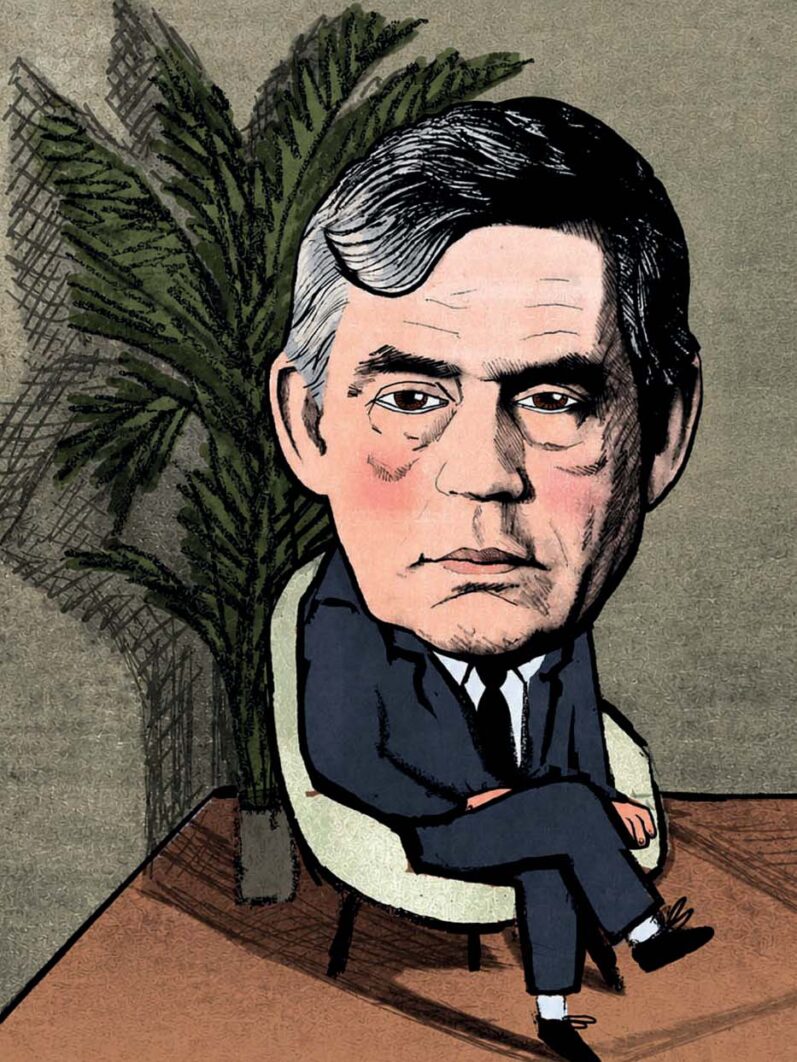
At 75, Gordon Brown likes to joke that he is too old for British politics and too young for American politics. The line hints at the ongoing energy of the former prime minister who, more than 16 years after leaving office, still rises at dawn to bash at his keyboard with two fingers in the upstairs study looking out at the Firth of Forth from his home in North Queensferry, Fife.
Fife has always been “home”. Though Brown was born near Glasgow, he was three when his Church of Scotland minister father moved the family to Kirkcaldy, where the Reverend Brown traced his family’s history in the county back to the early 1700s.
It’s also where Brown’s parents are buried, alongside his baby daughter, Jennifer; where he proposed (ringlessly) to Sarah, then built a rounded life and a shared hinterland with her; and where in 2022, alongside his work in global education for the UN, Brown launched the Multibank, at which Fife’s poor can make use of a range of unused goods from the likes of Amazon, Ikea and Tesco. There are now six multibanks across the UK.
This matters because the thesis running through Brown’s ambitious, cautiously optimistic new book, The Future Starts with Us, is that a potent combination of the breakdown of the international rules-based order on the one hand and the erosion of local community on the other, has left people alienated, lonely and vulnerable to ruthless populism and nationalism. His solution is not for individuals to wait for government action, but instead to volunteer in their communities, join local organisations and help their neighbours. Brown echoes Tip O’Neill, the former US speaker of the House of Representatives, who said: “All politics is local.”

“I have spent much of my life close to the centre of national and international politics, trying to push back against entrenched interests through decisions that I hoped would change our societies for the better,” writes Brown, who was the longest continuously serving UK chancellor. But, he adds, “It is only recently that I have come to the conclusion I should have reached years ago: that the best and perhaps the only way to start change is to start with our own lives and in our own local communities.” It was perhaps only after Brown left Downing Street and returned home to Fife in 2010 that he began to think seriously about what more he could do for his area.
The link between global instability and “civic decline” is borne out by fascinating polling, commissioned for this book, of almost 100,000 people across 45 countries. It confirms that people who are prey to the darker forces in politics have suffered repeated blows, such as deindustrialisation. But only a minority of them are entrenched and unpersuadable. Fewer than one in four see the world as a struggle between “us” and “them” – whether that’s foreigners, immigrants or “global elites”.
Brown criticises the “neoliberalism” espoused by his prime ministerial predecessors – Margaret Thatcher and Tony Blair – for relying on the model of Homo economicus. Such a society, as Brown describes it, is “simply the sum of the individual choices of self-seeking consumers maximising their economic self-interest in a marketplace”. Privately, Brown is relaxed about Andy Burnham’s critique of the past 40 years of neoliberalism. And in the book, Brown judges the economic ideology against his own “five Es” – the metrics by which he says the public view a legitimate and successful economic order: employment, equality, environment, efficiency and ethics.
Unlike some politicians, Brown authors his own books and articles. In a previous life, he was a historian, and makes what could have read like a dissertation surprisingly gripping. He takes aim at Donald Trump and JD Vance, the latter of whom “deliberately overlooks the true uniqueness of America”: that it is a nation of immigrants. He also attacks global autocrats – Vladimir Putin and Xi Jinping – because they are “prepared to abandon long-established precepts”.
All nationalism is scrutinised in this book, including English and Scottish. In 2014, of course, with a series of impassioned speeches, Brown tipped the balance against the break-up of a Union that, though now harder to defend after Brexit, remains greater than the sum of its parts. Brown has long known that the poverty-stricken in Scotland have more in common with those on low incomes in England than each group does with the wealthy within their own borders.
Yet the former prime minister is a reconciler. On 20 August, I was preparing to address the Edinburgh Book Festival about my biography of Brown when he phoned me and advised that I “build a bridge” with what he guessed would be the many nationalists in the audience. Brown has been a lifelong devolutionist, and is now a firm federalist, too. It remains to be seen whether Burnham will adopt his old boss’s comprehensive programme for constitutional reform – which was rejected by Keir Starmer.
In December 2024, when his friend Jimmy Carter died, Brown wrote in a telling tribute that the former US president’s “second act” – his pursuit of good causes after leaving the White House – was even more “momentous” than his first. Brown wrote of Carter: “Championing democratic rights everywhere and in doing so, teaching the world that wealth and power mattered less than the opportunity to serve, the nearly 44 years of his post-presidential life and his unimpeachable integrity made him a beacon for moral leadership.”
Brown is in many ways reminiscent of Carter. In an ageist society, Brown may be regarded as “too old” for a return to British politics. But this book, and his pro bono work in international development and local poverty – the causes that first animated his entry into public life – show that this public servant, Labour’s most capable all-rounder since Clement Attlee, has so much left to give.
James Macintyre is the author of Gordon Brown: Power with Purpose (Bloomsbury)
The Future Starts with Us
Gordon Brown
Simon & Schuster, 416pp, £25
Purchasing a book may earn the NS a commission from Bookshop.org, who support independent bookshops
[Further reading: Inside the Nord Stream conspiracy]
Content from our partners



Related

This article appears in the 16 Sep 2026 issue of the New Statesman, Will AI kill us all?
Join the debate
Subscribe here to commentWhy did Gordon Brown make private sector defined benefit pension schemes unaffordable?Employers wanted to keep them. They ceased being able to afford them or the risk they represented on their balance sheets. That is because- as Roy Hattersley told me one year at the Edinburgh Book Festival- ‘Gordon needed to find extra cash for Tony’. So Gordon cancelled a tax relief which gave pension schemes dividends gross. Public sector schemes continue, underwritten by the taxpayer. Of course.