
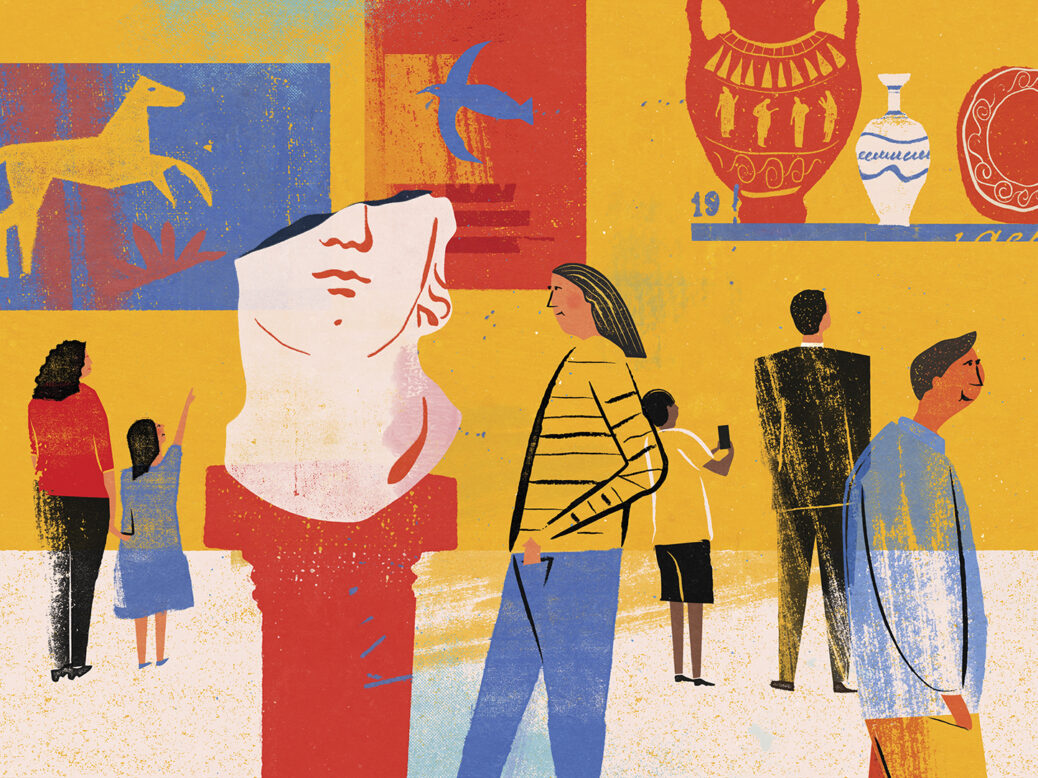
In the last week of the summer holidays I braved the hordes at the Natural History Museum. My stepdaughters wanted to see the blue whale. And the dinosaurs. Even the really scary one. So down to the raging maelstrom of South Kensington station we headed, navigating crowds and queues to worship among the skeletons of long-extinct creatures and pay homage at the altar of British scientific prowess.
The entire day out cost about a tenner, thanks to TfL policy of free transport for children and some homemade sandwiches. And it was utterly magical.
Such days out might be under threat. Back in March, ministers raised the possibility of ending a quarter of a century of free universal access to England’s national museums. Right now, the government is looking into the idea of charging international visitors.
The arguments for are pretty straightforward. Britain is strapped for cash, and the cultural sector is always the first port of call for officials trying to pinch back a few pennies. Free museums cost the taxpayer £485m a year, while 19.4 million overseas visitors enjoyed this generosity in 2024-5. So why shouldn’t foreigners who want to see a first edition of Charles Darwin’s On the Origin of Species, paintings by Rubens and Rembrandt, or the Lewis Chessmen (when they’re not on loan to France as hostages for the Bayeaux Tapestry) cough up a bit for the privilege, like Brits who want to see the Mona Lisa or the Sistine Chapel?

A couple of reasons, in fact. Let’s start with the idealistic. When the British Museum was established in 1753 by an Act of Parliament it was as the world’s first free national museum, open to “all studious and curious persons”. Such a sentiment should be a source of national pride. Britain, once a mighty empire, still has a reputation as a bastion of soft power. Our museums – like our universities and our creative industries, which are also too frequently overlooked by short-sighted politicians – are part of our global cultural footprint. Their universality is part of their power.
Indeed, as one politician put it ten years into the landmark free access policy in the midst of austerity: “Our free museums and galleries ensure that culture is for everyone, not just the lucky few. I am particularly proud that we have secured the future of free museums despite the current financial climate.” That profligate spendthrift softy? The then culture secretary, Jeremy Hunt.
It is also a handy riposte to the arguments that many of the artefacts on display in UK museums should be sent back to their country of origin. The Akropolis Museum in Athens, where the Parthenon Marbles would be displayed were the Greek government to be successful in its perennial demands for their return, charges €20. Maintaining free access lends moral weight to the case for the British Museum as a custodian of treasures from all over the world.
Imagine how politically uncomfortable the calls for return would become if Greek citizens were charged to see “their” statues – then turbocharge it for all the other artefacts with backstories linked to colonialism housed in British institutions. Andy Burnham, who has spent most of his political career as a vocal proponent of repatriating the Marbles (including as a backbench MP supporting a bill that would have made that easier, and tweeting in 2023 that they should be returned with “no strings”), recently backtracked and argued it was a matter for the British Museum. Does the new Prime Minister really want to be drawn into the row about the UK’s past exploits and present responsibilities that would inevitably be sparked by imposing charges?
This isn’t just about the British Museum. It’s about the 15 museums (or, more accurately, museum groups) which received taxpayer funding from the Department for Culture, Media and Sport. And it’s a story that extends far beyond London – as well as the capital’s most famous museums and art galleries. Institutions on the list include the National Museums in Liverpool, the Royal Armouries in Leeds, the Tate Galleries in Liverpool and Cornwall, and Science Museums in Manchester, York, Durham and Bradford. All those places benefit. The 2001 policy has been championed for boosting overseas tourism to the UK; in 2011 Visit Britain estimated free museums earned the country £1bn a year from tourists – twice the amount it costs DCMS.
Proponents point out that having to pay to visit the Louvre or the Rijksmuseum doesn’t seem to be denting tourism in Paris or Amsterdam. We are outliers in our largesse – and, as with the mooted “tourist tax” proposed last week, lessons from Europe add a note of realism to the dire warnings about a collapse in visitor numbers. The real financial risk, I would argue, is not that tourists stop coming to these cities or visiting these museums, but that their behaviour changes when they do.
The 15 sponsored museums have had 25 years to work out how to maximise income without charging for entry. Special ticketed exhibitions and out-of-hours events abound – the 7.5 million people expected to view the Bayeaux Tapestry at the British Museum, many from overseas, will either pay handsomely for the privilege, or else are members who fund the BM all year round. Museum and gallery gift shops have perfected the art of intellectually stylish souvenirs at just-short-of-extortionate prices. All solicit donations.
Back in the echoing halls of the Natural History Museum, I spotted something unexpected: Pikachu. The Earth Hall gift shop had been transformed into a Pokémon pop-up shop experience, full of exclusive products fusing Japanese anime gaming culture with the history of evolution. It was packed with as multilingual a crowd of shoppers as you’d find at Heathrow Airport.
According to the Financial Times, an average of 46 per cent of the sponsored museums’ income came from the government in 2024-5. The rest was self-funded. There is a real risk that, by charging overseas visitors for what used to be free, those overseas visitors stop paying for the “extras”. By trying to extract more value from our cultural institutions, we could end up impoverishing them, and making us all poorer as a result.
And when I say poorer, I don’t just mean financially. Aside from the blue whale and animatronic T-Rex that have captivated children for generations, the Pokémon shop and the skeletons, what I noticed at the Natural History Museum were the variety of British accents. People had clearly travelled from all over the country for this experience. Maybe their transport costs were more than a tenner, but as educational entertainment went, the value for money was off the charts – and so was the appeal.
In the first decade of the free museums policy, visits increased by 151 per cent in London and 148 per cent outside the capital. In 2024-5, 22.6m Brits stepped through their doors. That’s a cultural trend worth celebrating. While the proposals are to charge foreigners only, it’s hard to see how this could be achieved without creating friction for domestic visitors. We don’t have digital ID in the UK and plans to impose it are long-dead. Would Brits have to show a passport, or reclaim their entrance fee by submitting a recent council tax bill? Given how hard it is for UK hospitals to work out who is eligible for free care and extract payment from patients who aren’t, I don’t envy the officials tasked with developing a workable scheme.
And while that scheme is being worked out, the message to people up and down the country is that our national museums and galleries are just that little bit less welcoming than they were. Maybe our next trip to the Natural History Museum wouldn’t be quite as crowded, maybe we wouldn’t have to queue to see the really scary dinosaur. But I think that would be a loss – to British visitors, and to our sense of national pride.
[Further reading: Will AI kill us all?]
Content from our partners



Related



Join the debate
Subscribe here to comment