
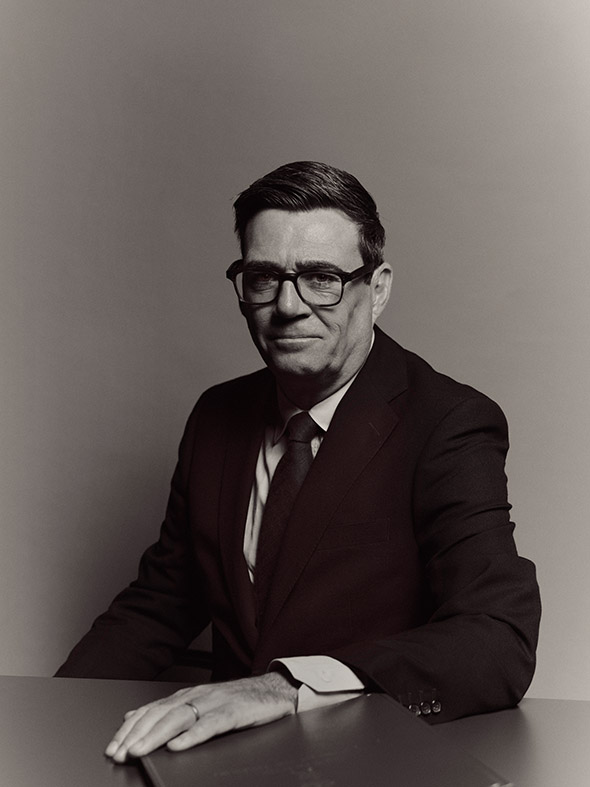
Andy Burnham finally has what he always wanted. He is only a few weeks into the job, but there is an intensity about him that has caught even some of his closest allies off guard. The Prime Minister has long imagined himself in this position, dreamed about its possibilities, thought about what he would do and how. But there was also a part of Burnham that had accepted his apparent fate – the fate of a nearly man. Now he is Prime Minister and grabbing at his power like someone seized by the sudden, fleeting sense that he must not let go of the opportunity.
It has not been an easy start, nor the one he would have wanted. Burnham entered No 10 in July just as his father descended to the last, fatal stage of Alzheimer’s. The loneliness of power collided with the loneliness of grief. As the relentless demands of the job rolled in – calls with world leaders, security briefings, prime ministerial visits and parliamentary tussles – the private agony of a family crisis was playing out.
“It’s been hard since I came in,” the Prime Minister tells me over the phone, opening up about the death of his father, Roy, in our final conversation for this profile. “It’s all very raw, to be honest with you,” he says. “I’ve not felt alone because the messages I’ve had have been lovely, but then again you are alone with it because you can’t quite get over to people how you feel.” The two days he took off to be with his family helped. This was a chance for them to share their memories, to “let it all out”. “It’s been simultaneously a very public thing, but very lonely as well,” he explains. “It’s been a hard one, I must say.”
His father had died a week earlier. The pace of events, however, had remained relentless, as warnings of escalation with Russia, oil shortages, volatility in the bond markets and threats of AI Armageddon swept across the Continent. “The volatility of the world means you wake up every other day and the situation has changed,” Burnham observes. What concerns him most is that the UK is often “that little bit more exposed” than other countries.

Before his first party conference as leader, he flew to New York to address the UN, warning against the influence of right-wing populism, and meeting Donald Trump for the first time. This was all before the funeral for his father, which will take place shortly after the conference.
On the phone, there’s an obvious sadness in his voice, a doleful tone and cadence; reflective and slow to be drawn, only to burst quickly into reminiscences, as if he is both reluctant to speak and then, suddenly, keen to do so. He says the family had been recalling their treasured memories: of how Burnham’s father would turn up to vote, year in, year out, for women to be allowed into the Lancashire Country Cricket pavilion (which they eventually were in the late 1980s); of how he would gently chide his middle son for not understanding why it was obvious he was wrong on some political point or another. Roy Burnham was old Labour, “uncompromising” in his politics. His mother, by contrast, was moderate, New Labour. This was the family dynamic that shaped the Prime Minister.
Despite the mournful challenges of his first two months in the job, Burnham has relished its demands and found himself energised by the pace and possibility of the power he now holds; of being at the centre of things, making decisions, proving people wrong, being leader. Whatever the country feels about its seventh prime minister in just over a decade, Burnham himself is seized by the sense that this time it will be different, that he will be different – the culmination of everything he has worked for.
Before this profile, the last time I’d seen him in person was in Manchester, long before he became Prime Minister – before he’d even begun his challenge. We were standing on the street outside the city’s mayoral office, with the official car waiting to take him home, the street dark and empty. Inside, we had been talking formally and on the record, but, outside, he was more open. An opportunity was coming in Westminster – he could feel it. And he wanted me to know something: he was ready.
A year later and his life has transformed. On a train heading north, the T-shirt and moccasins – the “Andycore” of Manchester – have gone, replaced with a prime ministerial suit. On the table in front of him is his prime ministerial red box, and behind him, his prime ministerial security detail, guarding entry into the carriage where we sit. It isn’t just Andy Burnham sitting before me, but the office of state.
That’s the thing with this Prime Minister. The persona we all know is real: the 6 Music dad who loves his football; the ordinary bloke who likes normal things and normal people. And yet normal people do not tend to become Prime Minister after 16 years of trying. Beneath Burnham’s bashful, almost apologetic exterior lies a will to power as strong as I have seen in Tony Blair or Gordon Brown. He is gripped by a certainty of what he – and he alone – can do with the job.
“Hello Prime Minister,” I begin, as Burnham spots me entering the carriage – and I detect a slight surprise at my formality. Burnham had agreed to meet to reflect on everything that has happened since we spoke in Manchester a year ago, when he laid out his pitch for power, the “Manchesterism” for which he would become known. Openly challenging Keir Starmer’s authority, Burnham had dared to ask Labour MPs whether they were up for his plan – and, by extension, although it was never quite said, him. “It can’t be just a changing of the guard,” as he had put it. “You have got to change the whole culture… Are people up for that?”
The initial answer, however, was far from conclusive. After our interview was published, the Starmer government went on the attack, ministers criticised his intervention and Westminster seemed to have concluded that Burnham had blown his chance. That he had said Britain should not be “in hock to the bond markets” was declared a sign of unseriousness. Footage of Burnham quietly leaving the Labour Party Conference went viral. He was accused of sneaking away, escaping, retreating.
A few months later, Starmer blocked Burnham from standing as the Labour candidate in the Gorton and Denton by-election. It is hard, today, to appreciate how much of a blow this was. Privately, Burnham was despondent. Even some of his apparent allies began dismissing his chances of returning to parliament in time for a leadership contest. He didn’t have the numbers, it was said. Morgan McSweeney had sewn it all up. It was classic Andy: nice bloke, trying to have it all, but missing the killer instinct. And then everything changed. Labour was routed in the local elections in May, and the herd moved.
How does he think about all this a year on? He smiles. “They couldn’t understand why I was saying some of the things that I was saying… [They] didn’t know what to do with it, but they did what they always do, which is they pulled one line out of it and then framed that one line within their world, rather than the one that I was talking about.” The reaction clearly still rankles, particularly the Treasury’s briefing against him. Indeed, he thinks this culture of deliberate oversimplification remains in Westminster.
We discuss Burnham’s recent remark at Prime Minister’s Questions (PMQs): when pressured by Kemi Badenoch to say whether he could cut welfare to increase defence spending, he replied that national security “can’t come at the expense of social security”. Here, Burnham tells me, he was using social security in the old-fashioned sense: literally, the resilience of society, a theme that will form the backdrop of this year’s Labour Party Conference. A few sentences later
at PMQs Burnham declared the welfare budget too high. But the reaction was instant: here he was again trying to have it all ways. Burnham hates this. “It oversimplifies the political discourse that we need to have, doesn’t it?” he says in his very Andy way, finishing his statement with a question, softening its attack, seeking to draw you in and secure your agreement.
Beneath this tendency, though, there is an obvious determination. Burnham does not resile from any of what he said. “I mean, the point about the bond markets, it holds – in that what I was saying was the country has left itself over-exposed.” Burnham argues that far from calling for spending restraints to be bypassed, he was making an argument for “a much more streamlined, productive state”. The same is true of welfare. So, which is it? Is Burnham the secret socialist of tabloid caricature, or an instinctive centrist whose language and demeanour hide a more conventional politics? What, in other words, does the Manchesterism he declared in the New Statesman a year ago mean in practice now that he is not the leader of a city, but of a country? Does the concept lean closer to the instincts of his father or his mother? Perhaps, most importantly, is he really still just Andy, trying to be all things to all people, as his critics claim, or is he up to the challenges of government when so many have failed before him? These were the questions to which I wanted answers from Burnham, 12 months after our last interview – a year in which everything has changed and yet, in the country, nothing much has changed at all.
Talk with those closest to Burnham in No 10 and it is impossible not to be struck by the immediate, unmistakable differences to Starmer. Where the former prime minister liked to retire with his papers to read alone upstairs and maintained a startling distance between himself and his wider parliamentary party, relying on formal processes and the ability of ministers to arrive at decisions themselves, Burnham governs in an intensely personal fashion. He intervenes in every major decision, imposing his agenda, making decisions in open discussion with his closest aides. Starmer saw government as a matter of administration; Burnham as a matter of politics.
To speed things up, Burnham has reinstated Blair-era “stock takes”, in which cabinet ministers are brought in to No 10 to update on the progress they are making towards his priorities. A weekly “political management meeting” has also been set up for the first time since 2007, bringing together the main Labour players: the deputy leader, leaders of the Commons and Lords, chief whip, chair of parliamentary party, general secretary, and so on. The whole weight of the party is being put to work. Concerns about “death by cabinet sub-committee” have also led Burnham, his chief of staff, James Purnell, and the First Secretary of State, Louise Haigh – the most powerful figures in this government – to prioritise informal ministerial groupings empowered to push through decisions.
While Haigh is the most important of Burnham’s lieutenants – she ensures the government as a whole delivers on his agenda – Anneliese Midgley is his most important parliamentary operator, the main bridge between No 10 and Labour MPs, a bridge that had all but collapsed under Starmer. In her role as chief whip, she has encouraged the Prime Minister to be far more open and visible with his MPs, voting in the lobbies as regularly as possible. Ministers are expected to attend votes, too – Burnham has told them that they needed to be more responsive to the Parliamentary Labour Party.
There are small political touches Burnham’s team believe are important. He has established a routine of decamping after PMQs for a Commons buffet lunch, where he is joined by a rotating cast of Labour MPs arranged by his parliamentary private secretary (PPS), Nic Dakin. These lunches have been likened to the type of “Charlie Chalk” family pubs that used to be popular in the 1990s. Back-bench drinks in the No 10 garden have improved morale and the role of PPS – ministers’ parliamentary aides – has been elevated.
This is how Burnham wants to be as Prime Minister, and he has felt “very at home” in the job, he says. “You know what, I love the feel about it [in No 10]… Yeah, it’s not fazed me.” Does everyone else around him feel similarly unfazed? “It’s a new life, and it’s different for my mum, and everybody, really,” he says. “Of course, they’re living it as well, and it affects them, the good things I do, the bad things I do… so, it’s different, but we’re all getting there.”
But does he himself feel different now he is Prime Minister? “Not so much,” he replies. “I don’t know if it comes over, but I decided there’s only one way to do this, which is to be yourself.” This is the Burnham who “found himself” in Manchester, his friends say, after years of not quite knowing how to fit in. “There’s no other way, as far as I could see, to do the job,” he says. To his critics, of course, this will ultimately be his downfall: being too much of a “yes man”, as Badenoch chided him in their first encounter at PMQs.
Burnham is determined to prove this criticism wrong and says he will leave people in no doubt as to where he wants to go and what his priorities are. These are already being felt in No 10, where he is pushing hard on national resilience, social care, devolution and jobs for the young. All these themes will come out in his speech at the conference and have emerged as the principal sources of concern in his first weeks in power.
What ties them together, he says, is the idea of resilience. “We don’t have sufficient control of our destiny and that theme will come through in what I say in Liverpool,” he tells me. The speech, not yet finalised, will build on the Manchesterism that he set out in the New Statesman. “You could say, what you wrote last year holds and it’s a year on and I will develop the themes, but those will be the themes. People might say you get into government and you dial down. I don’t feel like that. I won’t be dialling it down, put it that way.”
He returns to resilience. “I think defence and resilience from local right up to the top – Manchesterism, No 10 North – driving power out and building places back up, is all one thing,” he explains. Burnham believes a big part of this will be “investment in prevention” rather than paying for failure, as he puts it. And to do that, he says, reform of the state through devolution will be essential. Britain will host the G20 in Manchester next year and Burnham wants to take a lead on AI, which he says cuts across all of the themes of his premiership: defence, security, misinformation, biosecurity.
What about his own resilience, I wonder? Why is it that he kept going, kept believing he could be prime minister, despite all the setbacks? “I’ve never lost the drive,” he says. “The drive does come from a feeling that the country isn’t there in terms of how it treats people in different parts of it.” But surely the source of his motivation is more personal than that? Lots of people are unhappy with the state of the country but don’t try to become prime minister. “It’s being one of three brothers,” he says. “You should have seen us… I’m in the middle, so that explains everything. My mum will tell you.”
When I say I am sceptical, he starts circling closer to the truth, explaining how he was raised in a culture where “justice” and “fairness” were in the ether. “It’s a very Liverpool thing,” he says – the tradition in which he was brought up in the 1980s, a combination of his dad’s politics and his mum’s Catholic faith. “Both shaped everything that I’m about, I guess. She more from a faith point of view, him from a politics point of view.” Burnham wears his Catholicism lightly, a cultural inheritance as much as an evangelical faith, shaping him and his deepest instincts.
Still, though, I wonder why it was him and not his brothers who chose the life he did? “Actually, you know, it’s that thing – I know I overplay the kind of thing about imposter syndrome – but there’s always a thing where if somebody says, the idea that somebody might say, ‘You don’t deserve to be here,’ you then say, ‘Right, I’ll show you.’” Does he still have it, I wonder, the imposter syndrome? “No,” he replies, sharply, without hesitation.
When Burnham set out his case for Manchesterism a year ago, he described his programme for government as “business-friendly socialism”, unwinding the Thatcherite consensus of the 1980s. His critique of “40 years of neoliberalism” provoked an angry response from Tony Blair, who questioned whether he really believed nothing good had come from the government in which he had served (a simplification of his argument that Burnham rejects). In private, Blair remains despairing about Burnham.
As Prime Minister, however, Burnham has sharpened his critique still further. In the past four decades, he told MPs, power has been centralised, public services privatised and the economy deindustrialised. This has left the country poor, divided, unhappy and fragile to external shocks. Here is the Burnham diagnosis, the story he tells to explain why Britain is failing – the “narrative” the Starmer project so obviously lacked. When I asked the previous prime minister whether he thought the basic settlement that had been in place since the 1980s was fundamentally broken, he insisted it was not. The contrast with Burnham is clear.
Burnham believes not only that his diagnosis is clear, but his prescription too. “It’s about control,” he explains. “If you strip it back, and all the fluff and, you know, the verbiage, you can actually strip it back to one word, which is control.” In Burnham’s mind, then, this is the point of his premiership. “It’s about… setting your own ambitions, your own path towards it, and then having meaningful control of the things that enable it and drive that progress towards something.”
There’s something quite dirigiste, old Labour, even French about his programme for national sovereignty, resilience and independence. He laughs. “President Macron said as much to me.” He thinks this element of “Burnhamism” is too commonly overlooked. Yes, he believes local government has been hollowed out and privatised, leaving swathes of the country without the levers to change things. But he also believes a big part of Britain’s malaise is that British towns and cities have “too little control over their own investment strategy”. This isn’t a statist agenda, he insists. It is, in fact, a Blair-style public-private partnership. “People aren’t going to come in and invest in a significant way where the place isn’t functional and it’s in major decline.” Burnham says the state’s job is to “create the optimum conditions for private-sector investment”.
This is a central tenet of the Manchester model in place for much of the past two decades, combining a powerful city administration and mayor with a wave of foreign investment. While this has revamped Manchester’s city centre, the decline of much of the wider region has continued. To some critics, the Manchester model is little different to the Treasury model for the UK, under which London and a few other areas have boomed, fuelled by foreign billions, while the economy overall peters out – unproductive, poor and increasingly left behind. Without a return to core strategic questions – energy supply, production, balance of payments, competitiveness – Britain’s fundamental malaise will not lift, critics argue, no matter how successful Manchester becomes. The power of Burnham’s critique of the past 40 years is that much of the country’s decline has clearly never abated. But that does not necessarily mean Manchesterism is sufficient as a solution.
The other obvious criticism of the Burnham demand for national control is that this is exactly what voters demanded in the referendum of 2016, to take back control. But no British government has been able to deliver it since, whether on immigration or living standards. Perhaps national control itself is a mirage, a nostalgic idea that does not account for the harsh reality of dependence for a mid-sized country in the 21st century. When I ask him whether his ambitions for Britain are possible outside the European Union, he equivocates. Yet he also insists his voters in Makerfield are right when they demand border controls.
Burnham accepts that while Manchesterism remains the basis of his project, it is not enough on its own. “I have to evolve it,” he says. “It was right to… localise it when I was the mayor of that area, but now I think you can broaden it out… it is about broadening it out into a theory of growth.” But what is his theory of growth? The Burnham story doesn’t explain why European countries that did not follow the British path of centralisation, privatisation and deindustrialisation are also suffering the same kind of economic decline, social unrest and political alienation that is happening here. Isn’t there something much more profound at play?
When I push him on this, he speculates about “the media and the social media climate” that is similar across all developed countries. Is this really a sufficient explanation though? Across Europe, countries of wildly different socio-economic models are suffering from the same energy dependency, China shock, Trump whiplash and AI revolution. Amid such sweeping changes, the critique of Burnham – and Burnhamism – is that it is not enough to demand growth “in every postcode”: he must identify friends and enemies, vested interests to take on and destroy, anachronisms which need to be smashed and demographics that will lose out in order for Labour’s people and places to thrive in this new world. It cannot be just about changing the nature of government.
Burnham, though, I sense, believes that the UK’s malaise is no longer merely political or economic, but somehow spiritual; that the lack of “resilience”, as he puts it, is not just structural but stems from a loss of belief in ourselves – perhaps something he has felt himself at times. “I very much think what you’ve just described is the national mood – a sense of ‘we can’t do much any more, we can’t fix things any more’,” he says. “We seem to have lost a sense of ourselves, what do we stand for.”
It is for this reason that Burnham believes Ed Miliband’s decision to sanction Israeli settlements in the West Bank – and the international support the government was able to corral behind this position – was such an important moment. “The risk,” he says, “is we’re worried about trade with all the different parts of the world and how do we navigate all of that… and the risk is, Britain stops standing for something.” The country, he says, “feels a bit unsure of itself” and part of his job is to change that. “We’ve just got to get that belief back into Britain, that, yeah, we know what we’re about, we know what we stand for, that is what we’ve always been, so we can do it again.” As with his instinct for more national control, there is something distinctly traditional – even old-fashioned – about Andy Burnham; the politics of his dad, the faith of his mum. He believes in belief. He has found it in himself. Now he has to persuade the country.
When assessing political leaders, Henry Kissinger observed, it is character that should concern us more than ideology, intelligence or any other quality. Ideology offers a useful guide for understanding the inevitable crises that will crash over a government. Intelligence is an important trait for any political leader, though there are always plenty of clever people who can be hired to give advice. Character, though, is the hardest quality to define or procure, combining instinct, conviction, bravery and strength. It is character which really decides between success and failure. It is the quality that guides a premiership, revealing itself in crisis, shaping decisions that must be made quickly and without all the relevant information. It is a trait developed in childhood, but also, in some senses, that just is.
Burnham’s character has been the source of much disdain in Westminster over the years. His critics accuse him of changing his clothes to suit the prevailing fashion. For Burnham, this is particularly frustrating. “That’s another thing that Westminster doesn’t like much, does it? That you change and you adapt and you come back at things and you think about it.” He is happy to admit that this is something he has “done a bit more than others… I’ve been prepared to sort of rethink things and look again at things and come back at things.”
This is certainly a point of difference with, say, Thatcher and Blair, whose political projects were defined by an almost prophetic sense of certainty. Burnham, in contrast, is a Prime Minister defined by earlier failures and a return, as he sees it, to earlier, natural convictions.
This means Burnham can appear less forceful and confident than most of the prime ministers I have known. In fact, I have rarely come across a leading political figure as willing to display his own vulnerabilities, admitting that in the past he was not good enough to become prime minister – that he had not worked out his answers.
Thinking back to his defeat to Jeremy Corbyn in 2015, Burnham says: “My thinking wasn’t sufficiently developed.” He is also happy to talk about the personal challenges of the job. “Obviously it does disrupt your life,” he tells me, at one point. “It does take you away from, you know, your loved ones to quite a considerable degree. It does make you feel a little isolated, if I’m honest, at times.”
The loneliness of leadership is another Kissingerian observation. Strip away everything else and the point of leadership is to make the decisions that cannot be left to others: to expose your own judgement to the capriciousness of events. The isolation of life in No 10 is something Burnham also manages practically, balancing his life between north and south. He and his wife, Marie-France, are splitting their time between both; their three children are now all in their twenties and working. All this has made the death of his father harder to manage.
“It is hard to describe, coming into this job when I did and when things were happening,” he explains, “so it’s obviously been hard.” And yet, he believes his father’s death has reaffirmed his priorities. “I’ve also been finding a sense of power in it,” he tells me. “I can hear him and I know his quiet insistence on the things I should do. I’ll be drawing on that when I speak in Liverpool.” The voice Burnham hears is the voice of a traditional Labour man, old-school in some senses, progressive in others, but always resolute and clear-eyed about his beliefs.
Burnham tells me the quiet voice he can hear from his father is both moral and political. He was a lifelong advocate of proportional representation, an important part of his son’s conversion. He also “didn’t put a foot wrong” personally, Burnham says. “He treated people just wonderfully – he barely ever fell out with anybody,” as he puts it. “You asked what I took from him. I’ve tried to treat people like that myself, always.”
If there was a “quiet insistence” in the father, it is fair to say there is something similar in the son: an insistence about the things he wants to do and his own ability to do them. “If you can say, ‘I know why I’m doing it and I can see the difference that I’m making,’ then it all comes together and you can rationalise it,” Burnham explains, contemplating the challenge of power ahead of him.
So why is he doing it? “It is back to… rewiring the country,” he says. “Life for people in large parts of the country just isn’t good enough, and they don’t have enough power to change things.”
I push him on why he thinks only he can fix it and not someone else. “Oh, I don’t want to be arrogant,” he says, again, almost apologetically, hiding the steel of his conviction. He has been beating this drum for years, he says. He saw the injustice of the Hillsborough disaster and then in government was given the chance to change things. He tried to speak for the north in Westminster for 16 years but found he was “shouting into the wind” until he moved back home.
It sounds as though he believes there was a destiny to his journey. “I’m a believer that you get better at things through life if you do learn from things that happen, because they happen for a reason,” he replies, carefully. “So, you know, I do think things happen for a reason: the question is, what do you then do with that situation and how do you process it?” Does he believe in fate, then? “Fate is a bit of a mystical thing to believe in, and all that, so I’m not sure I quite believe in that, but I am a believer in that, you know, you learn and you change.” His mind is drawn to the weeks ahead: speaking to the Labour Party Conference for the first time as leader – back home, in the area he was born and shaped, where his family still live and where his father died. “The one thing I would want to sort of say is… how Liverpool will be a big thing, going to Liverpool for conference. When you talk about fate and all of that, that does feel a bit, you know, major in my life.”
Burnham believes his speech to the conference is the moment he will define the purpose of his premiership in ways that will leave no one in doubt of his intent. “It’s a moment to weave all of these threads together and to lay out the path, I think, and say, ‘Look, Britain’s here, we can be there’ – a much better place – ‘but we’re going to have to be honest with ourselves about what it takes to get from where we are right now to where we should be.’” Being honest with the country: this is the bar the Prime Minister has set for himself. “This has to be a point where the country says, ‘Right, we can’t carry on like this, we need to set a new, clear direction, a new clear path.’” Burnham believes he would be “seriously letting down the country” if he fails to deliver this.
The Prime Minister, though, is gripped by a conviction that this time it will be different, that he will be different. “People won’t be in any doubt what I want to do with the job,” he says, now forceful again. “The question people will have to ask is: do they agree with what I’m trying to do? And will I actually be able to achieve it?” And then, with his intensity rising: “There were too many people who wanted to have the job to have the job, whereas I wanted it because of what I can do with it and I am seized with that more than ever right now.”
Andy Burnham has a sense of the power he possesses. Now he has to prove he’s up to wielding it.
[Further reading: Andy Burnham’s plan for Britain]
Content from our partners


Related
This article appears in the 24 Sep 2026 issue of the New Statesman, A Sense of Power
Join the debate
Subscribe here to commentI did’t vote for Andy in 2010 or 2015 and feel that I should have done. He has all the outward appearances of David Miliband who I voted for in 2010 and all the confidence of Blair whose election in 1994 caused me to rejoin the party I had left in 1978 because of its inability to deal with Entryism from the disbanded Communist Party of GB. Now he is saying all the right things and placing all the right people in position to govern the country properly. It is beyond time the country was properly governed and growth restored. We have most of the right ingredients to become a leading member of the G7 and a bulwark against the Right Wing politics that is slowly eating up normal politics in Europe.
Sure but I’d like to see him reign in some of the anti-freedom and authoritarian stuff that Starmer’s goverment brought in. It’s one thing to be a bulwark against the right but it’s totally meaningless and hypocritical if all you are doing is packaging the same authoritarianism up as sensible, morally sound politics. Doing it in the name of paternalism does not make it somehow better from the left. The “right wing” seems to only mean anti-immigration now so as long as you are correct in your thoughts about this you can bulldoze liberty in all other aspects of life with creeping state over reach. There is risk with freedom of course, but let’s have a bit more of the Miltonic virtue about our politics please no more of this neo-stalinism. Treat people as adults and believe they can have their own independent thoughts and opinions that they don’t need protecting from.
I’m hoping he’ll do something about social care. The entrenched issue is that everyone wants social care, no one wants to pay for it.