
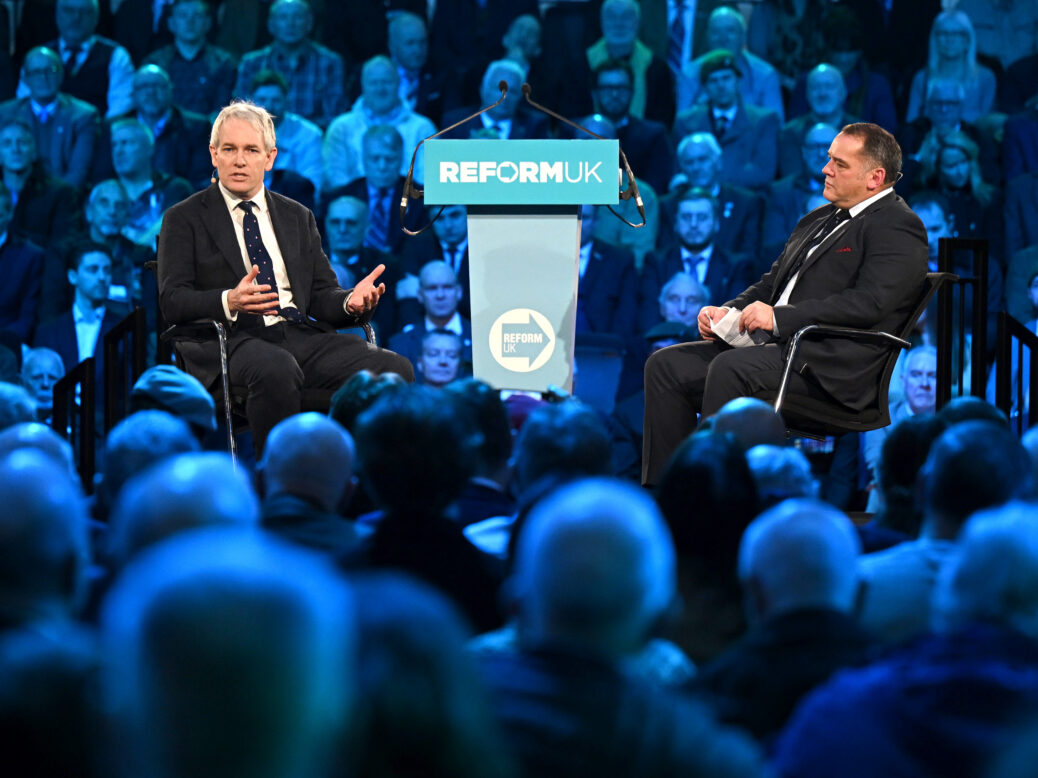
Last June, at a conference in London entitled “Now and England”, a revealing argument broke out. On the panel: the historian Robert Tombs, the businessman-turned-populist-politician Rupert Lowe, the Tiggerishly patriotic social media influencer Thomas Skinner, and the cerebral MP Danny Kruger, then still a Conservative MP. On the agenda: the timelessness of England, with a nod to TS Eliot, all under the aegis of the Roger Scruton Legacy Foundation.
When we get to the Q and A, the camera reveals a strikingly young crowd, with some recognisable faces from the world of online right-wing commentary. Up speaks a plaintive, even apologetic voice. The questioner comes from Rotherham, he says; the allusion to the grooming gangs scandal does not need to be spoken. English democracy, he goes on, has been a means for reconciling differences. But is it still? “My question is: if we reach a juncture where democracy becomes a zero-sum game between different ethnic and religious blocs, what feasible future is there for it?”
Prolonged and fervent applause. Some whoops. Kruger, who three months later will defect to Reform, looks out intently, struck by the reaction. “I detect a very strong sense and desire for urgent action to restore the basis of our politics,” he tells the audience, “otherwise we’re going to lose it altogether.” As well as reducing immigration numbers, the demands on newcomers will have to be “much more explicit”.
But already another questioner has pushed the discussion into a different zone: who has the right to say they’re English? Tombs, author of the acclaimed The English and their History, points to the Michaela School in Wembley, where “you see little girls with headscarves on reciting Kipling and singing the national anthem”. It shows, says Tombs, that people can become English if they are required to try. Then: “Ridiculous,” a heckler in the front row, “the idea that you can teach somebody to be English.” Tombs is unruffled: “Of course you can. That’s how we all learn it.”

In these few minutes, you can catch a glimpse of the new divisions on the right: between those – particularly those from an older generation – confident that the nation has a future, and those who see Britain as in such a state of emergency that only a radical upheaval can save it. And – a separate distinction but a related one – between those still basically hopeful that integration can work and ethnic differences can be set aside, and those who believe that the question of ethnicity is now central to politics.
New Statesman readers will perhaps react to this as George HW Bush did to the Iran-Iraq war: “Why can’t they all lose?” But the series of earthquakes that have changed the landscape of the right are of a broader significance. For the Conservative Party to go under would be dramatic enough. For British conservatism itself – a habit of thought which has satisfied artists as great as TS Eliot and minds as formidable as Roger Scruton’s – to be facing such existential challenges, suggests we are living in revolutionary times. If it can happen to conservatism it can happen to anything.
Three figures loom over the recent history of the right: a prime minister, a philosopher and a political maverick. They are not the three most representative conservatives, maybe not even the most consequential. But the tendencies they stand for have come to define the co-ordinates of right-wing politics, even in the era of Reform.
The first is, of course, Margaret Thatcher; the second, Roger Scruton, entered public life determined to correct Thatcher’s philosophical errors. Scruton became political in May 1968, watching from a Paris flat as long-haired students tried to bring down the bourgeois order by throwing rocks at policemen. He was horrified – surely Paris should make you love civilization, not try to smash it up? – but also, paradoxically, inspired. He set about crafting “a complete philosophy, in answer to the complete philosophies of the liberals and the socialists”.
By the time he had arrived at a definition of conservatism, Thatcher was already preaching her own: the gospel of the sovereign individual, free to exercise their rights without the dead hand of state intervention. For Scruton, by now teaching philosophy at Birkbeck, this was highly misleading. The language of “rights” and “freedom” has little to say about what really makes a difference in our lives – being born into a particular country and home, starting a family, even finding a hobby or supporting a football team. These experiences shape us in ways we did not envisage, let alone choose; we only discover ourselves through belonging to something with a life of its own.
For Scruton, politics is about belonging, more than it is about any concrete achievements. “Politics with a goal” is what the left specialises in; the right is more concerned to keep things going in some kind of ordered equilibrium. Parliament, monarchy, law: these should be judged, not in terms of whether they secure social justice or equality or liberty, so much as whether they help us to live together despite our differences. That, for Scruton, is the meaning of conservatism: not maximising “freedom” as the Thatcherites believed, but nurturing the institutions, traditions and communities without which our freedom doesn’t make any sense.
Abstract as all this may sound, it was the foundation for Scruton of a career of unending controversy. In 1984, for instance, the Salisbury Review, the magazine Scruton had founded two years earlier, published an article by a Bradford headmaster called Ray Honeyford. A passionate believer in the transformative power of education, Honeyford complained that Muslim parents were banning their daughters from drama, dance and sport; that Asian families were more likely to take their children out of school in term time; that too few immigrant children were being taught in English; and that all of these deleterious changes could not be questioned because of an “anti-racist” ideology which made serious debate impossible.
Honeyford offered a few more provocative claims too: “The roots of black educational failure are, in reality, located in West Indian family structure and values”; Britain was at risk of importing “the hysterical political temperament of the Indian subcontinent”. Honeyford hoped to spark a national debate. He succeeded; but the Mayor of Bradford called for his sacking, there were huge protests at the school gates, and pupils wore badges reading “Hate your headmaster”. Honeyford eventually had to retire from teaching. For Scruton, who suffered no-platformings and allegations of racism, the episode demonstrated the ruthlessness of the left, and the importance of immigration as an issue.
The British people, Scruton wrote, had never consented to the scale of post-war demographic change: “they are conscious that they live on a small island, whose freedoms have been dearly fought for, and whose genial way of life depends upon a long-standing trust between neighbours.” More than once the Salisbury Review paid tribute to the politician who had spoken most forcefully against mass immigration: the third towering figure of recent conservative history, Enoch Powell.
Powell made the case for Thatcherite economics two decades before Thatcher. He is also one of the fathers of Euroscepticism, the issue over which he left the Tory party. But for more radical conservatives today, his greatest legacy is his warnings about immigration, and his calls for large-scale repatriation.
Nigel Farage has named Powell as his hero; for the Reform leader, Powell was broadly correct about immigration, even if he was “clearly wrong about race”. That caveat underlines the other thing about Powell: that he helped cast a sinister shadow over the whole subject of immigration restriction. Powell’s 1968 “Rivers of Blood” speech predicted violent racial conflict, quoted a constituent’s fear that “the black man will have the whip hand over the white man”, and cited a lurid story about an old woman being persecuted by West Indian immigrants, a story which may have been false in the first place.
Ever since, politicians sounding the alarm about immigration have had to contend with the suspicion that they are stirring up the racial hostilities they say they deplore. Thatcher, despite her respect for Powell, kept her distance from him on this subject. By contrast, Scruton believed that, whatever Powell’s exaggerations, “The silencing of Enoch Powell has proved more costly than any other post-war domestic policy in Britain.” Thatcher remains, of course, the defining political leader for many on the right: the Tories, Reform and Restore tend to default to an essential Thatcherite understanding of the economy. Powell is increasingly seen as a prophet and a model of the conviction politician. Scruton, meanwhile, stands unchallenged as the premier twentieth-century theorist of conservatism.
Boris Johnson called Scruton the greatest modern conservative thinker. Kemi Badenoch cited Scruton’s How to be a Conservative as one of the books that defines her outlook. For Michael Gove – who subscribed to the Salisbury Review as a precocious teenager in Aberdeen – Scruton “saved this country”. Reform’s two leading thinkers are Scruton devotees: Kruger, now leading the party’s preparations for government, and James Orr, who was Head of Policy until his suspension on Friday after alleged breaches of electoral rules. When Robert Jenrick met JD Vance in the Cotswolds last year, he gave the vice-president a signed copy of Scruton’s England: An Elegy.
At the height of the summer heatwave, in search of Reform’s guiding philosophy, I spoke to Danny Kruger over Zoom. A bowl of water and a fan were visible on his desk. Scruton was “the principal icebreaker,” Kruger tells me, “for a renewal of the communitarian tradition in conservatism, which had been silent for 30 years, and arguably silent for 100 years.” It has flickered on and off ever since, he says, but is now back “much more meaningfully with Reform.” The party has, Kruger says, “a relational vision of society…a sense of the importance of being socially embedded, related, dignified through our membership”.
In his 2023 book, Covenant, Kruger argues for a conservatism “less concerned with maximising opportunities for individual freedom than with shoring up the conditions that make freedom possible”. That means strengthening “the foundational institutions of family, community and nation.” Kruger believes that Thatcher, notwithstanding the “caricature”, valued those institutions too. So, he argues, does Nigel Farage. Farage, a former City trader, praised the Liz Truss mini-budget and once called himself a “radical economic liberal”. But, Kruger says, “since the beginning he’s always been a communitarian at heart… Nigel believes in the principal obligations we have to family, community, and country.”
“Family, Community, Country” is the slogan Farage adopted in 2024 – an important point for Kruger (whose book was subtitled The New Politics of Home, Community and Nation). Reform has pledged to “reduce the financial pressures that stop working people starting families”, and to introduce a Women and Motherhood Protection Act, extending some employment rights. Farage likes to talk about his childhood in a Kent village, where everyone knew everyone and a neighbour would go round to check if an old lady hadn’t taken in her milk.
Yet policy here is difficult to frame, and critics may wonder if Reform’s main impact on families and communities will be its policy of abolishing Indefinite Leave to Remain. Under the plans, migrants previously granted ILR would have to reapply for visas, and those who do not meet the standards – including a salary threshold – will have to leave. Isn’t this, some will ask, the vindication of all those warnings about Powellism? “I’m not going to pretend there won’t be disruption for a lot of individuals, potentially families,” says Kruger. “But we have taken in hundreds of thousands of people who on any objective measure shouldn’t have been put on a path to permanent settlement.” It is, he says, “the only way to try and undo the damage”.
Thatcherite economics, Powellite opposition to immigration, Scruton’s defence of institutions and communities: you can plot much of the recent history of the right in those terms. It makes sense that the most successful right-wing cause of recent times would manage to gather all three under its banner.
Contemplating the long history of Brexit, you feel as though you are in an epic novel where apparently minor figures briefly appear who will later take centre stage. Here in the early Nineties is Michael Gove attending London dinner parties where Roger Scruton, the “guru” of the circle, holds court. Here in 1994 is a newbie UKIP candidate, Nigel Farage, unsuccessfully asking Enoch Powell to come and support his campaign. Here in 1997, standing in the Cotswolds seat for James Goldsmith’s Referendum Party, is a Thatcherite businessman called Rupert Lowe. Here is a new campaign group, Business for Britain, hiring a young Dominic Cummings…
Yet even 20 years before Brexit, the idea of actually leaving the EU seemed utterly improbable. In 1996, a contributor to Scruton’s Salisbury Review observed that Eurosceptics only ever advocated a changed relationship with Europe: to propose withdrawal would automatically place one on “the lunatic fringe”. Powell, nevertheless, believed that the world was coming round to his way of thinking. That same year, in his final interview, Powell reflected on “these mysteries which govern the great waves of public opinion”. Views might be preached for a long time before, suddenly, they began to spread contagiously. And in this case, something very specific was catching on. “The nation,” Powell said, “has returned to haunt us.”
For the Powellite tradition, Europe was a threat to national independence. (Powell argued that parliament, as an institution, had literally ended with Britain’s accession to the EEC in 1972.) For the Thatcherites, the EU was too constrictive, re-imposing the “frontiers of the state” which she had rolled back. For the Scrutonian school of thought, too, the EU came to be seen as intolerable.
In 1998 Scruton published England: An Elegy, an attempt to provide “a conception of national identity free from the old racial myths”. For instance, Scruton sees a clue to English history in the habit of apologising to someone who bumps into you. It was a natural concomitant of “English reserve”. Anger is too much like a relationship: “it is a bond between opponents which verges on intimacy. The English habit of apology was a way of bowing out of conflict, lest it breach the barriers which kept people comfortably apart.”
Instead, quarrels were settled “by law, convention and a silent appeal to precedent” – the importance of precedent being a feature of Scruton’s beloved common law. Thus the English stood on their “rights”, but also on the notion that the individual had his own realm where others could not intrude. “While the English believed in law and authority, they despised officialdom and distrusted the state.”
But for Scruton, the traditions of England have practically vanished – not least because the common law has been displaced. “English courts are required to apply European directives, regardless of native precedent. For the first time in their history, the English are ruled not by judgements but by decrees.” Brexit was the culmination of all conservatism’s main traditions. It also fused those traditions into a new, unstable compound. The right still speaks the same kind of language, but now it speaks in urgent, sometimes apocalyptic tones.
After 2016, conservatism might have taken an irenic, optimistic approach. That was certainly Scruton’s hope. It was time, he wrote, to bring together the Remainers and the Brexiteers, the Somewheres and the Anywheres, the winners from globalisation and the losers, around a common understanding of Britain as a shared home. Scruton made various policy suggestions for uniting the country – vocational training, “a conscious effort to direct resources northwards”, a new national consensus on immigration restriction (which “does not have to be inhumane”). But he was less focused on policy than on encouraging what he thought was happening anyway: a growing sense of common purpose and belonging. “The British people remain bound to each other by ties of mutual responsibility and social trust, and these bonds have been strengthened by recent troubles.”
Even when Scruton turned to the most incendiary subjects, he was inclined to think they might be resolved. His 2015 state-of-the-nation novel The Disappeared portrays an organised attempt by migrants to rape and traffic young British girls. It is directly inspired by Rotherham and the other grooming gang stories, and is clearly intended as a judgment on failed immigration policies. Yet it is also a book about forgiveness and reconciliation, which contains a touching portrait of an Iraqi family of asylum seekers. In 2017, responding to a question about ethnicity and identity, Scruton mused that even if ethnic differences have any empirical basis – “it’s a big question whether they’re real, even” – they are less fundamental than culture. Whatever Britain’s difficulties with Islam, “We’ve had no problem integrating the Sikhs or any other people from the Indian subcontinent into Britain; on the contrary, throughout my lifetime they have given us the model of the English gentleman.”
Scruton’s sense that politics is about peaceful coexistence, his wariness of populist methods, his downplaying of ethnic difference, his optimism: much of this, to a rising generation on the right, looks naïve. The cult newsletter J’Accuse, for example, inveighs against “the cuddly banalities of Roger Scruton”. The editors of Pimlico Journal, which emerges from the same online circles, tell me that the Scrutonian politics of unity and peace-making is dead. There can be no compromise, they say, with a left which they see as radical, authoritarian and wholly destructive.
Restore Britain’s co-founder Charlie Downes, meanwhile, goes even further, proposing that “the left… must be wholly destroyed. Gut their patronage networks, proscribe their organisations, outlaw their symbols, imprison their leaders.” The “establishment” right will also “not be welcome” in Restore’s “new political paradigm”. J’Accuse and Pimlico Journal represent a young right loyal to Farage, and should be sharply distinguished from the Restore faction. The Farage-supporting young right tend to see Restore as cranks and amateurs. For Restore’s supporters, meanwhile, Farage is an untrustworthy moderate who has filled his team with the same Tories responsible for the country’s present troubles.
Yet these different tendencies on the right do have a few things in common. They are, of course, preoccupied above all with immigration. The Pimlico Journal editors tell me that the heart of their objection is “the alienation that comes from living in a place where your neighbours do not share your culture, do not live as you do, and often do not even speak the same language (at least in their daily life), ultimately leading to the transformation of the country”.
For Restore the issue is even more existential, and shades into explicit ethnonationalism. “Deport the invaders in the many millions” is one typical pronouncement from the party. Members of their policy team have described Kemi Badenoch as a “foreigner” and declared that “the Anglo-Celtic peoples of Britain” have been “demographically cheated out of a homogenous homeland of our own”. (Restore did not respond to an interview request.)
Second, the younger right is less impressed by historic institutions. Harrison Pitt, a Senior Policy Fellow at Restore, recently tweeted that while “older generations of right-winger are interested in institutions,” they need to accept “the fundamental primacy of demographics”. The Pimlico Journal’s editors tell me that they have no special attachment to long-established practices: “We believe, for example, that a sovereign Parliament is the best way to run a country – but for us it is only coincidental that this is also a British tradition.” The Church of England, for instance, gets a frostier treatment.
Also integral to the young right is a sense of crisis, of emergency. In J’Accuse, a vicious, borderline nihilistic, and sometimes brilliantly perceptive publication, you can find semi-serious proposals to privatise the military, abolish the monarchy and introduce “a Dubai-style guest worker system”. Britain, argues the more wonkish and earnest Pimlico Journal, is at risk of disappearing as a prosperous and independent nation: unless we succeed, they tell me, in “preventing our demographic replacement at home and ensuring our economic, technological, and military competitiveness internationally, we are at best in the position of the Native Americans – powerless to defend ourselves from predation, and reliant only on the goodwill of others”.
Reform itself holds together the old right and the new. Farage has always prided himself on what he regards as his zero tolerance policy for racism, and believes people around Rupert Lowe are “saying things that we’ve not heard in this country since the 1930s”. Even so, the language of ethnicity is returning. Reform’s Suella Braverman wrote last year that she did not consider herself English: “For Englishness to mean something substantial, it must be rooted in ancestry, heritage, and, yes, ethnicity.” More broadly, Reform are likelier than the Tories to describe the country as broken and suggest that only a radical upheaval can rescue it.
Is the right, then, becoming a revolutionary movement rather than a conservative one? If anybody can reconcile the two, it’s Danny Kruger. “We’re revolutionaries in the English-American tradition of turning back to a model that we’ve lost,” he says. If Reform might clash with institutions, it is only where those institutions have arrogated new powers to themselves. The judiciary, for instance, has adopted an “essentially unconstitutional idea of itself in recent decades, through international human rights law, through judicial reform, over-judicial review, through the Supreme Court, through the way that judges are essentially self-elected”.
Can Reform leave the country less divided than it is at the moment? “The left always project,” Kruger says. “They always accuse you of what they themselves are guilty of, and being ‘divisive’ is the perfect example.” While there will be “a lot of squealing in some quarters” if Reform take power, “there will be overwhelmingly a sense that we have a government on the side of the people, which will lead to a more tolerant, more decent society”.
Meanwhile, many of the answers about the fate of the right depend on one man who, after a quarter of a century in the spotlight, remains mysterious. What does Nigel Farage believe? Which of the traditions of the right does he really belong to? Is he, in the end, prime ministerial material? Is the latest crisis, over alleged breaches of campaign funding law, the one that sinks him? And if he does implode sometime in the next three years, who on earth will emerge as the new leader of the right?
Even Roger Scruton sometimes wondered if the politics of peace-making had a future. He had tended, he confessed in 2010, to think “we could all just arrange things by sticking to nice, agreeable procedures, being the decent stiff-upper-lip Englishmen that we’ve always been, and let the whole thing manage itself”. Perhaps that was short-sighted, Scruton mused. “The more I live, the more I see that humanity is always poised on the brink, and can fall into chaos and disaster at any time.”
[Further reading: The Tory party is lost in the wilderness]
Content from our partners



Related

Join the debate
Subscribe here to comment