
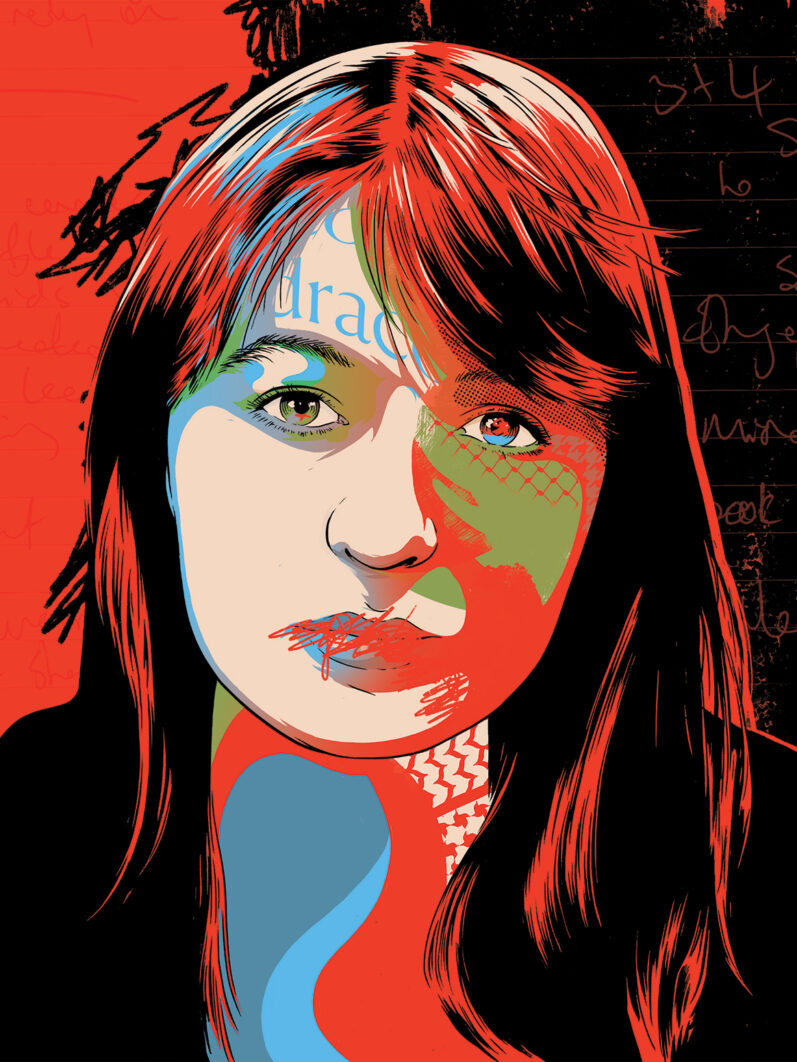
If you ever sought out the novels of Sally Rooney in bookshops – when that was still possible – you’d know they sit in the fiction stacks adjacent to the novels of another SR whose books have been withdrawn in dastardly political circumstances. Until last week, “Rooney” and “Rushdie” had little in common beyond being shelfmates; now they have more than just a physical proximity.
The circumstances of the withdrawal of books by either author have in each case their nuances – the causes and consequences are different. But let us try to understand this with a little more imagination. Let us take a leaf out of Rushdie’s book even, and imagine that books have lives and minds of their own. What might they be saying to each other? You can picture the portly, ageing Rushdie tome there on the shelf, taking by the arm its brightly coloured companion, the slim Rooney paperback, imparting valuable lessons about the life to come – how to cope with the confinement of the storeroom, or the physical terror of being remaindered… Most of all, though, the common ordeal of these books is the pain of separation from their loving readers.
Is it so fanciful to think about it this way? Sally Rooney’s novels brim with romances. But the real love affair in her writing isn’t between her characters; it is between book and reader. Recall the moment in Normal People when Connell’s reading of Emma is interrupted by closing time at the library. “He had to close the book and walk home in a state of strange emotional agitation,” Rooney writes. “He’s amused at himself, getting wrapped up in the drama of novels like that. It feels intellectually unserious to concern himself with fictional people marrying one another. But there it is: literature moves him.”
The literature Rooney has given the world has not moved as many readers as Jane Austen has, but enough will now find themselves in a state of emotional agitation. The library is not just being closed; the bookshelves are being emptied. From a cultural point of view, this is the starting point for any consideration of the issue: Sally Rooney’s books must be available to all who desire to read them. Instead, the law now seeks to forbid the tryst between reader and writer. Whatever laws and policies have led to the absurdity of some of the most beloved books of this century being unavailable to the public must be reconsidered.

On this, some of the most important cultural voices of our time have come together in agreement. Between them, the signatories to our New Statesman open letter have won every major literary prize. They include three Nobel laureates: Anne Carson, the most recent winner of the literature award, Annie Ernaux and JM Coetzee, a product of apartheid South Africa who knows a thing or two about repression. The wider Rooneyverse is also speaking up, from Paul Mescal, who first became a sensation after playing Connell in the BBC adaptation of Normal People, to the show’s director, Lenny Abrahamson. Among them, also, are independent-minded writers such as Zadie Smith, who has challenged the simplifying language used in some pro-Palestine protests. All understand that there is a principle at stake bigger than one’s personal views about Gaza, the Middle East conflict or Palestine Action.
At the crux of all this is the government’s draconian Terrorism Act – under which Palestine Action has been proscribed. One need not like Palestine Action to know there is a difference between a direct-action protest group and the splinters of al-Qaeda that dominate the UK’s list of proscribed terror groups. The group is not innocent of violence – one activist injured a police officer with a sledgehammer. But when the law was passed in 2000, ministers assured parliament that it was to apply to those threatening lethal, mass-casualty violence, not the kind of criminality Palestine Action has been guilty of. The High Court has already ruled that proscribing Palestine Action was out of proportion with its activities – a judgement since overturned in a still ongoing judicial process.
Designating a movement against genocide as a terror group was the first falsification of language. With the sprawling inevitability of the worst lies, the law has subsequently criminalised all expressions of support for this movement as terror offences too: this is the second falsification, for it is plainly not terrorism to hold up a sign. Rooney has been anathematised as a terrorist for pledging royalties to Palestine Action (this would be legal in Ireland, where she lives). This is the most egregious falsification: Sally Rooney is a writer, not a terrorist. Yet she would be arrested in the UK. And were her publisher to pass funds to her, it would become, in the law’s eyes, a terror financier. This is the final falsification, making out that the venerable home of the TS Eliot backlist could possibly be equivalent to the Haqqani network.
So here we have a law which has already seen over 3,000 peaceful protesters – many of them pensioners, one the daughter of a Holocaust survivor – carted off to police stations for expressing support for Palestine Action and opposing what leading scholars consider to be a genocide. The same law is now cancelling a politically active writer and forcing a publisher, in effect, to suppress her works. In his book Giving Offense (1996), Coetzee speaks of censorship as a “passion” with a “contagious power”. This, then, is a law with a passion for silencing, its many provisions spreading and mutating like some infectious madness.
The censorship of Rooney is indirect. It wasn’t intended by the framers of the Terrorism Act, nor by the current government. But the passion of censorship is uncontrollable; once you let it inside the law, there’s no knowing what petty new directions bureaucrats and magistrates will take it in.
The last time books by a controversial author were withdrawn from retailers was during the more heated affair over The Satanic Verses. The UK government, of course, had not banned Salman Rushdie’s novel, but a climate of fear had led to its voluntary withdrawal. The government has not intentionally banned Rooney’s books either; the withdrawal of her work is equally voluntary, but based, likewise, on a climate of fear. The difference lies in how the fear has been stoked. Rushdie’s censor was terrorism – actual terrorists, who spilled real blood over his book. In Rooney’s case, it is legislation. The proscription of Palestine Action under the Terrorism Act and all its smothering clauses makes out that Rooney herself is some kind of terrorist and creates a climate of fear for her publisher. To bring itself to this – the withdrawal of what are among its most lucrative titles (2.3 million copies sold in the UK to date) – Faber & Faber will have been terrified of being sanctioned. All this over something an author, ultimately, has said – a stated intention. Critics argue that she should simply disavow this intention, and the books would again be available. They sound a little like the extremists who said Rushdie should revert to Islam. A free society doesn’t ask its writers to recant. It asks the government to recant from the restrictions it imposes on them.
We are, slowly, losing the freedom of expression we expect of this country, at a time when its alliance with a state so credibly accused of the worst possible crime – genocide – demands the most vigorous scrutiny. Rooney has shown us that the laws aren’t fit for purpose, that writers cannot always dissent from government policy with the outspokenness and commitment that is their right.
We have gone backwards. In 1972, after winning the Booker Prize, John Berger donated his winnings to the Black Panthers, whose forceful protests were not unlike Palestine Action’s. It was controversial, but Berger was charged with no crime. In 2026, by contrast, Rooney will find her books there beside the whiskey and cigarettes smuggled as contraband across the Irish border. We will go to shelves marked “R” in bookshops and find once more a gaping hole. It’s 2026, but we are reminded of a heinous kind of history. After the Library of Alexandria was pillaged, Edward Gibbon writes, “the appearance of empty shelves excited the regret and indignation of every spectator”. Bookshop shelves are now going to be pillaged by the law. The same regret and indignation is called for today.
[Our open letter: Sally Rooney is a writer, not a terrorist]
Content from our partners



Related
This article appears in the 21 Oct 2026 issue of the New Statesman, Sally Rooney is a writer, not a terrorist
Join the debate
Subscribe here to commentPlease read George Packer’s piece in The Atlantic for a much better comment on this affair than this rambling silliness. TLDR of Packer: Palestine Action have done things that are clearly anti-Semitic; the group should still not be classified as a terrorist group; Rooney herself shows little commitment to free speech for people who disagree with her
Sadly, the NS’s piece, in trying to equate Rushdie and Rooney, abandons logic. It attempts join dots that belong on different pages. Serious arguments should be based on logic not angry emotion
The crass and ludicrous comparison in the first paragraph between Rooney’s situation and what Rushdie has endured since before she was born, including his attempted murder, vitiates anything else that you have to say about her self-chosen position. There’s lacking perspective, and then there’s just lacking all sense whatsoever.
Then there is that final paragraph. John Berger could do what he liked with the Booker Prize money, but not fund terrorists. And he didn’t fund terrorists. British Black Panthers were not proscribed – nor did they engage in activity remotely similar to that of PA. They were not linked directly to the US BPM, and it is nor was illegal to fund them as a British citizen. So, Tanjil has book-ended his article in a really poor way, which fatally undermines its credibility.
Your argument that the British Black Panthers aren’t terrorists and Palestine Action are entirely misses the point. The Government chose to proscribe Palestine Action despite its tactics and strategy being about property damage not violence against people, which the Rashid argues were similar tactics to the British Black Panthers.
The difference between how authors funding the two groups was treated in UK law has nothing to do with any innate difference between the groups, but in the content of the Terrorism Act and the Government’s decision to proscribe Palestine Action under it.
Relying on their proscription as justification is simply a circular argument “group x is a terrorist group because the government decided it is a terrorist group.” it doesn’t justify why.
To be fair you also say that the tactics were different: fine that is a logical argument. No two groups are identical, but if you want to make that argument the question is not “are the British Black Panthers and Palestine Action’s tactics different in any way?” but rather “Why should Palestine Action’s tactics put them and their supporters in the same legal category as ISIS rather than in that of the British Black Panthers?”
I’ve not heard anyone defending the prescription of Palestine Action convincingly answer that question.