
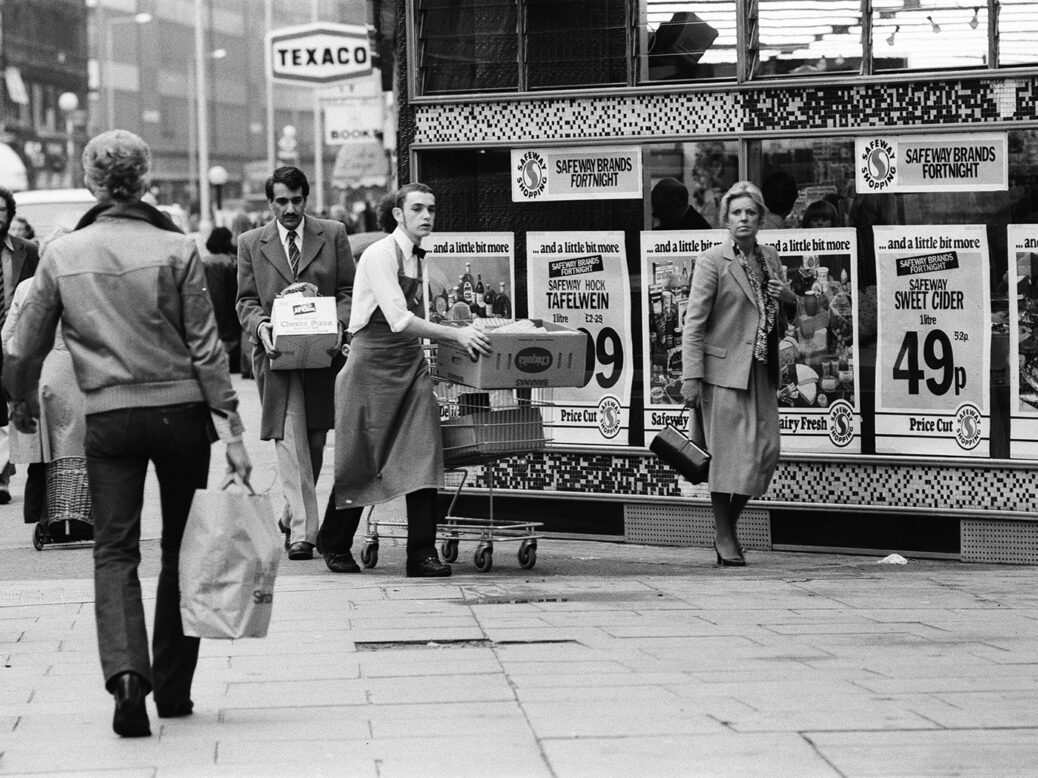
Andy Burnham and Nigel Farage have something in common: neither man can stop talking about the Eighties. Each believes in his own way that it’s all been downhill since Bananarama were in the charts and Arnold Schwarzenegger was the world’s most important actor.
For Farage, the Eighties were Britain’s greatest decade. In October 1986 the London Stock Exchange switched to electronic trading and the financial services sector was deregulated. The City boom took Farage on regular trips to Reagan’s America, where his political character took shape in an environment of shameless greed. Like Donald Trump (also very much a creature of the Eighties) he favours the baggy, double-breasted suits of that decade. On the day Liz Truss announced her fateful plan for the UK economy, Farage tweeted: that it was “the best Conservative Budget since 1986”.
For Andy Burnham, 1986 was the year of the Smiths’ The Queen is Dead album, and the year his English teacher told him to think about applying to Cambridge. But it was also when the UK deregulated its bus services – the error Burnham corrected with his Bee buses in Manchester, and one of “a series of wrong turns” the country took in what he calls 40 years of “flawed thinking”. The selling off of the country’s water, energy, steel, telecoms and transport services turned Britain into a country that takes its orders from the market, a state that can’t fix things because it doesn’t control them.
So, was Britain better off in 1986? An economist would say no. Today, people live an extra six years on average, our GDP per capita is about 75 per cent higher and our real household disposable income (RHDI) has roughly doubled.

It’s hard to argue with greater life expectancy, but RHDI isn’t as real, or as disposable, as it sounds. I’ll spare you the detail, but it includes money you can’t spend (the imputed value of things you own, such as property and pension assets) and it leaves a lot out. Rent, for example: in 1986, rents across the UK averaged about 15 per cent of tenants’ income. Today, rent takes up about 36 per cent of tenants’ income, and in some London boroughs that rises to over 50 per cent. An entry-level knowledge worker in the capital is, in real terms, paying their landlord three or four times what their parents spent on housing.
The same principle applies to some of the other major costs. In 1986, the best-selling new car was the Ford Escort, at about £5,000 (roughly £15,000 in today’s money). Today, the most popular new cars (such as the Jaecoo 7 or the Ford Puma) start at around £30,000. Insurance varies a lot, but, again, costs roughly twice as much after adjusting for inflation. Energy bills were lower for a long time, but recently – thanks to Vladimir Putin and Donald Trump – returned to affordability levels last seen in 1986. Water bills, once adjusted for inflation, are more than twice as expensive as they were in 1986.
What this means is that while you might have twice the “disposable income” (as viewed by an oddly calculated economist’s measure) of someone in 1986, you are also paying twice as much, if not more, for many equivalent goods and services, and even more for the biggest expense: housing (this is also true if you’re a homeowner – house prices as a multiple of earnings have roughly doubled).
Some people are much better off, especially pensioners; the state pension in 1986 was half as generous. Rich people are also having a much nicer time; the income share of the top 1 per cent of earners has also roughly doubled since 1986. Students, on the other hand, were actually paid to go to university in 1986. Today they leave with an average of £47,900 in debt.
There are also lots of things that economists count as “discretionary spending”, but which are, in real life, not optional. How many people do you know who could reasonably avoid paying for a smartphone, a laptop, a broadband connection?
It has also become less easy to not spend money. In 1986 consumers spent around £900m (in today’s money) on cassettes and vinyl records, which they chose individually – true discretionary spending – and kept. Today, people in the UK spend more than £2bn a year on streaming services, so we are paying more than twice as much for music (and when you stop paying, you lose access entirely). The same is true of TV; in 1986, VHS machines were still very expensive, and most people just watched what was on (the TV license cost the same, adjusting for inflation). Today, the UK spends well over £5bn a year on streamed video. We can access more music and TV than ever before, but we do so in a more passive, inevitable way. An economist will tell you your purchasing power has grown – but so has the market power of the platforms selling the things you want.
Should we try to go back to 1986? Obviously it would be great to see Chris de Burgh back in the charts. But the past is a foreign country, for which none of us have a visa. The real question is which aspects of the Eighties we want to regain. For Burnham, it’s affordable housing and a state with greater control of its spending; for Farage it’s a Britain with much lower immigration and a less regulated economy. Voters who envy the past may come to find either proposition attractive.
[Further reading: Andy Burnham’s vision for Britain]
Content from our partners


Related

This article appears in the 07 Oct 2026 issue of the New Statesman, The Suspicious Relationship
Join the debate
Subscribe here to comment