
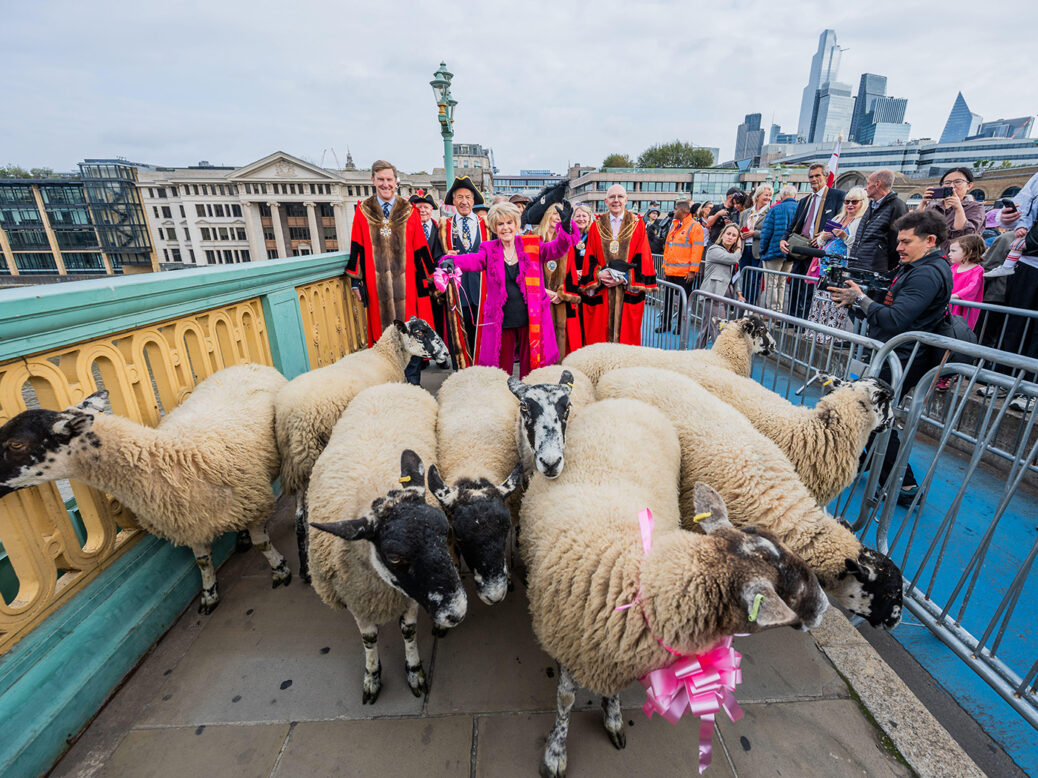
The views from Southwark Bridge are something to behold: St Paul’s Cathedral, majestic city skyscrapers, the Tate Modern’s soaring chimney… and the sheep. There are nine of them, mildly ambling down the pavement of the bridge in the shadow of the Shard. They are the calmest thing about this scene, which includes crowds of camera-wielding spectators shouting encouragement as figures in bright red robes urge them (the sheep, that is, not the spectators) across the river. The cycle lane has been co-opted as a pen for the next batch of wannabe-shepherds, who have been corralled there to wait for their turn at sheep driving.
“Is your job to herd the sheep?” I ask a volunteer in a scarlet cloak attempting to maintain a sense of order. He gives me a withering look. “The sheep herd themselves. My job is to herd the people.”
Welcome to the Woolmen Sheep Drive, when the countryside is ushered into the heart of the City of London. For one day a year, lucky individuals granted Freedom of the City are invited to exercise their ancient right to cross the river toll-free and lead their livestock to London’s markets. They enjoy other privileges: if sentenced to death they have the right to be hanged by a silken rope, and if they are discovered drunk, the police are meant to take them home rather than throw them in a cell – although the Master Woolman (David Hopkins to his friends) admits, “I don’t think the Metropolitan Police are taught that these days”.
Driving sheep and cattle across the river (originally over London Bridge) ceased from the mid-19th century onwards as the markets stopped trading in livestock and the roads filled up with motor vehicles. And that was that – until 2013 when the Worshipful Company of Woolmen decided to revive the tradition via the more practical Southwark Bridge as a way to celebrate the City’s history and raise money for charity. “The plan was written and accepted, veterinary surgeons were arranged, traffic barriers were ordered, security stewards briefed and portaloos booked,” Bill Clark, the former Master of the Woolmen, reflects.

On my visit the bridge is full of people – some in traditional guild robes and hats, some in their best country tweeds, a couple inexplicably dressed as sheep – who have come to join in. I even spot a few sheepdogs looking miserable and redundant. The schedule is packed and tightly orchestrated – no wonder, as a record 1,200 Freemen and their guests are taking part, along with thousands of spectators.
Those who don’t have any sheep need not feel excluded – indeed, Freemen are discouraged from bringing their own. To paraphrase Ian Paisley: “Sheep will be provided”. The 50 or so north of England mules (they walk the bridge in small groups and get a rest at each end before heading back again) come courtesy of David and Barbara Seamark from Bedfordshire and are, I am repeatedly assured, “show sheep” who are used to dealing with crowds and won’t panic in urban environment. These are distinct from the “petting sheep” entertaining children on the north side of the bridge, and from the “shearing sheep” further up at the Livery Fair, who are enlisted throughout the day for demonstrations of traditional hand-shearing. If you’ve ever wanted to see a man expertly shave his way around a sheep’s penis with a pair of giant scissors while the animal sits upright like a rag doll on the brink of mutiny, this is your chance.
Beside the shearing pen is a food van somewhat insensitively selling lamb burgers, although by the length of the queue no one is bothered by the morbid irony. The street is packed with members of various Livery Companies letting visitors try their hand at ancient crafts: wheelwrighting, basket-weaving, bow-making. They are joined by sheep-related organisations from further afield who have brought a host of traditional looms and spinning wheels and are showing off. The Cotswold Woolgatherers’ stall boasts a certificate reading “From sheep to jumper: 8 hours 54 minutes – 2nd fastest team in the world”. I note that the wool from the recently hand-shorn sheep has vanished.
All this is happening under the auspices of the City of London, a mysterious institution so old no one bothered writing down when it was incorporated. London – Londinium – is a Roman invention, as are the City walls defining its boundaries. “The City of London shall have/enjoy its ancient liberties” declares Magna Carta of 1215, but its privileges date back to before the Norman Conquest; a document from 1067 from the City’s archive, currently on display at the British Museum as part of the Bayeux Tapestry exhibition, records William the Conqueror confirming the continuation of the existing rights of the citizens of London. The City of London could make a case for being older than the concept of England as we know it.
It has also maintained its unique status, subject to its own strange rules and customs, whilst serving as the engine of the economy over 800 years of history. From the establishment of the Bank of England in 1694 to loan money to a cash-strapped government at war with France, to the financing of the industrial revolution and the country’s imperial ambitions, the story of Britain’s success as a nation is bound up with the success of this rabbit warren of ancient alleyways, now dwarfed by looming skyscrapers.
Modern politics too is stamped with the City’s mark. The “Big Bang” deregulation of the financial markets in 1986, centred on the London Stock Exchange, cemented London as the finance capital of the world and fuelled another decade of Thatcherism. Its legacy is felt in Westminster today – technically a separate city to London – in the emergence of Nigel Farage, who cut his teeth in the City’s trading floors, and Andy Burnham’s reactive determination to rebalance Britain away from its historic centre.
And still, its traditions live on. Within the Square Mile that makes up the City, demarcated with 14 dragon statues, the Lord – or more recently Lady – Mayor of London, elected each year by the liverymen, theoretically holds precedence over everyone other than the sovereign. It is one of the oldest continuous civic offices in the world, although not quite as old as the Worshipful Company of Woolmen, which is first referenced in 1180.
The Livery Companies, which evolved out of the guilds, are a cross between professional networking bodies and secret societies. Become a member and you too can wear a bright cloak and floppy hat, as well as get invited to all the best dinners. Back in Medieval times, these associations of merchants, artisans and tradesmen held tremendous economic and political power. The earliest include the Weavers, Bakers, Skinners and Cordwainers, alongside the Woolmen. But there are now over a hundred, as new ones are founded all the time to reflect changing industrial trends – the most recent being the Worshipful Company of Human Resource Professionals, which charts its history way back to February 2026.
“All livery company members must be Freemen of the City of London so they’re all entitled to drive the sheep,” I am told by Master Woolman Hopkins as we amble across the bridge towards the end of the day, carefully avoiding piles of sheep droppings. But Freedom of the City can also be bestowed upon outsiders deemed worthy of the honour. Recipients include Ian McKellen, Nelson Mandela, Jimmy Choo, Tim Berners-Lee, Barbara Windsor, Mark Carney and the 2022 England Women’s football team. One of the later additions is the actress Gloria Hunniford, who along with the Lady Mayor kicked off this year’s sheep drive wielding a crook decorated with a pink ribbon to highlight Breast Cancer Awareness month. There are whispers that an offer is under consideration for Taylor Swift, if she fancies a trip down to London next year.
Hopkins acknowledges the celebrity sparkle is a big part of the day, but stresses the historical importance of both the sheep drive and the guilds, his in particular. “For hundreds of years wool was the staple product of the economy,” he reminds me, having spent some time extolling the virtues of wool as a sustainable natural fibre. “Edward III required his Lord Chancellor to sit on a bale of wool.” That’s the origin of the Woolsack that sits in the House of Lords, and, indirectly, the bar inside the Palace of Westminster for parliamentary staffers. The wool trade 800 years ago played a similar role to today’s financial sector, underpinning the country’s prosperity. “This is the biggest event for the Woolmen,” he says proudly, adding that it’s second biggest event in the City of London’s calendar, after the Lord Mayor’s Show. “It’s the one that puts our company on the map.”
Hopkins’s own background is not in wool but in chartered accountancy. This, I am told by an eager Woolman apprentice, is hardly unusual. While companies for modern professions do exist (the aforementioned HR, for example), people from all industries can now join the ancient guilds. He himself works in IT. If I wanted one more suited to my skillset, might I consider the Worshipful Company of Stationers and Newspaper Makers?
And for a moment, I am tempted. There is something intriguing about the fusion of the arcane and the modern represented by the Livery Companies, their emblems and incantations breathing colour into the monochrome glass and steel skyscape. At a time when defending London’s commercial centre has become deeply unfashionable in Westminster, they remain the City’s unapologetic champions – guardians of its heritage, just as the 14 watchful dragons guard the Square Mile itself.
If I am to join, though, there is one last thing I need to know. I ask the Master Woolman: what if someone with Freedom of City wanted to exercise their right on one of other 364 days of the year, bringing their own sheep to cross Southwark Bridge? He winces. “I think they’d be very foolish to – given the traffic.”
[Further reading: We have all desecrated Diana]
Content from our partners



Related

Join the debate
Subscribe here to comment