
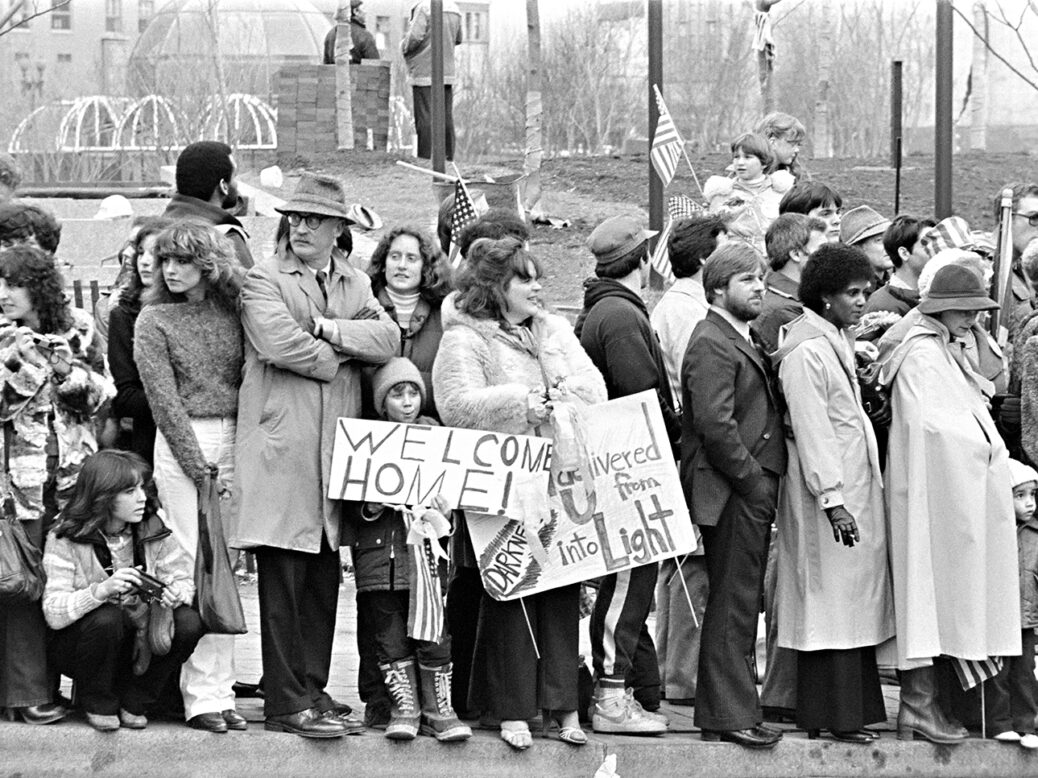
Jimmy Carter lost the November 1980 presidential election to Ronald Reagan after failing to spring an “October surprise” by securing the release of US hostages in Iran. Seven years later, Christopher Hitchens wondered if new revelations about Reagan’s dealings with Iran might shed light on the strange events of 1980.
Last time I wrote about the doings of the Reaganites, I suggested that in order to understand them you needed the nasty sort of mind that is possessed by a District Attorney in a Mafia case. Only thus can the nexus of deniable orders, hush money and dummy companies be made to make sense. On 25 June, Judge Abraham Sofaer decided to illustrate my point. The judge is a legal advisor to the State Department, and has been highly prized in the past by Reagan and George Shultz [US Secretary of State] for his ability to make things legal after the fact. But he has had enough. In a deposition made to the Congressional investigation, he had this to say about the behaviour of his superiors:
“Generally, the whole thing smelled to me like the kind of thing you see in a trial – and I’ve presided over hundreds – in a narcotics case, for example, where they refer to the drugs as ‘shirts’ or something like that. You always have some kind of phrase that you use to describe what you’re selling when you don’t want to talk about it directly.”
It’s not every day that a senior Administration lawyer makes an analogy between his bosses and organised crime. But then it’s not every day that you find ground-to-air missiles being described, in forged memoranda, as “oil-drilling equipment”. It has become suddenly clear that there was real panic in the White House last November, and that the attempt to cover up the sale of weapons to Iran and the transfer of dirty money to the contras was authorised at the highest level. As so often in these cases, it is not the original sin but the bungled cover-up that leads to grief.

Much is beginning to turn on a memo dated April 1986. This memo is in the form designed for Presidential approval. Originating with Oliver North and revised by Admiral Poindexter, it boldly sets out a scheme to milk the Iranians for the contras. If it can be shown that Reagan did actually see that memo, then he can be impeached.
We don’t yet know for a certainty that Reagan did see it, though Admiral Poindexter is known to have cleared everything else with him. A hint of the significance of the memo was provided by Assistant Attorney General Charles Cooper, who was questioned last week. He was asked what was the reaction of his boss, Attorney General Edwin Meese, to the discovery of the document.
My recollection is that the attorney general said something analogous to, ‘Oh, darn.’ But it’s perhaps more strenuous than that.
What a strange reaction from the nation’s leading law officer! It is possible to interpret in more than one way, of course, but it does sound rather as if Mr Meese was annoyed without being surprised. This impression is reinforced by the discovery that Mr Meese lied several times during his famous 25 November press conference. Mr Meese was also present at meetings where evidence was altered and where the shredding of documents was facilitated. It was this aspect of the scandal which led Judge Sofaer to edge nervously towards the door and try to get on the right side of the investigation.
The Administration’s life is going to get more and more miserable as one rat after another springs overboard. Already the cover-story is in tatters, and the Justice Department is reduced to attacking the special prosecutor for spending too much money and taking up too much office space. These are the ploys of a cornered and desperate cabal, whose last hope is the widespread and contemptuous belief in Reagan’s stupidity and amnesia. Only that belief can save him.
Just as the mills of the law are starting to grind smaller and smaller, a nightmare has re-emerged from the forgotten past. At the moment it is only a hypothesis; a suspicious muttering among people like myself with nasty minds. But evidence and testimony are beginning to accumulate. The question is – did the Reagan team steal the 1980 election? Let me explain.
When the Tower commission investigated the covert sale of arms to Iran, it limited itself to the transactions that took place after 1985. These transactions involved the American hostages held by alleged Iranian proxies in Beirut.
But it has now been established that the shipment of arms to Tehran began in February 1981, a few weeks after Ronald Reagan was inaugurated as President. At that time, there were no American hostages in Tehran or Beirut. Nor were there any of the fabled Iranian “moderates” in prospect. So for what ‘quid’ were those arms a ‘quo’? The theory now current is that the Reagan team made a deal with the mullahs before the 1980 election. The mullahs were to keep the American embassy hostages and refuse to release them to Jimmy Carter. In return for this electorally disastrous humiliation, the incoming Reagan administration would ship badly-needed spare parts and weapons to the American-equipped Iranian armed forces.
This may sound the stuff of which paranoid conspiracies are woven. But it becomes more believable upon examination. We know that the Reagan camp in 1980 set up a special paramilitary committee, headed by William Casey, Edwin Meese and Richard Allen. These veterans recruited a network of serving and retired CIA and military officers, with the explicit intention of denying Jimmy Carter an ‘October surprise’. (This was the code-name for his frantic effort to release the hostages in time for the 4 November election.) We also know that Richard Allen and Robert McFarlane met with an unnamed envoy of the Iranians in October 1980. They refuse to say more about the meeting, which was only revealed this year. But Abolhassan Bani-Sadr, who was President of Iran at the time, says that two ayatollahs were in contact with the Reaganites that month, planning the humiliation of Carter in return for weapons shipments after the elections. He names one of the ayatollahs as Hashemi Rafsanjani, speaker of the Iranian parliament who has since emerged as the main Iranian contact in all subsequent secret arms trading with Washington.
OTHER TANTALISING details are starting to emerge. Ms Barbara Honegger, who worked on the 1980 Reagan campaign and was later rewarded with a job in the White House, recalls being in the campaign ‘Operations Centre’ one night in October 1980, and hearing an exultant senior staffer say, ‘We don’t have to worry about an October Surprise, Dick cut a deal.’ Dick was Richard Allen, who later became Reagan’s first National Security Advisor.
In 1984, there was a brief scandal when it emerged that the Reagan 1980 campaign had pilfered Jimmy Carter’s briefing papers and cribbed his notes for the Presidential debate. The Congressional investigation into ‘Debategate’, as it was frivolously known, unearthed a lot of detail about the destabilising ‘October Surprise’ team. (An attempt to set up a criminal investigation was blocked by the Justice Department, which fought the idea tooth and nail.)
But among the discoveries made by the Congressional inquiry was a cache of documents in the files of Edwin Meese and Ronald Reagan. The documents were classified papers from the American embassy in Tehran. It was established, in the words of the inquiry’s report, that these papers ‘were obtained from Iran after being in the possession of Iranians’. That made no sense in 1984. It makes sense now.
If there was collusion with Iran as far back as 1980, then the evident panic in the White House today needs no further explanation. Ronald Reagan owes his election to the reverses suffered by Jimmy Carter in Iran.
If it can be shown that he and his advisors deliberately contributed to those reverses, and deliberately prolonged the captivity of the hostages, then impeachment would be the least of it. And the whole moral basis of the ‘Reagan revolution’ would be retrospectively abolished.
Watch this space.
[Further reading: From the archive: Jim Callaghan’s still small voice]
Content from our partners



Related
This article appears in the 21 Oct 2026 issue of the New Statesman, Sally Rooney is a writer, not a terrorist
Join the debate
Subscribe here to comment