
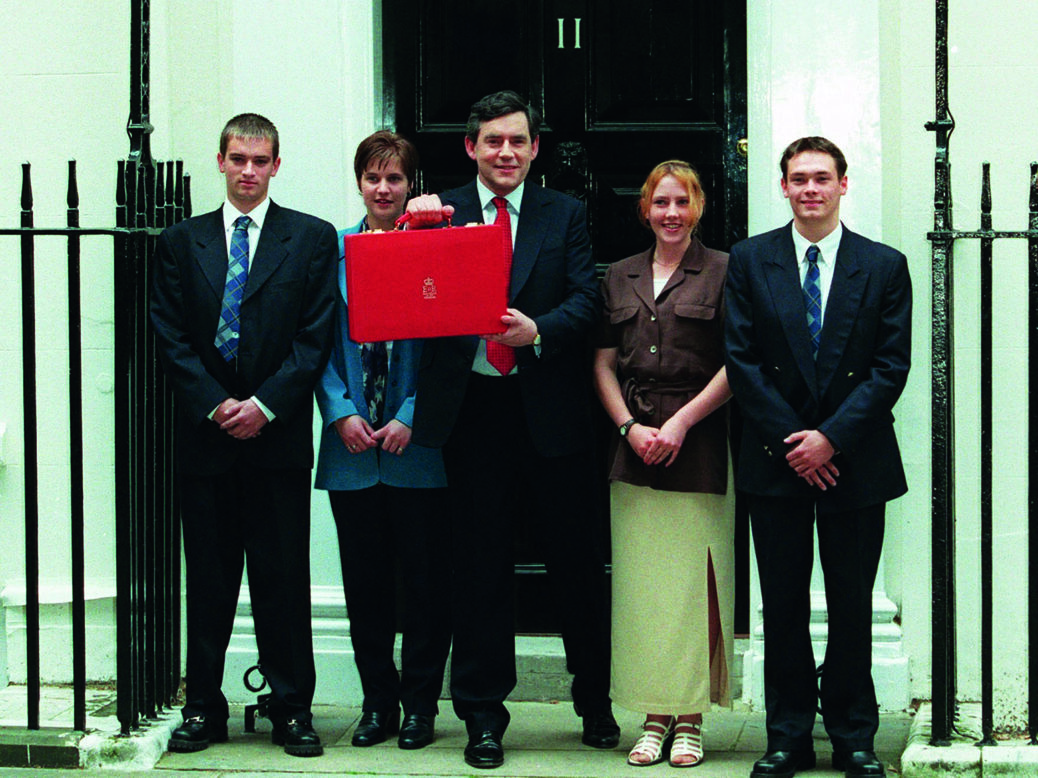
The Budget delivered by Gordon Brown on 2 July 1997 was the first by a Labour government for almost two decades. In a broadly positive response in its editorial, the New Statesman sounded a note of warning – that the chancellor was setting small resources against towering ambitions.
It was not exactly a Bacchanalian revel out there on the floor of the Commons. Armed only with a glass of water, Chancellor Gordon Brown delivered his first Budget as if he expected bad light to stop play. Without pausing to make a single joke (the only laughter was when it transpired that the £1.3 billion he has found to repair schools will be parcelled out over five years, rather than one), he took just one hour to lay the foundations of the new welfare state. With productivity levels like the Chancellor’s, the world will soon be talking about the Tigers of Albion, or should that be the Tigers of Caledonia?
Brown produced a Budget that confirms both the excellence of the new government’s intentions and the genuinely serious difficulties which lie in the path of their realisation. Just as new Labour in opposition always sounded inhibited, because it feared awakening voter memories of past profligacy, new Labour in government sounds inhibited because its ambitions are so large and the funds available for their furtherance so constrained. There is no point wishing it were not so: the government would not be in the commanding position it now enjoys had it proceeded much differently.
So the best we could hope from this Budget was that it would signal, on all fronts, the right direction and this it has accomplished: it speaks to under-investment, it attacks unemployment, benefits traps and social exclusion; it spends more on education and health; it taxes environmental damage and it indicates a cautious return of confidence in the financial probity of local government. Moreover, it does all of these things within a credible framework of economic stability, which closes no doors to Europe.

The steps taken, however, range from the confident stride to the nervous tiptoe. In juggling business taxes, the windfall tax and dividend tax relief, the Chancellor did well, broadening his appeal to small business, while plucking a few feathers from the corporate goose without risk of too much hissing. If his macroeconomic strategy works, and higher short-term interest rates are rewarded by lower ones in the longer term, he will have made a significant improvement in the operating conditions for British business.
Full architect’s drawings for the new welfare state will, properly, have to await the outcome of various reviews, but the determination of the assault on unemployment shows Brown at his most committed. If the government can marshal business and the voluntary sector to help deliver this programme, it will make a significant difference. The Chancellor was also right to place heavy emphasis upon child care in addressing the question of lone parents.
The rest of the Budget was performed on tiptoe. Brown’s green taxes showed no imagination and he will need to discover, between now and next spring, a coherent approach to the taxation and regulation of carbon emissions, across transport and power generation, if Britain is to have any hope of meeting the CO₂ reduction targets so proudly trumpeted by Tony Blair at the Earth Summit in New York.
In the spending department, having nailed himself to Kenneth Clarke’s cross, there was not much to be done: the little offered on education and health are welcome, though they cannot conceal that Labour as yet has no strategy on the mismatch between health supply and demand.
On the subject of local authority finance, Brown released capital receipts, but retained capping, and mentioned a previously un-noticed review of local government funding. With most of the extra money raised in taxes hugged close to the Chancellor’s chest (in the contingency reserve) or set aside for deficit reduction, there is no sign yet of the level of confidence or innovation we need to give financial meaning to Labour’s devolution programme. Brown must beware Treasury Knows Best Syndrome. It can be fatal.
So this is a disappointing Budget only if you think new Britain can be built in a day. The construction programme must be managed against a grimly familiar background: sterling is too volatile and, latterly, too high; inflation is creeping up as the economy hits capacity constraints; interest rates must go higher, but how much higher?
But Brown has laid the foundation stone. Most of his many reviews have only a year to do their work. His next Budget, in spring 1998, will be harder to make than this one.
[Further reading: From the archive: Proposals for a revenue tariff]
Content from our partners


Related
This article appears in the 28 Oct 2026 issue of the New Statesman, Bin the Budget
Join the debate
Subscribe here to comment