
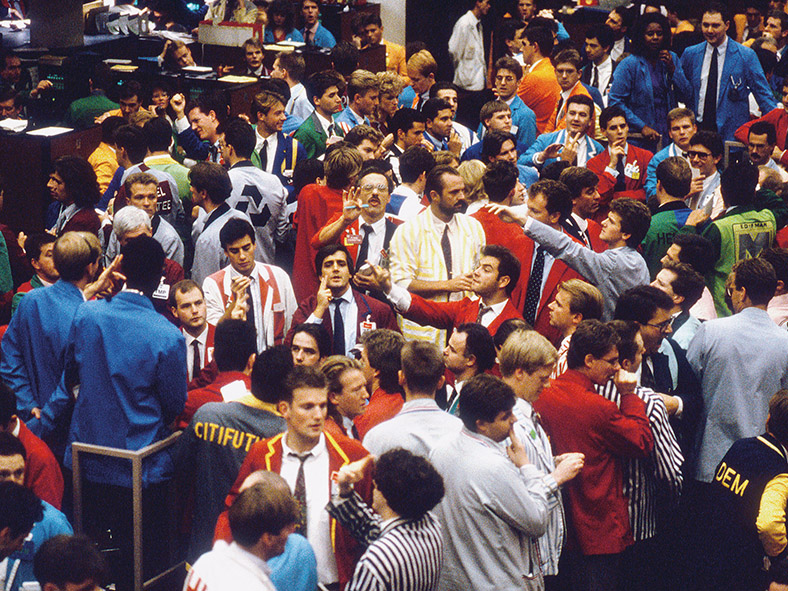
In 1998, German computerised financial exchanges were competing with London’s old-school trading floors. Ed Crooks, then a technology reporter at BBC News, predicted that “fat cat” professionals, rather than manual workers, would be the main casualties of the coming data revolution
The trading floor of the London International Financial Futures and Options Exchange, Liffe, is an inferno of the unbound profit motive, a bedlam of frantic buying and selling. The garishly dressed traders shout and gesture at each other across the pits, knowing that they can make or lose a fortune in a matter of minutes. This is the City of London red in tooth and claw, and apparently rampant. But there is a smell of desperation in the air. The traders are masters of a dying art. And this trading floor is 1998’s equivalent of Ravenscraig or Flint, Michigan.
Liffe was the City’s great success story of the 1980s. Just five years ago, it was so far the pre-eminent futures exchange in Europe that its competitors in France and Germany were barely mentioned. Today, the exchange is in deep, deep trouble. Its German rival, the DTB, is gaining fast, and has already bitten off big chunks of its market.
The Germans are succeeding with the traditional German tactic of using the latest technology to make themselves quicker, cheaper and more flexible than their competitors. Where in London there are a lot of highly paid men – almost all men – yelling their orders to buy and sell across the trading floor, dealers on the German exchange sit in offices, which could be anywhere in the world, trading on computers. If London wants to keep up, it will have to start using computers too. One of the exchange’s senior people has suggested that within two years the trading floor could be gone for ever.

The story of Liffe is just the most dramatic example of the way that new technology is beginning to revolutionise highly paid middle-class careers, which have until now been relatively placid and secure. Smug professionals who have enjoyed the gains from new technology without taking any of the pain may be about to get their comeuppance.
Over the past 20 years or so, Britain has become a much more unequal society. The rich have got a whole lot richer, and the poor have, at best, got only a little less poor. The cause has had very little to do with 20 years of Conservative rule, and just about everything to do with technological change. Manual and clerical jobs have been destroyed by automation, and the pay and conditions of manual and clerical workers have suffered. Highly skilled, highly educated people have been relatively unscathed, and those with skills in demand have been rewarded accordingly.
But in the future high-powered computers and the Internet will wipe out many professional jobs, too. A new study from the Institute for Public Policy Research has found that professionals are now more worried about their job security than manual workers. And with good reason. If the archetypal victim of automation was a steelworker in the 1980s and a bank clerk in the 1990s, then in the next decade it could well be a stockbroker or a lawyer.
Share dealing, for example, is being transformed by the Internet. The American stockbroking firm Charles Schwab says half its customers now buy and sell their shares not by talking to a broker, but through their PCs. If you want to call for information, you can talk to a machine – not an answerphone, but a sophisticated computer – which will tell you what you want to know.
The result is that each deal costs only tens of pounds, often less than £20, compared with the hundreds charged by traditional brokers. No wonder old-fashioned firms are worried. Most are reinventing themselves as “investment managers”. But given the generally ropey state of advice – chimpanzees and parrots have famously given better advice than many stockbrokers – few people may be prepared to pay hundreds of pounds extra for such unreliable guidance.
The investment firm Pareto Partners has in its London offices an innocuous-looking Apple computer with a potentially explosive impact. It runs a system that has been christened, in tribute to its awe-inspiring abilities, RoboTrader: part-woman, part-machine, all trader. Its origins are somewhat mysterious: it was developed in conjunction with the missile-guidance experts at Hughes Aircraft’s top-secret labs in California, and much of the work behind it is still classified.
But the principle is straightforward: the computer has been given all of the knowledge, expertise and judgement of one of the firm’s top traders, Christine Downton. It uses that knowledge to process tens of thousands of items of economic and political information from around the world, and then works out what to buy and what to sell.
It is not just as good as a human analyst, it is better. The returns of RoboTrader have consistently beaten the market average by two to four percentage points. In the investment business, that is an extremely impressive margin of extra profitability.
It is a bit like chess: even very sophisticated computers could be beaten by the world’s top players, because the computer’s ability to process millions upon millions of possible different positions was still inferior to a highly skilled human’s instinctive sense of position and strategy. But once computers become powerful enough, then even the best people can be beaten. When IBM’s Deep Blue beat Garry Kasparov last year, we apparently reached that point in chess; we may be rapidly approaching it in finance, too.
The City is not the only job market being turned upside-down. Lawyers can also easily be replaced by computers. An enormous amount of the bread-and-butter work of most solicitors is routine and mechanical. A new Internet site, FreeLaw, will soon make it possible for people to do a lot of that routine legal business – from getting a divorce to buying a house – for free. You will be able to look up the relevant web page, and then be guided through all the necessary steps. Only if you want more complex advice will you have to speak to – and pay for – a real live lawyer. In the United States, it’s now possible to get a divorce at an automatic booth. And, although most people may not particularly enjoy talking to a computer, they probably like talking to a lawyer even less.
The Internet makes it possible for the knowledge of one lawyer or one firm to be distributed around the country, potentially doing for local legal practices what Sainsbury and Tesco have done for local village stores. The rewards for a few big names will be high, but many smaller firms will find it impossible to go on. The Law Society is predicting that a third of the country’s 10,000 law firms will go out of business. Computers are bound to accelerate that process.
A similar system is being developed to use the Internet in the NHS: cutting costs by enabling top-level medical expertise to be distributed around the country. But there is a crucial difference. At least some of medicine is necessarily “hands-on”. Doctors have to meet and talk to people, to ask how it feels and where it hurts, and they have to set bones and stitch wounds physically. Those are jobs that a robot may do one day, but not in any of our lifetimes.
The American environmentalist Jeremy Rifkin, among others, has warned that we are heading for a world in which only a fortunate fifth of the population has properly paid, stable employment. These people, it is said, will be the hi-tech elite – the “symbolic analysts” as they are sometimes known – the highly educated computer-literate manipulators of data: bankers, engineers, consultants and so on.
But as the economist Paul Krugman of the Massachusetts Institute of Technology has pointed out, manipulating data is in general something that computers are better at than people. What’s more, data knows no borders, and data processing is the classic internationally mobile business. If they survive being replaced by a computer, the symbolic analysts of the US and Europe may find themselves replaced instead by cheaper competitors in Mauritius or Bangalore.
In fact, the best jobs to have in the 21st century will be the ones that only people can do. That means jobs which demand face-to-face contact, and skills in handling not strings of zeros and ones, but real things in the real world. And those skills will be distributed much more widely than just the elite top fifth of the workforce. There are plenty of things that people are still much better at than machines. Deep Blue may be better than Kasparov at chess, but in a competition to unblock a drain, for instance, or get a duvet into a duvet cover, Kasparov would still have the edge.
There is plenty of evidence that people are aware of this truth about the changing world of work. Cooking, for example, has become a desirable career choice. Ten years ago, catering was close to the bottom of the pile in terms of pay, prestige, conditions and prospects. But in London, at least, that is no longer true. Restaurant chains such as Chez Gerard offer training programmes and career development. Young cooks can, with a bit of effort, get to £30,000 a year quite quickly. Several have become very rich indeed.
Gardening, too, is rising rapidly up the popularity charts. Colleges offer courses for people wanting to train as gardeners, which are attracting many professional people who hope to change careers. Those who trade in stockbroking for gardening can at least be confident that their jobs have stayed the same for centuries and are likely to remain the same for centuries to come.
Think, too, of the huge growth of personal services: personal trainers, personal shoppers, personal assistants. In many of the new occupations that have boomed in the 1990s, it is the human relationship that is all-important. We want an understanding with a person, who knows what we want and how we feel, not a pre-programmed machine.
We have become used to the idea that new technology always replaces unskilled workers. But this has been the case only relatively recently. The main victims of the Industrial Revolution in England, for example, were among the most skilled of all workers: hand-loom weavers. Their jobs were destroyed, while many unskilled jobs were created in the new factories.
Brokers, lawyers and accountants may be the hand-loom weavers of our era: for a while they have benefited from a temporary conjunction of markets and technology, but in time they may find themselves swept away by the winds of economic change. The future may belong not to hi-tech elites, but to the cooks and the therapists, the plumbers and the gardeners.
[Further reading: From the archive: Life under Cameron]
Content from our partners



Related
This article appears in the 24 Sep 2026 issue of the New Statesman, A Sense of Power
Join the debate
Subscribe here to comment