
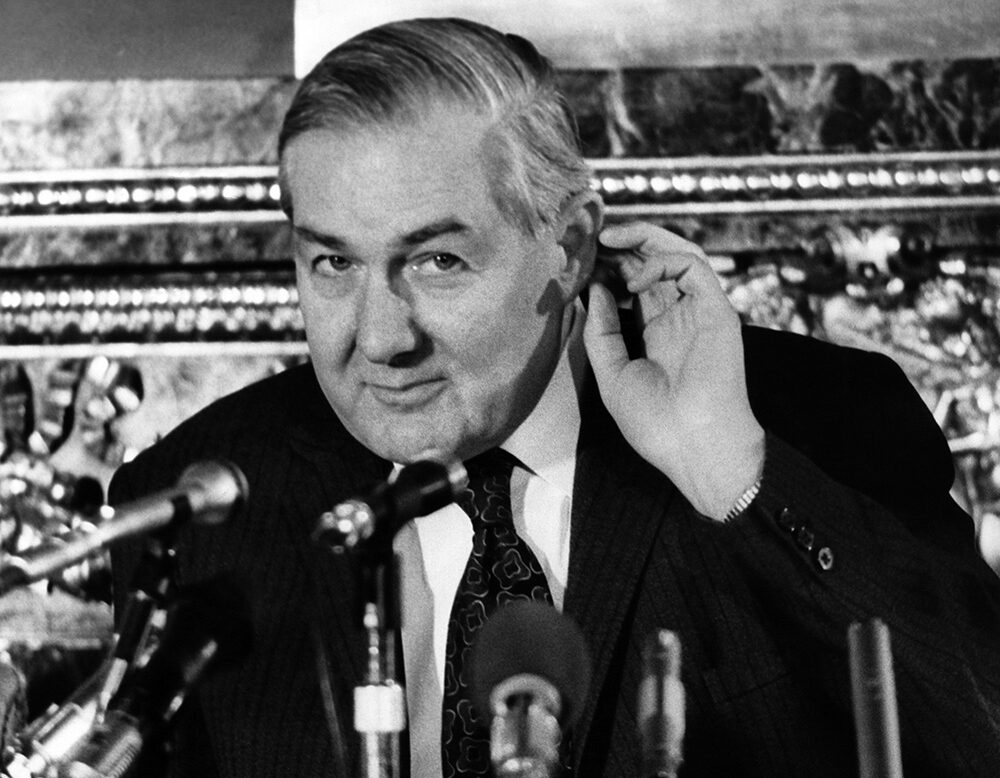
In March 1978, the minority Labour government’s pact with David Steel’s Liberals, which was helping keep it in office, was strained. A snap election looked plausible. In the New Statesman, the journalist and poet James Fenton considered the case for James Callaghan going to the country.
Visitors to Downing Street in the last few days have noticed the enormous relief of the cabinet at the defeat of the French Left. The Chancellor of the Exchequer, otherwise known by his correct title, Her Majesty’s Blob from Outer Space, was particularly thrilled. David Owen, who does not trust the Eurocommunists as far as he can throw them, will, we may be sure, feel thoroughly heartened: ‘Old François and I get on very well, and I’ve worked a lot with Georges, and of course there’s my vieux copain Robert – nous sommes les mieux d’amis but franchement, as I said to Valéry, they had it coming. Jacques agrees with me. “Ils avaient le venant”, he said. . . .” As for the Prime Minister, it must be heartening to see that an electorate does sometimes settle for more of the same old poison even after 20 years of it. For this is the sort of slogan on which he will be going to the country in October.
Why October? Well, what are the alternatives? There are, it is true, certain attractions in February next year. It is thought that the economy will, barring accidents of global proportions, hold up quite well. The psephologists are encouraging, and would probably advise the old boy to hang on while living standards rise and the disasters of the past recede from the public memory. But 1979 is already rather booked up with elections. June has been fixed by Owen as the date for the European elections. The local elections are due in May. This leaves less room for manoeuvre than Callaghan would like. If it’s 1979, it really has to be February. If it’s February, the traditional advantage for Labour in going to the polls on a new electoral register has to be balanced against the traditional disadvantage of bad weather.
Then there is the question, can Labour hold on till next year? And the key figure here is David Steel. Steel is as always under pressure to end the pact. There are indeed members of his party who would like the pact ended now, right away, in a blaze of publicity. Ditch the budget. Ditch the remaining legislation. Climb into the cockpit and do a kamikaze nosedive into the polling-booths. Steel is reluctant to follow this advice: he wants the pact to end, but to end cleanly. Deliver the Finance Bill, with a sufficient number of Pardoe amendments to impress – well – someone. Deliver those other Bills to which Liberal support has been committed. And then say, sorry, no more pact. From now on your support will be on a day-to-day basis.

It does not follow that the end of the pact means the end of the Government. But it would be a dangerous gamble to attempt to prolong the life of the minority administration. It would seem more ineffectual as the days went by, and would give the Tories the opportunity to adopt the slogan, ‘We need a strong government.’ An October election, on the other hand, allows Callaghan himself to stand as the would-be strong man. A clean end to the pact means a good opportunity for him to call for a new mandate: ‘I’m sorry to have to do this. I offered the Liberals a chance to continue in partnership – a partnership which, I think you will all agree, has been particularly helpful for the stability of the country and in particular the economy. But I have here a piece of paper from Mr Steel which says “Sod Off”. Now, I don’t blame Mr Steel. He has his job to do. I have mine. But the time has come for a clear decision . . .’
October is also a convenient date from the point of view of Scotland, where, incidentally, Labour is less despairing than in the past. (They are feeling rather hopeful about the Garscadden by-election.) With the Scotland Bill on the statute book, but as yet no referendum, Labour will be able to challenge the Tories as to whether they propose to go ahead with devolution as planned. Mrs Thatcher will be in a tight spot, relying as she does now on the anti-devolution vote. It will also be possible to argue to the pro-devolutionists that an SNP vote is a wasted vote, since only Labour can deliver the goods.
Finally there is the attraction in not holding any party conferences in the autumn. No conferences. No resolutions. No compositing of resolutions. No points of order arising from the compositing of resolutions. No referrals-back arising from points of order arising from compositing of resolutions. No Tribune rally. No lecture from Tony Benn about the virtues of the 1945 Labour manifesto, the radicalism of Attlee, the socialism of Herbert Morrison, etcetera, etcetera. And on the other hand, no 12-year-old Tories delighting their audience with impassioned pleas for individual initiative and lower taxes. Yes, in that way an October election comes to seem very attractive indeed.
And yet, and yet . . . However compelling the logic may seem, however the favourable circumstances may mount up, there is always the Still Small Voice factor to be taken into account. ‘Wot no job?’ says the Still Small Voice, ‘Wot no car? Wot no Chequers? Wot no whopperoo of a salary? Wot no banquets? Wot no official visits? Wot no pumping of hands with exotic people who are shortly to be taken out and shot?’ And once one listens to the Still Small Voice, the tone of the debate begins to change. One finds oneself wondering dreadfully about such trivial matters as the exact sum Lord Weidenfeld would be prepared to advance for one’s useful little volume on the role of the cabinet in decision-making today. One begins to wish one had kept a diary. One begins, in short, to feel a little chilly.
It would be so foolish, would it not, to throw it all away now. Why not, one begins to think, why not throw it all away later? Heavens above, one begins to think, we’ve got plenty of time left allotted to us. Why, we’ve only just had a chance to find our feet. It’s not fair. We’ve not had a fair crack of the whip. There’s so much left to do. For instance there’s the wealth tax – no, sorry, forget that – there’s Rhodesia. We mustn’t leave office until we’ve honoured our obligations to Rhodesia. To leave office before we’ve honoured our obligations to Rhodesia would be the most irresponsible betrayal of our responsibilities. Yup. No question. We must hang on, whatever the risks. We owe it to the country.
Many are the Still Small Voices whispering in cabinet ears – as many voices as there are careers at stake. Some of them, admittedly, must be urging October. The SSV in the Blob’s ear, for instance, will be arguing thus: ‘Either way, Jim’s going to retire soon, retire in triumph, retire in disgrace – it makes no difference. The sooner the election, the sooner the retirement. And then, O Blob, O great and wonderful Blob, the whole thing is yours. Think of it! Jobs for the Blobs. Blobby correspondents hanging on your lips. National Blob-a-job week. O Blob Our Help in Ages Past thundering from the organs of the great cathedrals . . .’
And at the same time, the SSV in Callaghan’s ear is saying: ‘Look, Jim, we’ve known each other a long time. We’ve come a long way together. We’ve had our good times, and, heaven knows, we’ve had our bad times. But, gracious me, if I’d thought that you would allow yourself to chuck it all away when, gracious me, you’ve only just got it – well, I’m not sure I would have thought it worthwhile. Now I know what you always say, about going back to your farm and so on, and in many ways I sympathise with you. But what about the history books? Which looks better – James Callaghan, 1976–78, or James Callaghan, 1976–79? I ask you. And look at the Blob over there, already trying on the crown. Doesn’t it make you sick? Well, I know you’re a man of your own mind, and I respect that, but heaven knows, gracious me . . . Have a think about it. Take your time. An October election, yes, but what about October 1979?’
[Further reading: From the archive: Life under Cameron]
Content from our partners


Related
This article appears in the 01 Oct 2026 issue of the New Statesman, Sunshine and Rain
Join the debate
Subscribe here to comment