
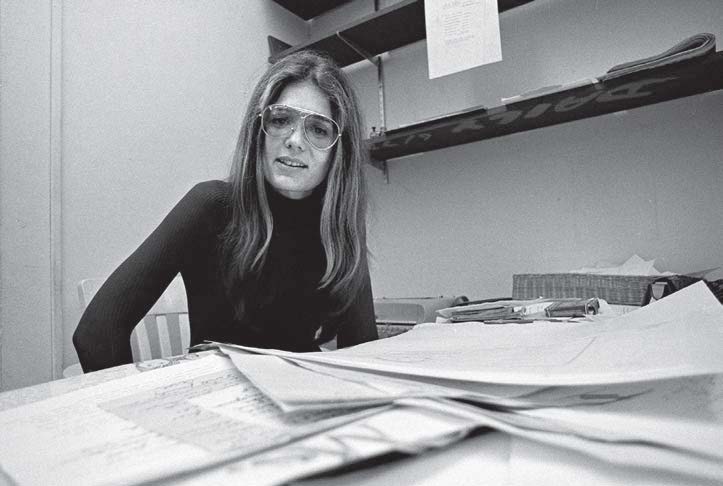
The writer and activist Gloria Steinem died on 2 September 2026, aged 92. A collection of her essays published in the early Eighties, Outrageous Acts and Everyday Rebellions, was reviewed in the New Statesman by Anne Smith.
Gloria Steinem is an American feminist journalist, co-founder of Ms. and New York Magazine. Outrageous Acts is a selection from the articles she wrote, mainly for Ms., between 1963 and 1982. In her introduction Steinem explains and illustrates the conventional cultural attitudes to which Ms. and her own work are a challenge and an antidote: “At The Ladies’ Home Journal… one of its two top editors (both men of course) was so convinced that I was nothing like its readers (whom he described as ‘mental defectives who curlers in their hair’) that he used to hand a manuscript and say, ‘Pretend you’ve a woman and read this.’”
The most engaging feature of this collection, apart from its maturity and humour, is Steinem’s habit of turning the world outside-in at the stroke of a pen, in her own observations and in snappy anecdote. She tells for example how, when she and a friend were discussing the friend’s book on abortion in the back of a Boston taxi, the elderly Irish woman driver commented, “Honey, if men could get pregnant, abortion would be a sacrament.”
This notion is picked up and extended later in her sharp, hilarious piece entitled “If Men Could Menstruate”. For a start, Steinem suggests, “They would brag about how long and how much.” She goes on to imagine “Paul Newman Tampons” and “John Wayne Maxi Pads”; street slang – “He’s a three-pad man” – and so on through to the inevitable “menses envy”.

She writes of her own efforts to fit into “the proper grown-up and womanly role, whether that means finding a well-to-do man to be supported by or a male radical to support”. She points out that “sons-in-law may be the ones who really sleep their way to power”. In a piece about women’s college reunions she recalls how a Washington woman reporter told her she was writing an article “on why so many women of accomplishment had gone to Smith College”. “Like who?” Steinem asked. “Like Nancy Reagan and Barbara Bush,” was the reply, to which Steinem rejoined, “Do you think a reporter is interviewing Mr Thatcher’s schoolmates to find out how they were trained to marry a chief of state? Is Mr Thatcher one of the top men in England?”
She throws new light on some of the glamorous women who seem to symbolise everything that their mentally defective sisters in hair curlers, those avid consumers of the ubiquitous guides to nest-making and husband control which masquerade as women’s magazines, want to be. There is the story of Judy Holliday’s movie interview at which, after being chased round the desk by the lecherous head of the studio, Holliday “just reached into her dress, pulled out her falsies, and handed them to him. ‘Here,’ she said, ‘I think this is what you want.’” She tells how Marilyn Monroe persuaded a night-club owner to hire Ella Fitzgerald despite his no-blacks policy by promising to take a front-table for every performance, which she duly did.
Steinem links the struggle for racial equality with the struggle for sexual equality, arguing that women and coloureds have been conned and bullied all through history into providing a support-system for the supreme white male. Her political reportage is riveting. Newspapers could make political campaigns vastly more interesting to the public if they adopted her technique of concentrating on the characters of those who offer themselves as our leaders, rather than on their images; if they told us what was really said on campaign buses and planes, rather than what is handed out predictably and repetitively, for the consumption of the voter. A casual comment such as the one she quotes from a colleague, talking about Nixon, can be worth a thousand words of “analysis”:
“Maybe he doesn’t use the Western Behavioural Institute the way Reagan did, you know, and came out with all the positions that would fit a basically conservative frame of mind; Reagan just took out the card file when we asked him questions.”
In a collection that ranges widely and with brilliant clarity from articles on Linda Lovelace (a shocker) to Alice Walker (the best review of The Color Purple I’ve ever read), to pieces on the sexual politics of conversation, little facts are constantly popping up to surprise, horrify or amuse: Americans spend $8 billion a year on pornography (Steinem makes a valuable distinction between pornography and erotica); the increase in male impotence which was blamed on working wives and turned out to be a side-effect of medication for high blood pressure; or just the fact that Ms. had a hard job “convincing advertisers that women look at ads for shampoo without the accompanying articles and how to wash their hair, just as men look at ads for shaving products without articles on how to shave.”
All this and much, much more, as they say – including the famous piece, “I Was a Playboy Bunny”. My only criticism of this fascinating collection is that it is a pity Ms Steinem did not take the time to make a real book of it, rather than simply collecting her best in one place. So many links might have been made across articles, to even greater effect.
[Further reading: Ed Miliband’s dynamism is remaking Britain’s foreign policy]
Content from our partners



Related
This article appears in the 10 Sep 2026 issue of the New Statesman, The World According To Ed
Join the debate
Subscribe here to comment