
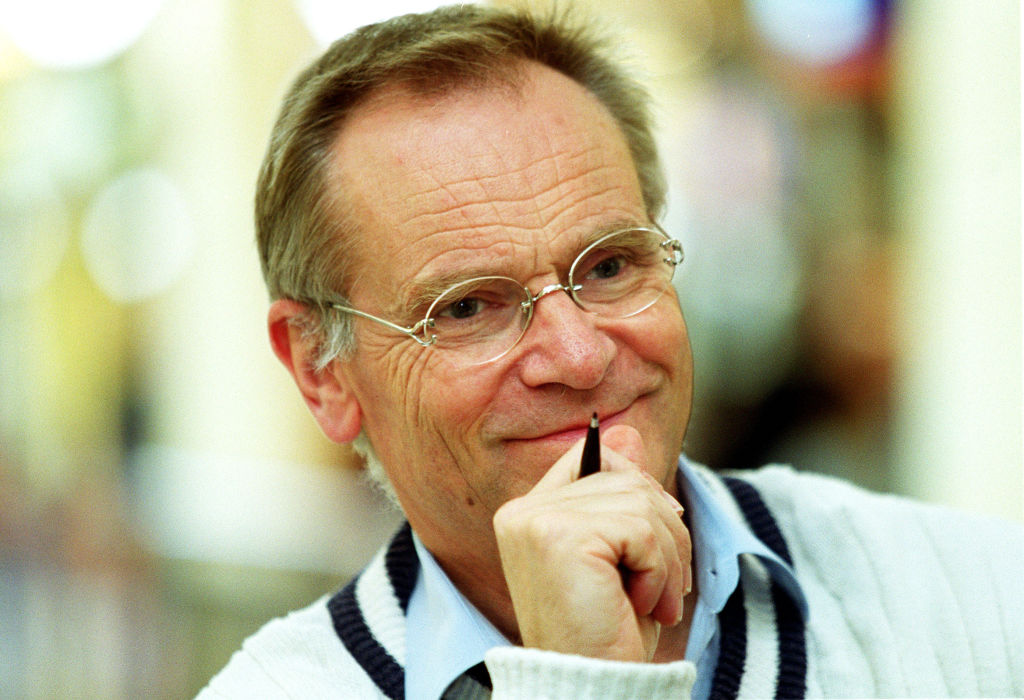
The death of Jeffrey Archer unleashed a tsunami of bonhomie. Colder assessments, principally those inspired by Michael Crick’s research, were swamped away. He was, the general verdict decreed, a really good chap, if a bit of a rascal on the side. But what should really be inscribed on Archer’s tombstone? Queen Camilla’s instant, one-word tribute, “irrepressible” would serve. Until any truth-telling biography comes out, we can acknowledge that he was a crook and a conman, but loved by many. We sometimes like being conned.
Archer’s get-out-of-bankruptcy card was fiction. Few critics would call him a master of the art: fewer would deny that he was genius at shifting warehouses full of volumes. It is claimed that he achieved lifetime sales of over 300m. The 1990 £20-million deal with HarperCollins made him, at his glorious zenith, the highest paid novelist in the history of the world.
Whatever else, Archer was not frightened by hard work (unlike, I’m told, his rival Ian Fleming). As Charles Dickens did before him, Archer died at Gad’s Hill, while taking a break between spells of writing. The scrawling he was doing in his last hours was, almost certainly, promotional notes for his imminent novel, Adam and Eve, to be loosed on the world the next day, 6 October. There would be a swathe of interviews.
Not all of Archer’s oeuvre will last. Some novels, like Shall We Tell the President?, are absolute stinkers. But will any part of his canon be remembered well? Max Hastings, who loathed Archer like many in the Tory old guard, dismissed the novels as “ghastly”. Others more impishly cite his greatest works of fiction to be his CV, slyly praised by his loyal wife Mary as “creative”, and his three volumes recording his two years in prison. He was there after lying on oath about his relationships with the sex worker Monica Coghlan. (Private Eye has never stopped reporting on the uglier side of Archer’s life.)

Nonetheless, a case can be made that Archer’s shrewdness about the ins and outs of roguery, as a grandmaster of the art himself, is the main selling point of his novels. Two of his works deserve critical respect. The first is his semi-fictional portrait of super rogue Robert Maxwell, The Fourth Estate (1996). I haven’t read Adam and Eve yet (there has been a strict embargo) but I hope Jeffrey Epstein and Ghislaine Maxwell make an appearance. Archer could well have been the shady couple’s Boswell.
The other is First among Equals (1984), which astutely forecasts the current woes of a Tory party where premiership can last less long than lettuce. I praised these two novels in a previous article, and Archer responded with a postcard offering lunch, which I declined.
Archer never made it to Prime Minister, although he was appointed deputy chair of Margaret Thatcher’s Conservative Party. He might well have become mayor of London, had Scotland Yard not stalled his career. After his time in prison, John Major made him Lord Archer of Weston-super-Mare. The plot of First among Equals is what Disraeli called “high office” in the House of Commons – a slippery pole to which only those uber-slippery themselves could scale. Young Jeffrey grew up in an era of long-serving PMs. In his few years as an MP, from 1969 to 1974, he foresaw that his party’s centre could never hold in an egalitarian world.
The novel opens seven years in the future. There has been a dead-heat election, and King Charles III is on the throne. Unlike his punctilious mother, he is a meddling monarch and must decide, as sovereign, which of the three eligible members of the House shall form the new government.
The narrative flashes back to summarise the intertwining candidates’ careers and tussles. All are originally part of the “new boy” intake of 1964, in whose subsequent wave Jeffrey Archer MP was elected. Simon Kerslake is Oxford-educated but stuffily middle-class and Thatcherite. As Alan Clark said of Heseltine, he buys his own furniture. The Honourable Charles Gurney Seymour is Etonian and the younger son of an Earl. Prime items of his furniture date back to before the Conservative Party. Ray Gould is Yorkshire-born, working-class, union-backed and Labour to his (doubtless week-worn) woollen socks.
All three candidates in the novel have messy marriages. The novel climaxes with King Charles dramatically summoning Gould to the Palace to announce his choice of PM. Before the enjoyable denouement, Archer cheekily gives walk-on parts in the narrative to Alec Douglas-Home, Harold Wilson, James Callaghan and – most daringly – Thatcher. I now will never be able to tell him over lunch, but First Among Equals brings out Archer’s best.
[Further reading: From the archive: Jeffrey Archer’s moment of truth]
Content from our partners



Related
Join the debate
Subscribe here to commentActually it was Michael Jopling who said of Michael Heseltine, ‘The trouble with Michael Heseltine is he has to buy all his own furniture.’ Alan Clark quoted Jopling in his acerbic diaries. Jeffrey Archer lived a life that could only have been a best seller as it was so unbelievable. He was definitely creative and he does not get me worked up too much because he never had real power. In effect he was an entertainer if a tad louche. I wonder what he made of Mary Archer and all that physical chemistry! Now that would have made interesting reading!