
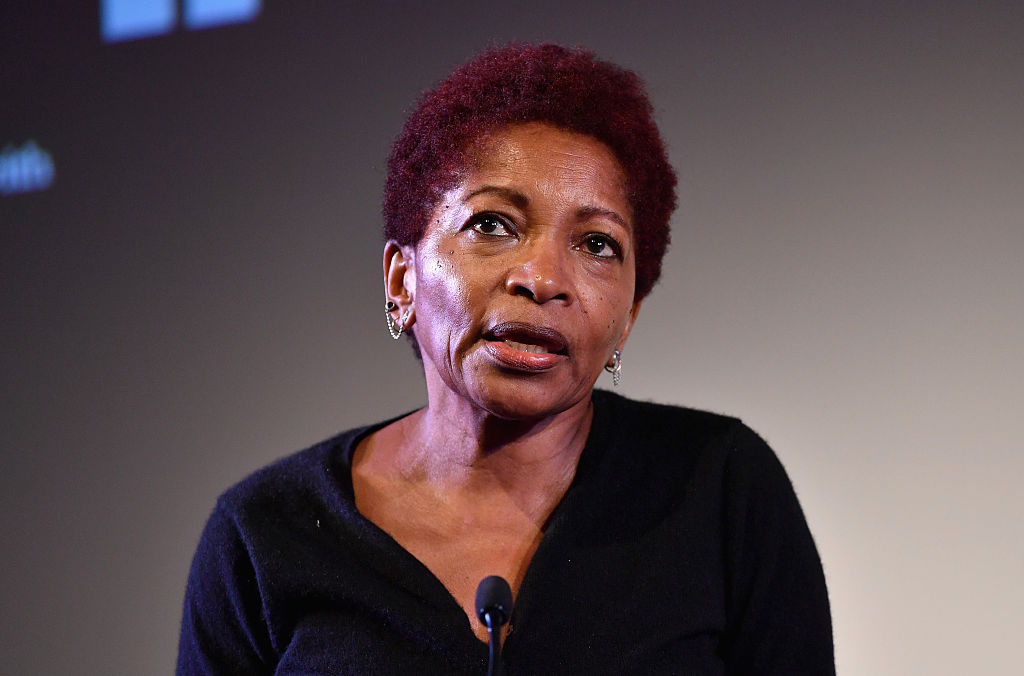
I remember the first time that I saw the late Bonnie Greer. It was on a television screen and she was doing one of the things that she did so brilliantly: talking about the arts. For me it was a complete revelation. Here was a black woman on national television discussing culture with complete confidence. It is easy to forget that 40 years ago British cultural pundits were all white, nearly all Oxbridge and nearly all male. But Bonnie could not have been more different.
She had come to Britain in 1986 to take part in the Edinburgh Festival and never went home. She burst on the British cultural and arts scene like an explosion of fireworks. The range of her contribution to Britain’s cultural life was extraordinary. She was primarily a playwright, producing work for the stage and radio, writing plays for BBC Radio 3 and BBC Radio 4. As the years went on she took her place at the helm of many important arts institutions. This included serving as a trustee of the British Museum also as a board member of organisations like the Royal Opera House and the London Film School.
Her work with black arts organisations was very important to her. This was not necessarily well-known in the arts world as a whole, but made her famous in the black community. The organisations she worked with included the Talawa Theatre Company, then the UK’s leading black-led theatre company founded to champion black excellence, and the Black Theatre Co-operative, another pioneering British theatre group.
But Bonnie was not just a practitioner of the arts. She became increasingly well-known in Britain as a cultural commentator on television programmes like BBC Newsnight Review. Viewers marvelled at her incisiveness, clarity of vision and humour. Bonnie may have left Chicago to settle in the UK, but her home city never left her. That Chicago energy always infused her commentary and made it special.

I got to know Bonnie personally in the 1980s and was drawn to her straight away. I spent time with her and organised events that allowed other black men and women to meet her. She was always very interesting and great fun. I completely identified with her. Like her, I was a black woman of working-class roots trying to survive in a white and usually male world. We both knew what it was to be an outsider and continually be reminded of that in the elaborately polite but emphatic British manner.
I admired her courage, refusal to be typecast and insistence on speaking her mind. We both could have easier lives if we had been less outspoken, but we both did not have it in us to be any other way. As she dipped a toe into political commentary our worlds converged. Like many of her admirers I was a little uncomfortable with her going on BBC Question Time with fascist Nick Griffin. However she went about it with typical Bonnie bravado and almost everything else she said over the years I completely agreed with.
Sadly she has passed away unexpectedly young. As we witness rise of the far right in western Europe, the United States and here in Britain with Reform, it has never been more important to have high-profile black figures who are prepared to speak out. Britain needs more Bonnie Greers. She will be greatly missed.
[Further reading: The mystery of Dolly Parton]
Content from our partners



Related

Join the debate
Subscribe here to comment