The Olympics have always been a bit fascist, Tracey

Tracey Emin's observation that vintage Olympic posters "look a bit fascist" is cannier than she know

It was announced yesterday that Tracey Emin would be among twelve artists who would be designing posters for next year's Olympic Games. As she posed for the photographers, Emin said that she wanted her effort to look different from posters from previous Games, "because they look a bit fascist, to be honest". I have yet to see any footage of Lord Coe as he stood alongside her, but I've no doubt that he must have winced considerably. Whatever Coe's reaction, the fact is, Emin is right - the posters do look a bit fascist, because the Olympic Games themselves are a bit fascist.

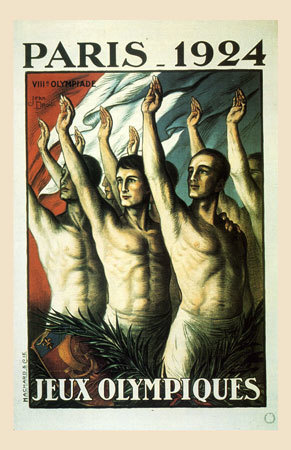
Essentially, both Olympism and fascism are secular religions that venerate the human body and seek the triumph of the will. The Olympic motto of "citius, altius, fortius" ("faster, higher, stronger") is something that could have been dreamed up by Hitler or Mussolini. Indeed, throughout the 1920s and 1930s, celebrations of the Olympiads and fascist rallies grew increasingly indistinct. Both were quasi-religious experiences, complete with increasingly sophisticated rites and rituals, and adorned with striking iconography. Even their salutes looked the same. (Just check out the Paris 1924 poster.)
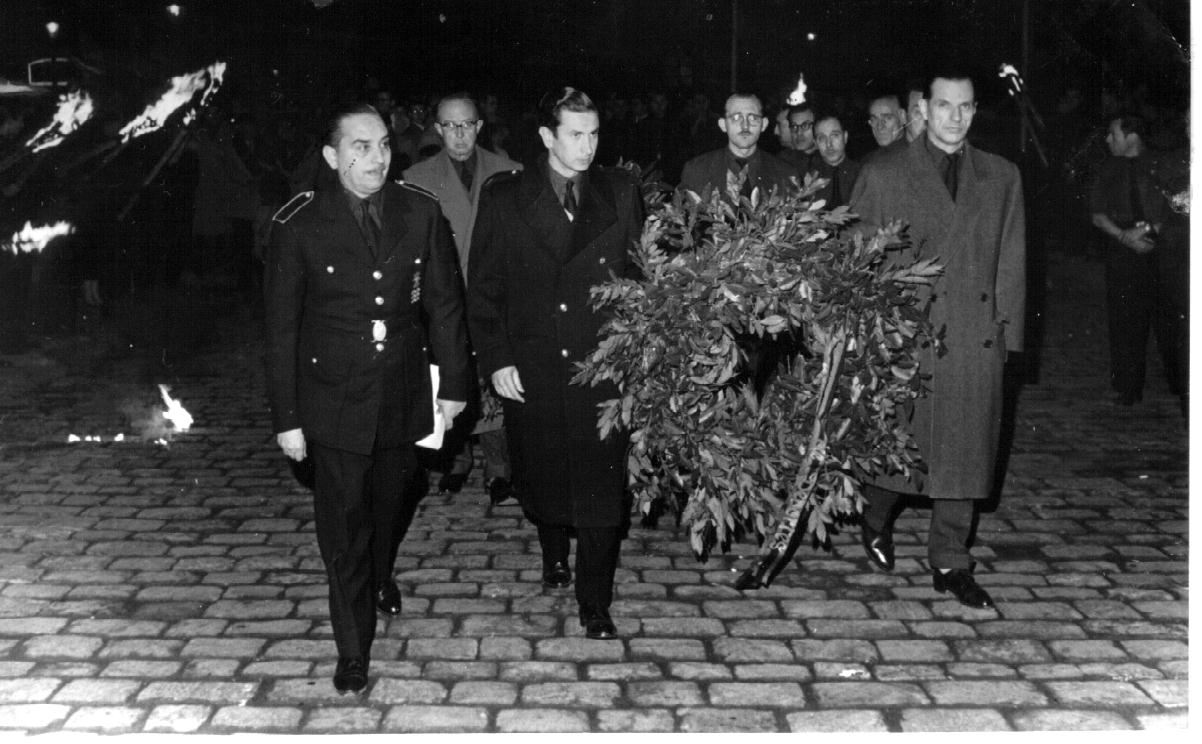
During that period, the Olympics and fascism also adhered to a cult of personality. The founder of the Olympics, Pierre de Coubertin, was almost regarded as Christ, and the IOC president, Henri de Baillet-Latour, as his chief disciple. As I wrote in my book Berlin Games:

"[T]hese men were regarded as being infallible, because they embodied an idealism that far transcended the grubby quotidian strivings of humanity. It was a pagan idealism, its pageantry godless, but its chauvinist adherents were nothing less than fanatic, men for whom no other point of view was acceptable. If anyone obstructed their ideals, then they would be subjected to the most vicious ad hominem attacks."

Sounds familiar?

And then there is the notion of race. Although anybody watching next year's 100 metres final would be hard pressed to claim that the OIympics were today racially discriminatory, early adherents of Olympism such as the future IOC president, Avery Brundage, spoke about the Olympics in the 1920s in ways that sounded like Alfred Rosenberg:

"Perhaps we are about to witness the development of a new race," Brundage observed at a dinner in Chicago in 1929, "a race of men actuated by the principles of sportsmanship learned on the playing field, refusing to tolerate different conditions in the other enterprises of life; a race physically strong, mentally alert and morally sound; a race not to be imposed upon, because it is ready to fight for right and physically prepared to do so; a race quick to help an adversary beaten in fair combat yet fearlessly resenting injustice or unfair advantage..."

The Olympians and the fascists also regarded the success of a nation as the result of the physical health of its people. Admiring Hitler's programme of enforced physical education, Brundage observed that countries that performed well at the Olympics, such as Finland, did well in other arenas. "What pleases those of us who are interested in sports is that the Finns carry the ideals from the playing field into other relations," Brundage wrote. "At least little Finland is the only country that recognises its obligations to pay war debts." The idea that athletic prowess is linked to sound financial management was a curious one to say the least, but such views were taken seriously at the time, not least by the Nazis.

When the Games went to Berlin in 1936, the union between the two movements was blessed. In many ways, the Berlin Olympics were the ultimate Olympic Games, because the Nazis were the only people who really "got" Olympism. For the Nazis, Olympism and Nazism dovetailed so neatly that, in the words of a memorandum from the Propaganda Ministry from October 1934, "the Olympic idea is a cultural requirement of National Socialism, which concerns the entire German people".

The Nazis added many little flourishes to the Olympics that are still evident today, not least the torch relay, which was the idea of the Secretary General of the Organizing Committee, Carl Diem. It was Diem who was later to rally thousands of Hitler Youth at the Olympic stadium in March 1945 as the Russians assaulted Berlin. Diem called on the assembled teenagers not to capitulate, and to show some "Olympic spirit". (In case Olympic spirit was not enough, execution stakes were set up around the stadium, ready to be used if there were any displays of cowardice.)

Since the war, the whiff of fascism has always clouded around the Olympics, not least in the form of Juan Antonio Samarach, who was a member of the Spanish Falange. And the Olympic movement still carries on with its funny rituals at its opening and closing ceremonies. It will be interesting to see what sort of poster Emin comes up with. In a way, I'd like her to do something a bit fascisty, because - ultimately - that would be an accurate reflection of the type of mumbo-jumbo that accompanies a few running races and some women's beach volleyball.

14 comments

Guy Walters's picture

@Adam

I think you're absolutely on the money when you accuse me of not considering the broader cultural context in which the posters – especially those from the 1920s and the 1930s – were produced, and you're right to take me to task. I was aware that this was lacking even when I typed, but the exigencies of time meant that I skipped over the issue, for which I apologise. In short, I think that both Olympism and *elements* of fascism were products of philhellenism, body worship, sprinkled with a bit of Nietzche and washed down with a wary embracing of technology and modernity.

As regards some of my other comments, I was being somewhat tongue in cheek. But the Olympics does seem to attract an enormous amount of ritual and pageantry, and yes, I am somewhat suspicious of both, whether set in a religious context or not.

There's no doubt that Olympism and fascism made comfortable bedfellows between the wars, and the Olympic movement's acceptance of Samaranch (and others) after the war, is indicative of blackshirty tendencies.

Best

Guy

P.S. Someone on twitter recommended this to me...
http://en.wikipedia.org/wiki/W,_or_the_Memory_of_Childhood
Do you know it?

Daryl's picture

I don't know about fascisty, but if you look at the Moscow 1980 poster long enough I think you will soon figure out what the olympics is really about.
http://2.bp.blogspot.com/_zqFoq3qej2c/SJcc4S3Do4I/AAAAAAAASb8/ZFK1tGbnMO...

Gus Lackett's picture

@Devon Aiderdale

I think it is you that has reduced the article to Nazism and Hitler. Though of course the article references the Nazis quite heavily (and in my opinion often without much care) it does so recognising Nazism as a phenomenon within fascism rather than the embodiment of fascism. If one is willing to broaden the definition of fascism, and here I follow the works of Roger Griffin, Stanley Payne and George Mosse then the article is poignant. It might be relevant here to quote Michel Foucault: 'The non-analysis of fascism is one of the important political facts of the past thirty years. It enables fascism to be used as a floating signifier, whose function is essentially that of denunciation.'

Devon Aiderdale's picture

Sorry, but this is bollox. Anything looks a bit like the Nazis, and is therefore EVIL, if you approach it from the right angle. "Reductio ad hitlerum" is one of the oldest tricks in the book.

In short, you fail.

bruce.turner's picture

@Guy Walters

Thanks for the reply.
"the exigencies of time meant that I skipped over the issue"
Fair enough, you can't cover everything, it is a blog post and not a full-length piece after all! Glad you mentioned philhellenism in connection with the cult of the (male) body in your reply- this came to mind when reading what you originally wrote.

I'm interested that you are "suspicious" of ritual and pageantry. Is your concern related to their true purpose and the end results they can produce? Or simply that they are always empty of real value as MJH seems to feel?

I had not heard of the book, it sounds interesting, thanks for mentioning it.

@Devon Aiderdale

I would read the piece again. Admittedly, I thought myself that some of the individual points made overstated the connection to fascism but don't let that colour your perception of what is being said. There really are a lot more points raised here (and interesting ones at that) than a simple "Olympics=Nazis" therefore "Olympics=bad".

Captain Sensible's picture

MPs get a long holiday, no surprise here. Surely the ordinary people could disrupt the games using passive resistance a knockout blow to the elite who give us this sort of thing and the dome

MJH's picture

@Adam

"Would you use the same language to deprecate other ceremonial occasions? The national anthem at the start of a football match, the opening of parliament, or a royal wedding for example?"

Yes.

It's all funny hat territory. You can't get a cigarette paper between the private rituals of the insane & the public rituals of the crowd.

Fergus Pickering's picture

The difference is that it's only bloody sport and not even popular sport either. Running is very boring to watch. Swimming is even more boring. And the opening ceremony is most boring of all. I shan't watch any of it and I resent every penny of my money stolen to put it on.

Gerry Tierney's picture

Why are we listening to that hack anyway?

Carolyn Yeager's picture

The 1936 Berlin Olympics poster is the best designed of the lot.

The Germans are the best designers in the world, so it's not surprising; they are masters of poster design. I'd like to know who designed that particular poster.

What Brundage said:
"Perhaps we are about to witness the development of a new race," Brundage observed at a dinner in Chicago in 1929, "a race of men actuated by the principles of sportsmanship learned on the playing field, refusing to tolerate different conditions in the other enterprises of life; a race physically strong, mentally alert and morally sound; a race not to be imposed upon, because it is ready to fight for right and physically prepared to do so; a race quick to help an adversary beaten in fair combat yet fearlessly resenting injustice or unfair advantage..."

Sounds good to me. There is nothing wrong with this kind of "fascism."

Carolyn Yeager's picture

Further, Walters wrote:
"The Olympians and the fascists also regarded the success of a nation as the result of the physical health of its people. Admiring Hitler's programme of enforced physical education, Brundage observed that countries that performed well at the Olympics, such as Finland, did well in other arenas."

...Physical health is good. Is caring about physical health too 'fascist' for you?

"What pleases those of us who are interested in sports is that the Finns carry the ideals from the playing field into other relations," Brundage wrote. "At least little Finland is the only country that recognises its obligations to pay war debts." The idea that athletic prowess is linked to sound financial management was a curious one to say the least, but such views were taken seriously at the time, not least by the Nazis.

The linkage of athletic prowess to good financial management is made by you, Guy Walters, seemingly to be cute, or clever, and anti-Nazi to boot. But for the facists and National Socialists, physical fitness was linked to better ethics and morals (healthy body - healthy mind), which is linked to carrying out your obligations such as paying your bills.

Have you lost that?

Rob's picture

Daryl,
the 1980 Moscow poster - you're talking all cock and bollocks mate.

bruce.turner's picture

Are The Olympic Games really nothing more than "a few running races and some women's beach volleyball"? I think many millions would disagree with you on that but okay, it seems you're not a sports fan.

I would disagree with the blanket statement that the posters for previous Games "look a bit fascist". This naivety and failure to consider the artistic and cultural contexts in which the posters were produced reminds me of people who read too deeply into the connection (if there ever was one) between Indian religions and Nazism due to the common use of the swastika.

I would love to know how the posters for the last five Games look in any way "fascist".

And I really don't think you're serious with: "the Olympic movement still carries on with its funny rituals at its opening and closing ceremonies". Would you use the same language to deprecate other ceremonial occasions? The national anthem at the start of a football match, the opening of parliament, or a royal wedding for example? What has that got to do with fascism?

The parallel with the cultish value assigned to athleticism is an interesting one but I wouldn't read too much into it. I know it's your professional focus Guy but not everything is solely to do with fascism and nazism! Ain't hindsight a pain!?

Latest tweets